
Driving Directions and Google Map of Romania — Roads, Routes & Navigation Guide

Romania — România in Romanian — is the largest country in south-eastern Europe by area and population, covering 238,397 km² with approximately 19 million inhabitants. It borders Hungary to the northwest, Serbia to the west, Bulgaria to the south (with the Danube forming much of the boundary), Ukraine to the north and northeast, and Moldova to the east, while the Black Sea coast stretches for roughly 245 km along the southeast. The country’s dramatic geography — the arc of the Carpathian Mountains bisecting the interior, the vast Wallachian and Moldavian plains, the Danube Delta, and the Black Sea littoral — makes Romania one of Europe’s most varied and scenically rewarding countries to drive through.
Romania drives on the right-hand side of the road with left-hand drive vehicles. Speed limits are in kilometres per hour. The national motorway and expressway network uses the A prefix (autostradă) and is managed by CNAIR (Compania Națională de Administrare a Infrastructurii Rutiere — National Company for Road Infrastructure Administration). Romania’s motorway network, while still expanding, centres on the completed A2 Sun Motorway (Bucharest to the Black Sea) and the strategically vital A1 corridor linking Bucharest westward through Pitești, Sibiu, and Timișoara toward Hungary. A defining feature of driving in Romania is the e-Rovinieta electronic vignette system: all vehicles must purchase a plate-registered vignette before using national roads, expressways, and motorways.
Romania enforces an absolute zero-tolerance alcohol limit of 0.00% BAC — any detectable blood alcohol is an offence. The currency is the Romanian Leu (RON / Lei); Romania is an EU member since 2007 but has not adopted the euro and RON is the only legal tender. Romania completed its accession to the full Schengen Area land border regime in January 2025, meaning border controls between Romania, Hungary, and Bulgaria are no longer mandatory for EU citizens. The unified emergency number across Romania is 112. Use the route planner on our homepage to plan your driving routes across Romania.
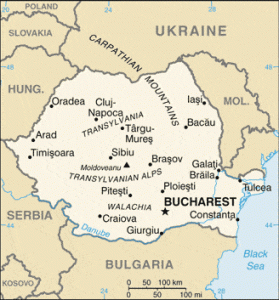
The Romanian Road Network
Romania’s road network is managed by CNAIR (Compania Națională de Administrare a Infrastructurii Rutiere), which oversees the national road infrastructure including motorways (autostrăzi), expressways (drumuri expres), and national roads (drumuri naționale, DN-prefix). Romania’s total road network is approximately 86,000 km; the national network accounts for roughly 16,600 km. Motorway and expressway construction has accelerated significantly since 2010 with EU Cohesion Fund support, though Romania continues to lag behind its Central European neighbours in total motorway kilometres.
Romania’s motorways and expressways use the A prefix for autostrăzi. Expressways use the same A-prefix designation in a unified numbering system. The network does not radiate uniformly from Bucharest — the geography of the Carpathians means that east–west and north–south routes must traverse or circumvent mountain passes, creating structural challenges that have delayed several major projects. As of early 2026, total motorway length is approximately 900 km with approximately 700 km of expressways, for a combined high-standard road network of around 1,600 km.
Principal motorways and expressways (A-prefix):
- A1 — Bucharest–Pitești–Sibiu–Orăștie–Lugoj–Timișoara–Nădlac (Hungarian border, ~550 km, partially complete): Romania’s most strategically important motorway corridor, running east–west across the southern portion of the country and forming the main link between Bucharest, the industrial Banat region, Timișoara, and the Hungarian border at Nădlac/Csanádpalota. The A1 connects to Hungary’s M43 motorway at Nădlac, which continues to Szeged and Budapest. The Bucharest–Pitești section (~116 km) was the first motorway in Romania, opened in the 1970s. The Pitești–Sibiu section traversing the Carpathian foothills has experienced long construction delays; the full Bucharest-to-Hungarian-border corridor was largely completed by 2024–2025, making it the backbone of Romania’s EU integration axis. Journey time Bucharest–Timișoara approximately 5–6 hours (560 km).
- A2 — Bucharest–Cernavodă–Constanța (~225 km, complete — the “Sun Motorway”): Romania’s most celebrated motorway, completed in 2012 and connecting Bucharest to the Black Sea resort city of Constanța. Known as the Autostrada Soarelui (Sun Motorway), the A2 is the primary route for summer holidaymakers heading to the Romanian Riviera — the resorts of Mamaia, Eforie Nord, and Neptun. The A2 includes the strategically important Cernavodă Bridge, a cable-stayed bridge over the Danube–Black Sea Canal. Journey time Bucharest–Constanța approximately 2–2.5 hours; expect significant delays on summer weekends.
- A3 — Bucharest–Ploiești–Brașov–Cluj-Napoca–Borș (Hungarian border, ~540 km, major construction ongoing — “Trans-Romania Motorway”): Romania’s most ambitious and most discussed motorway project. The A3 would create a high-speed north–south spine through the Carpathians, connecting Bucharest northward through Ploiești, crossing the Carpathians via the Prahova Valley, continuing to Brașov, Târgu Mureș, and Cluj-Napoca, before reaching the Hungarian border at Borș/Artánd. The Bucharest–Ploiești section (~60 km) and the Ploiești–Câmpina stretch are open; the Câmpina–Brașov mountain section through the Carpathian passes has been the most technically challenging segment, experiencing repeated delays. The Cluj-Napoca–Borș section (~100 km) is largely complete, connecting to Hungary’s M4/M60. As of 2026, the central Brașov–Cluj-Napoca section remains under active construction and is the critical missing link. Journey time Bucharest–Cluj-Napoca currently 5.5–7 hours on mixed motorway and national roads.
- A4 — Ovidiu–Agigea (near Constanța, ~23 km, complete): A short motorway near Constanța connecting the A2 terminus to the port of Agigea and providing access to the Constanța South–Agigea port complex and the Black Sea Canal infrastructure. Primarily of freight and logistics importance.
- A6 — Lugoj–Deva (part of the A1 corridor, ~71 km, complete): The A6 designation covers the Lugoj–Deva section of the westward motorway corridor, linking to the broader A1 axis. Deva is the gateway to the Hunedoara region in Transylvania.
- A10 — Sebeș–Turda (~70 km, complete): A north–south motorway segment in central Transylvania linking the A1 at Sebeș (near Sibiu) to Turda (south of Cluj-Napoca) and connecting to the A3. The A10 forms an important shortcut through Transylvania for traffic between Sibiu and Cluj without detouring far west through Deva.
- A0 — Bucharest Metropolitan Ring Road (in planning and early construction): A planned outer ring motorway around Bucharest, similar in concept to Hungary’s M0. The A0 would circumvent central Bucharest for through traffic, reducing the severe congestion on the city’s existing ring roads. Various sections are at different planning and tender stages as of 2026.
National Roads (DN-prefix): Romania’s DN (drum național) network remains critical for traffic in areas not yet served by motorways. The DN1 (Bucharest–Ploiești–Brașov–Predeal–Sinaia–Câmpina) is one of Romania’s busiest national roads, serving the Prahova Valley ski resorts and paralleling the incomplete A3 corridor; it is heavily congested on winter weekends. The DN7 (Bucharest–Pitești–Râmnicu Vâlcea–Sibiu, also called the “Valley of Olt” road) traverses the Carpathians via the Olt River gorge and serves as an alternative Bucharest–Transylvania link. DN13 connects Brașov to Sighișoara, Târgu Mureș, and Reghin through central Transylvania. DN66 serves the Jiu Valley coal mining region. Road surface quality on national roads is highly variable and in many rural areas remains significantly below Western European standards.
Driving Rules and Legal Requirements
Romania enforces absolute zero tolerance for drink-driving: 0.00% BAC. Even a tiny detectable quantity of alcohol in the blood is a criminal offence — there is no “social limit.” This rule applies equally to all drivers including experienced locals. Enforcement is by roadside breath testing; the Poliția Rutieră operates frequent checkpoints particularly on Friday and Saturday nights, near border crossings, and on major approach roads to resorts. Penalties include immediate licence confiscation, vehicle immobilisation, criminal prosecution, and prison sentences for repeat offenders.
Daytime headlights: Romania requires headlights to be switched on at all times when driving outside built-up areas — this is a mandatory year-round requirement, not limited to bad weather. Failure to comply results in an on-the-spot fine.
Mandatory equipment in vehicles: All vehicles must carry a first-aid kit, a fire extinguisher, and a warning triangle. These are enforced items and absence can result in fines at police checkpoints. In winter months — particularly when travelling through mountain passes — carrying snow chains is strongly recommended and in some cases required; the Poliția Rutieră can restrict access to mountain passes during snowfall to vehicles without chains or winter tyres.
Mobile phone use: Using a handheld mobile phone while driving is illegal. Hands-free devices are permitted. Fines for handheld phone use are significant and enforcement has intensified with camera-based monitoring systems introduced in major cities.
Child restraints: Children under 12 years or under 150 cm in height must use an appropriate child restraint system. Children must not be transported in the front seat without a rear-facing child seat that disables the airbag.
Vehicle registration and documentation: Drivers must carry their national driving licence, vehicle registration certificate (talon), proof of insurance (asigurare RCA — third-party liability, mandatory), and identification (passport or national ID card). Foreign-registered vehicles must comply with Romanian insurance requirements; EU Green Cards are accepted. Non-EU visitors should carry an IDP (International Driving Permit) alongside their national licence.
Seat belts: Mandatory for all occupants in all seats. Fines for non-compliance are applied equally to drivers and passengers.
Overtaking and lane discipline: On Romanian national roads, overtaking can be hazardous due to the frequent presence of slow-moving agricultural vehicles, horse-drawn carts (căruțe), cyclists, and pedestrians — particularly in rural Transylvania, Moldavia, and Oltenia. Exercise extreme caution when overtaking and treat every rural road section with additional vigilance. Lane markings on national roads may be faded or non-existent in some sections.
Horse-drawn vehicles: Romania is one of the few European countries where horse-drawn carts remain a common form of rural transport. Drivers must give way to horse-drawn vehicles and approach slowly to avoid startling horses. These vehicles may occupy the carriageway on national and even some county roads, particularly at dusk when they may be unlit.
Animal crossings: Deer, wild boar, and stray dogs pose a significant collision risk on rural roads, particularly at night. Romania has a large wild animal population in its Carpathian forests. Night driving on national roads in forested areas should be approached with caution.
Speed Limits on Romanian Roads
Romania uses a four-tier speed limit system differentiated by road type. All limits are in kilometres per hour (km/h). Fixed speed cameras and mobile radar units are widely deployed; camera locations are sometimes (but not always) indicated by advance warning signs.
| Road Type | Standard Limit | Notes |
|---|---|---|
| Built-up areas (urban) | 50 km/h | 30 km/h zones in school and residential areas |
| National roads outside towns (DN) | 90 km/h | Reduced to 70 km/h in hazardous sections and mountain passes |
| Expressways (drumuri expres) | 100 km/h | Dual carriageway standard |
| Motorways (autostrăzi) | 130 km/h | 110 km/h for vehicles towing trailers; 90 km/h for trucks |
Speed enforcement: Romania uses a penalty-point system in addition to fines. Exceeding the limit by 1–20 km/h results in a fine; by 21–50 km/h results in a fine plus licence suspension; by more than 50 km/h results in criminal charges, vehicle impoundment, and a 90-day licence suspension. Fixed camera systems (radare fixe) are increasingly deployed on the A1, A2, A3, and approaches to major cities. On-the-spot fines must be paid immediately or a receipt issued; always request and keep all documentation.
Young and novice drivers: Drivers who obtained their licence less than one year ago are subject to a reduced limit of 20 km/h below standard limits on national roads and are prohibited from exceeding 110 km/h on motorways. This restriction applies regardless of nationality.
The e-Rovinieta Vignette System
Romania uses an electronic vignette system called the e-Rovinieta for access to national roads (DN), expressways, and motorways. The rovinieta is mandatory for all vehicles regardless of nationality. Unlike older sticker-based systems, Romania’s rovinieta is fully electronic since 2012 — there is no physical sticker; instead, the vignette is linked to the vehicle’s registration plate in the CNAIR database and enforcement is carried out by ANPR cameras (Automatic Number Plate Recognition) installed at motorway and expressway entry points, as well as by patrol vehicles equipped with mobile ANPR scanners.
Where to buy: The e-Rovinieta can be purchased at roviniete.ro (the official CNAIR website), the e-Rovinieta mobile app, at petrol stations, post offices, border crossing points (look for the CNAIR kiosk), and authorised resellers. The system activates from midnight on the start date or can be activated immediately. Foreign drivers approaching via Hungary on the A1 or via the Borș crossing on the A3 will find purchasing points at the border.
Vignette validity periods and prices (2025–2026, prices in RON):
| Period | Category I (cars up to 3.5 t) | Notes |
|---|---|---|
| 1 day | RON 3 | Valid calendar day only |
| 7 days | RON 7 | 7 consecutive days from start date |
| 30 days | RON 13 | 30 consecutive days from start date |
| 90 days | RON 28 | 90 consecutive days from start date |
| Annual (calendar year) | RON 96 | Valid 1 January – 31 December; or 12 months from purchase |
Prices are set by CNAIR and are subject to annual revision; verify current rates at roviniete.ro before travel. Heavier vehicle categories (Category II motorbikes; Category III vehicles 3.5–7.5 t; Category IV vehicles over 7.5 t) are charged at different, higher rates. Trucks over 3.5 tonnes additionally require the e-Tariff (electronic tolling system for heavy goods vehicles), which operates separately from the rovinieta.
Penalty for missing vignette: Driving without a valid rovinieta results in an immediate fine of RON 500–1,000 and the compulsory purchase of a rovinieta. The ANPR enforcement system cross-checks plates continuously; there is no grace period and enforcement is automated. Always purchase the rovinieta before entering the first national road — do not rely on buying it at the first service area, as you may already have been detected by the time you reach one.
Additional tolls: Several specific structures carry separate tolls in addition to the rovinieta. The Cernavodă Bridge on the A2 over the Danube–Black Sea Canal formerly had a separate toll; as of 2024 it is included in the rovinieta. Point-to-point tolls remain in place at certain older infrastructure — always check at the tollbooth. The Giurgiu–Ruse Bridge over the Danube (Romania–Bulgaria border) carries a separate toll payable in both RON and BGN.
Fuel, Electric Vehicles, and Charging
Fuel is widely available throughout Romania. Petrol stations are present on all main national roads and motorways, with service areas (benzinării / stații de carburant) at regular intervals on the A1 and A2 corridors. However, on less-travelled national roads in rural Moldavia, Dobrogea, and the Maramureș region, stations can be spaced 40–60 km apart; checking fuel levels before mountain passes is advisable.
Fuel types available: Unleaded petrol (95 RON and 98 RON premium), diesel (motorina), LPG (autogas — available at a minority of stations), and increasingly E10 blends. The major international brands (OMV, Mol, Rompetrol, Petrom, Lukoil) are well represented on major routes. Petrom and Rompetrol are Romanian brands with dense coverage including rural areas. Fuel prices in Romania are generally lower than in Western Europe, though this gap has narrowed since 2022.
Electric vehicle (EV) charging: Romania’s EV charging infrastructure is growing but remains significantly less developed than Western or Central European countries. Charging points are concentrated in Bucharest, Cluj-Napoca, Timișoara, Brașov, and along the A2 corridor to Constanța. Fast chargers (DC 50–150 kW) are available at selected service areas on the A1 and A2. For EV drivers planning cross-country routes through Moldavia or Dobrogea, advance route planning is essential; charger density in eastern Romania is low. Use apps such as PlugShare, ChargeMap, or the Electromaps network to locate available chargers in real time.
Driving in Bucharest, Cluj-Napoca, and Timișoara
Bucharest (București): Romania’s capital, with a metropolitan population exceeding 2 million, has some of the most severe traffic congestion in Eastern Europe. The city’s ring-road system — the Centura Bucureștiului (outer ring, DN1A/A0 partial segments) and the inner boulevard ring — struggles to cope with the volume of vehicles. The lack of a completed outer motorway ring (A0) means significant amounts of transit traffic enter the city. Parking in the historic centre (centrul vechi) is extremely limited; visitors are advised to use park-and-ride facilities or arrive by public transport. Tram lines, bus lanes, and dedicated cycling infrastructure further reduce available lane space. The Inelul 1 and Inelul 2 (inner ring roads) are particularly prone to gridlock during morning and evening peak hours (07:00–10:00 and 16:00–20:00). As of 2026, Bucharest has not implemented a Low Emission Zone (LEZ) or odd-even traffic restriction, though these have been discussed for the historic centre.
Cluj-Napoca: The unofficial capital of Transylvania and Romania’s second-largest urban economy (~400,000 population, ~700,000 metropolitan area) is also one of Romania’s fastest-growing cities with associated traffic pressure. The city sits at the junction of several important roads including DN1 (Bucharest–Oradea), A3 (when complete through the city), and regional roads to Turda, Dej, and Bistrița. The historic centre (centrul istoric) has extensive pedestrianisation and parking restrictions. Cluj is the closest large city to the Hungarian border via the A3/M4 corridor and a major gateway for visitors arriving from Budapest.
Timișoara: Romania’s westernmost major city (~300,000 population) and the gateway from the A1 motorway at the Nădlac/Hungarian border crossing. Timișoara has a manageable city centre with tram network, bicycle lanes, and defined parking zones. As a European Capital of Culture 2023, the city significantly upgraded its urban fabric. The A1 passes south of the city; the connection from A1 to central Timișoara is well-signposted. The drive from the Hungarian border at Nădlac to central Timișoara takes approximately 45 minutes via A1/DN69.
Brașov: Situated at the foot of the Carpathians in the heart of Transylvania (~400,000 metropolitan area), Brașov is a major transit point for traffic between Bucharest and northern Romania. The city is approached via the DN1/A3 from Bucharest and is the starting point for excursions to Bran Castle, Sinaia, and the Bucegi Mountains. Brașov’s urban roads suffer from mountain valley geometry constraints; the western bypass (Centura Brașovului) provides some relief for through traffic.
Scenic Routes and Long-Distance Driving
Transfăgărășan Highway (DN7C): Arguably Romania’s most iconic road and one of the most celebrated mountain drives in all of Europe. The Transfăgărășan traverses the Făgăraș Mountains — the highest range in the Southern Carpathians — at an altitude of 2,042 metres at the Balea Lake pass. Built between 1970 and 1974 on the orders of Nicolae Ceaușescu as a strategic military route through the mountains, the road features hairpin bends, tunnels, and dramatic viaducts. The road was famously described by the Top Gear television programme as “the best road in the world.” The Transfăgărășan is open only between approximately June and October; it is closed entirely in winter due to extreme snowfall and avalanche risk. Journey time from Curtea de Argeș to Sibiu via the summit is approximately 2–3 hours for a relaxed drive. Expect motorcycle and sports car enthusiasts throughout summer; the road can become congested near Balea Lake at peak times.
Transalpina (DN67C): The second great Carpathian alpine road in Romania, running along the ridge of the Parâng Mountains at a maximum altitude of 2,145 metres — the highest altitude public road in Romania. The Transalpina connects Novaci (Gorj county) in the south with Sebeș (Alba county) in the north through Obirsia Lotrului. Like the Transfăgărășan, it is seasonally closed in winter. The Transalpina is narrower and less well-known than the Transfăgărășan, making it a preferred route for those seeking a less-trafficked mountain experience.
Prahova Valley (DN1 / A3 corridor): The most heavily used mountain corridor in Romania, following the Prahova River from Ploiești northward to Sinaia, Predeal, and Brașov. This valley is lined with ski resorts (Sinaia, Bușteni, Azuga, Predeal) and is severely congested on winter weekends as Bucharest residents head to the slopes. During ski season (December–March), DN1 in the Prahova Valley can experience multi-hour delays on Friday evenings (northbound) and Sunday afternoons (southbound). The parallel A3 motorway, once complete through this corridor, will provide essential relief.
Danube Gorges — Iron Gates (Defileul Dunării): The spectacular stretch of the Danube between Orșova and Drobeta-Turnu Severin, where the river cuts through the Southern Carpathians to form the border with Serbia. The road along the Romanian bank (DN57) offers dramatic cliffside views of the Danube, the famous carved relief of Decebalus Rex in the rock face, and the Iron Gates hydroelectric dam complex (Porțile de Fier). This is one of the most scenic drives in southeastern Europe and is increasingly popular with motorcycle touring groups.
Bucovina Monasteries Route (northeastern Romania): The painted Orthodox monasteries of Bucovina — Voroneț, Sucevița, Moldovița, and Humor among them — are a UNESCO World Heritage Site and one of Romania’s premier cultural tourism destinations. The route follows a network of county and national roads through the gently rolling hills of Suceava County in northeastern Romania. Road quality is good by Romanian standards though narrow in places. The nearest motorway access is via the A3 when extended, or via DN2 from Bucharest through Focșani and Bacău.
Bucharest–Black Sea (A2 Sun Motorway): For sheer ease of driving, the fully completed A2 corridor from Bucharest to Constanța (~225 km, approximately 2–2.5 hours) is Romania’s smoothest long-distance drive. The motorway passes through the flat Bărăgan plain, crosses the Danube–Black Sea Canal at Cernavodă, and terminates near Constanța port. At peak summer periods, the A2 is one of the busiest roads in Romania with queues forming at Cernavodă.
Border Crossings with Neighbouring Countries
Romania shares land borders with five countries — Hungary, Serbia, Bulgaria, Ukraine, and Moldova — and has numerous official crossing points. Since January 2025, when Romania (and Bulgaria) were admitted to the full Schengen Area land border framework, border checks between Romania and Hungary have been eliminated for EU citizens. Checks at the Bulgarian border were also lifted at the same time. The Ukraine and Moldova borders remain non-Schengen crossings with full document checks.
Hungary (6 main crossings):
- Nădlac / Csanádpalota (A1 ↔ M43/M5): The primary motorway crossing; highest traffic volume. Connects directly to the Hungarian motorway system toward Szeged and Budapest. The A1 approach from Timișoara is fully motorway standard. No border checks for EU citizens since January 2025.
- Borș / Artánd (A3 ↔ M4/M60): The northern motorway crossing near Oradea; connects to Hungary’s A3 and then M4 toward Budapest. Important for traffic from Cluj-Napoca, Oradea, and northern Romania toward Budapest. The Romanian A3 section from Oradea to this border is complete.
- Episcopia Bihor / Biharkeresztes (DN19): Secondary road crossing south of Borș; handles overflow traffic and local cross-border movements.
- Petea / Csengersima (DN19): Northern crossing near Satu Mare; serves the Satu Mare and Maramureș regions toward Debrecen and northeastern Hungary.
- Urziceni / Nyírábrány (DN19): Small crossing east of Debrecen; limited traffic volume.
- Valea lui Mihai / Ártánd South: Minor crossing; seasonal traffic.
Bulgaria (4 main crossings): Since January 2025, the Bulgaria–Romania border is also a Schengen internal border.
- Giurgiu / Ruse (DN5 ↔ Bulgarian A2): The principal road crossing over the Danube, using the Friendship Bridge (Podul Prieteniei). A separate bridge toll applies (payable in RON and BGN). Connecting to the Bulgarian A2 motorway toward Sofia and Varna. Heavy freight crossing; queues common.
- Calafat / Vidin (DN56): Western Danube crossing via the New Europe Bridge (opened 2013), connecting to Bulgarian motorway toward Sofia and the A1 pan-European corridor. Significantly reduced travel times for traffic between western Romania and northwestern Bulgaria.
- Turnu Măgurele / Nikopol: Ferry crossing; limited to smaller vehicles.
- Bechet / Oryahovo: Ferry crossing; limited use.
Ukraine (4 main crossings): All crossings operate full border checks. Since the 2022 Russian invasion, these crossings carry significantly elevated humanitarian, refugee, and freight traffic. Queues can be very long particularly at Siret and Isaccea.
- Siret / Porubne (Suceava county): Highest-volume crossing to Ukraine in northern Bucovina; DN2 approach; primary route for aid convoys and civilian traffic to/from Ukraine.
- Albița / Tudora (Vaslui county): Main crossing for traffic to/from the Republic of Moldova and onward to Ukraine via Moldova.
- Isaccea / Orlivka (Tulcea county): Danube crossing by ferry in the Danube Delta region; limited capacity.
- Sighetu Marmației / Solotvyno: Northern Maramureș crossing; road bridge over the Tisza river.
Moldova (6 crossings): The Republic of Moldova is a separate non-EU country. Document checks apply. Most crossings are on the Prut River.
- Albița / Leuşeni: Primary motorway-standard crossing on the DN24; main Bucharest–Chișinău route; heaviest traffic volume to Moldova.
- Sculeni / Sculeni (Iași county): Second most important crossing near Iași; road bridge over the Prut.
- Galați / Giurgiulești: Southern Prut crossing via the Danube port; limited road access.
Serbia (3 crossings):
- Moravița / Vatin (Timiș county): Main road crossing between Timișoara and Serbian E70 toward Belgrade; DN59.
- Naidăș / Kaluđerovo: Secondary crossing in Caraș-Severin county; mountainous approach roads.
- Porțile de Fier I / Đerdap: Near the Iron Gates Dam; crossing in the Danube Gorges region for Drobeta-Turnu Severin to northeastern Serbia.
Road Safety and Emergency Procedures
Romania has historically had one of the highest road fatality rates in the European Union, measured in deaths per million inhabitants. While significant improvements have been recorded since the mid-2010s following EU-funded road safety programmes and infrastructure investment, Romania’s fatality rate remains above the EU average. The primary contributing factors are: unsafe overtaking manoeuvres on single-carriageway national roads, excessive speeding, drink-driving (despite the zero-BAC law), poor roadway lighting in rural areas, and the presence of vulnerable road users (pedestrians, cyclists, horse-drawn vehicle operators) on the main road network.
In an emergency: Call 112 — Romania’s unified emergency number for police, ambulance, and fire brigade. The operator will connect you to the appropriate service. For road traffic assistance from the Romanian Automobile Club, call RAR (Registrul Auto Român) or the ACR (Automobil Clubul Român) roadside assistance line. Major motorways are equipped with emergency roadside phones at 2 km intervals on the A1 and A2.
Breakdown procedure: If you break down on a motorway or expressway, move the vehicle to the hard shoulder immediately. Deploy your warning triangle at least 100 metres behind the vehicle (200 metres recommended on motorways). Put on a high-visibility vest before exiting the vehicle on any fast road. Call for assistance from behind the crash barrier where possible.
Police checkpoints: The Poliția Rutieră operates both fixed checkpoints and mobile patrols throughout Romania. Checkpoints are common on major national roads near cities, on holiday-period approaches to resorts and beaches, and near border crossings. Stop fully, lower the window, and present documents when requested. Officers may be in regular police uniform or in high-visibility jackets. Fines for traffic offences are typically collected on the spot with a receipt (chitanță) issued; if unable to pay immediately, a court summons may be issued.
Seasonal hazards: Summer (July–August) brings extreme heat across the Wallachian plains and severe thunderstorms in the Carpathians, occasionally causing flash floods on mountain roads — monitor the Infotrafic website and app (infotrafic.ro) for real-time conditions. Autumn brings fog, particularly in river valleys and the Moldavian plain. Winter (December–March) makes mountain passes treacherous; the Transfăgărășan and Transalpina are closed; the Prahova Valley DN1 may be restricted. Spring (March–April) brings snowmelt flooding risk on lower-lying roads in Moldavia and the Danube plain.
FAQ: Driving in Romania
Do I need a vignette to drive in Romania?
Yes. All motor vehicles must have a valid e-Rovinieta to use national roads (DN), expressways, and motorways. The vignette is electronic and plate-registered — there is no physical sticker. It can be purchased online at roviniete.ro, via the e-Rovinieta app, at petrol stations near the border, or at Romanian post offices. Purchase it before entering the first national road after the border. Driving without a valid rovinieta risks an on-the-spot fine of RON 500–1,000 enforced by ANPR cameras.
What is the alcohol limit for drivers in Romania?
Romania enforces strict zero tolerance: the legal BAC limit is 0.00%. Even a tiny, technically detectable amount of alcohol is a criminal offence. Unlike countries with a 0.05% or 0.08% limit, there is absolutely no social margin for alcohol consumption before driving in Romania. This applies equally to foreign and domestic drivers.
Is the Transfăgărășan road open year-round?
No. The Transfăgărășan Highway (DN7C) is closed in winter — typically from October/November through June, depending on snowfall conditions. The exact opening date is announced annually by CNAIR. The road is only passable in summer and early autumn (roughly June to October). Check the current status at drumulnational.ro or infotrafic.ro before planning a visit.
Can I drive from Romania to Hungary without stopping at the border?
Yes, since January 2025. Romania completed its accession to the full Schengen Area land border framework in January 2025, meaning the internal land border between Romania and Hungary is treated as a Schengen internal border. EU citizens with valid EU documents no longer face mandatory stops or passport checks. Non-EU citizens (including UK, US, and other third-country nationals) still need valid travel documents but the formalities at Schengen internal borders are minimal.
What documents must I carry when driving in Romania?
All drivers must carry: (1) driving licence (EU licence accepted; non-EU nationals need an IDP plus national licence), (2) vehicle registration certificate (talon), (3) proof of valid insurance (EU Green Card or RCA certificate), and (4) personal identification (passport or EU national ID card). Additionally, the vehicle must have a first-aid kit, fire extinguisher, and warning triangle on board.
Are there toll booths on Romanian motorways?
The main toll system is the e-Rovinieta vignette (described above) which covers all national roads, expressways, and motorways. However, a small number of specific structures (such as the Giurgiu–Ruse Danube bridge to Bulgaria) carry separate point-to-point tolls. There are no traditional open-road toll booths on the A1 or A2 as of 2026; enforcement is by ANPR cameras. Heavy goods vehicles over 3.5 tonnes use the separate e-Tariff electronic tolling system.
Is Romania safe to drive in?
Romania is generally safe for tourists and foreign drivers on motorways and major national roads. Driving in rural areas at night requires extra caution due to unlit roads, agricultural vehicles, horse-drawn carts, and animals. The A2 and completed sections of the A1 are modern motorways comparable to Western European standards. Road quality on county roads (DJ prefix) varies widely. Using a GPS navigation app (Waze is very popular in Romania for real-time hazard reporting) is strongly recommended.
What currency do I need for fuel and tolls in Romania?
Romania uses the Romanian Leu (RON / Lei). Major petrol stations accept card payments (Visa, Mastercard widely accepted). The e-Rovinieta can be purchased online with a card in any currency (currency conversion applied). The Giurgiu–Ruse bridge toll accepts RON and Bulgarian Lev (BGN). Euro cash is not legally required for road-related payments inside Romania, though some border-area petrol stations informally accept euros.
Sources and Update Note
This Romania driving guide draws on information from CNAIR (Compania Națională de Administrare a Infrastructurii Rutiere — cnair.ro), the Romanian Government road legislation portals, the e-Rovinieta official system (roviniete.ro), European Commission road safety and transport statistics (ec.europa.eu/transport), ETSC (European Transport Safety Council) annual PIN reports, RAC/ACR driving in Romania guidance, and OpenStreetMap contributor data verified against satellite imagery. Schengen accession dates are sourced from official EU Council documentation. Speed limit and equipment regulations are sourced from the Romanian Highway Code (Codul Rutier).
Road infrastructure in Romania is actively developing: new motorway sections open regularly and regulations may be updated. Verify current rovinieta prices at roviniete.ro, current road closures at infotrafic.ro, and mountain road opening dates at drumulnational.ro before travel. This guide reflects information current as of February 2026.