
Driving Directions and Google Map of India — Roads, Routes & Navigation Guide
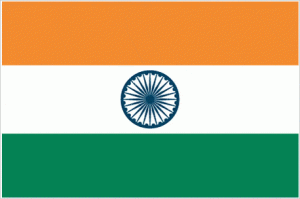 India — Key Facts India — Key Facts |
|
|---|---|
| Official name | Republic of India |
| Capital | New Delhi |
| Population | ~1.44 billion (2024) — world’s most populous country |
| Area | 3,287,263 km² (7th largest in the world) |
| Driving side | Left |
| Speed limit (expressway) | 120 km/h |
| Speed limit (national highway) | 100 km/h (cars); 80 km/h (buses/trucks) |
| Speed limit (urban) | 50 km/h (general); lower in school zones |
| Blood alcohol limit | 0.03% (30 mg/100 ml) |
| Motorway/expressway tolls | Yes — FASTag electronic toll system mandatory |
| Emergency number | 112 (national); 100 (police); 102 (ambulance); 101 (fire) |
| Official languages | Hindi, English (+ 21 other scheduled languages) |
| Currency | Indian Rupee (₹ / INR) |
| Total road network | ~6,617,900 km (2nd largest in the world) |
| National highways | 146,195 km (as of 2024) |
| Expressways | 6,059 km operational (2024) |
Introduction
India is one of the world’s largest and most geographically diverse countries, spanning 3,287,263 km² across the South Asian subcontinent. As the world’s most populous nation with approximately 1.44 billion people, its road network is vast and constantly expanding — now the second largest in the world by total length, covering over 6.6 million kilometres. From the snow-capped Himalayan highways of the north to the palm-lined coastal roads of Kerala, and from the desert expressways of Rajasthan to the forested mountain passes of the Northeast, driving in India offers an extraordinary range of environments and challenges.
India follows left-hand traffic — vehicles drive on the left side of the road, a legacy of British colonial administration. The country is governed by the Motor Vehicles Act, 1988 (amended 2019), which sets national standards for licensing, registration, speed limits, and road safety. Enforcement varies considerably between states and between urban and rural areas.
This guide draws on data from the CIA World Factbook, Wikipedia, OpenStreetMap, and the Indian Ministry of Road Transport and Highways (MoRTH) to provide a comprehensive, factual reference for drivers, travel planners, and visitors navigating India by road.
This India Google Map provides an interactive overview of the country’s extensive road network, national highways, and major cities. Use the map of India below to explore regional geography and plan driving directions in India across any of its 28 states and 8 union territories.
Use the interactive map above to explore India’s road network, state boundaries, major cities, terrain, and border crossings.
India at a Glance
India is the seventh-largest country in the world by area and borders six nations: Pakistan to the northwest, China and Nepal to the north, Bhutan to the northeast, Bangladesh and Myanmar to the east. Its 7,517 km coastline runs along the Arabian Sea to the west and the Bay of Bengal to the east, with the Indian Ocean to the south. This enormous geography — spanning 30 degrees of latitude and crossing five climatic zones — creates radically different driving environments within a single country.
India’s road infrastructure is managed at the national level by the Ministry of Road Transport and Highways (MoRTH) and the National Highways Authority of India (NHAI), which oversees the construction, maintenance, and operation of national highways and expressways. State highways and local roads fall under state public works departments. The country has invested heavily in road expansion since 2014, with national highway construction exceeding 30 km per day by 2024 and total highway length growing 60% in a decade to reach 146,195 km.
Geography and Terrain
India’s terrain is among the most varied of any country on earth, falling broadly into five geographic zones:
- Himalayan Region (North/Northeast): The world’s highest mountain range defines India’s northern and northeastern frontier. Passes such as Rohtang (3,978 m), Zoji La (3,528 m), and Nathu La (4,310 m) provide road access to Ladakh, Himachal Pradesh, and Sikkim but are closed seasonally by snow (typically October–May at higher elevations). Roads in these areas are narrow, often unpaved, and subject to landslides and avalanches.
- Indo-Gangetic Plain (North/Central): The vast alluvial plain stretching from Punjab in the west to West Bengal in the east is India’s most densely populated region and hosts the densest road and rail network. It is flat, fertile, and generally provides good driving conditions, though thick winter fog (November–January) in northern states can reduce visibility to near zero on highways.
- Thar Desert (Northwest): Rajasthan’s desert terrain is sparsely populated and features long, straight national highways with minimal traffic — but also extreme summer heat (50°C+), sandstorms, and limited fuel/service stations in remote areas.
- Deccan Plateau and Western/Eastern Ghats (Central/South): The peninsular interior is elevated plateau bisected by mountain ranges along the western and eastern coasts. Ghat roads — winding ascents and descents through these ranges — require careful driving, particularly in monsoon season when landslides and surface flooding are common.
- Coastal Lowlands (West and East): The Malabar Coast (Kerala, Karnataka, Goa) and Coromandel Coast (Tamil Nadu, Andhra Pradesh) feature well-developed road networks, though coastal flooding during monsoon (June–September) can temporarily disrupt travel.
Climate impact on driving: India’s monsoon season (June–September across most of the country, October–December in the south) is the most significant seasonal factor for road travel. Heavy rainfall causes flooding, landslides on Ghat roads, waterlogged urban streets, and reduced visibility. Winter fog in the northern plains — particularly in Delhi, Punjab, Haryana, and Uttar Pradesh — causes dozens of multi-vehicle pile-ups annually on national highways. Drivers travelling during these periods should adjust speed, use fog lights, and follow highway authority advisories.
Road Network and Infrastructure
India’s road network is one of the largest and fastest-growing in the world:
- Total road network: ~6,617,900 km — second largest in the world (behind the United States)
- National Highways: 146,195 km (as of December 2024) — second largest national highway network globally. National Highways represent 2.7% of total roads but carry ~40% of all road traffic.
- Expressways: 6,059 km operational (December 2024); a further 11,127 km under construction
- State Highways: ~186,528 km
- District and Rural Roads: Remaining ~6.2 million km, including village roads constructed under the Pradhan Mantri Gram Sadak Yojana (PMGSY)
Key expressways:
- Delhi–Mumbai Expressway (NE-4): 1,386 km — India’s longest expressway when complete; designed for 120 km/h; reduces Delhi–Mumbai travel time to approximately 12 hours
- Yamuna Expressway: 165 km — connects Greater Noida to Agra; 6-lane, 100 km/h
- Mumbai–Pune Expressway (E1): 94.5 km — one of India’s busiest; connects two major economic centres through the Western Ghats
- Lucknow–Agra Expressway: 302 km — 6-lane; connects Uttar Pradesh’s two largest cities
- Purvanchal Expressway: 340.8 km — connects Lucknow to Ghazipur in eastern UP
- Samruddhi Mahamarg (Mumbai–Nagpur): 701 km — Maharashtra’s 8-lane expressway
National Highway numbering: India’s national highways are numbered from NH1 upward, with higher numbers generally assigned to more recently designated routes. Major corridors include NH44 (Srinagar–Kanyakumari, 3,745 km — India’s longest national highway), NH48 (Delhi–Mumbai, 2,807 km), and NH27 (Porbandar–Silchar, 3,523 km).
Toll system — FASTag: Since February 2021, FASTag electronic toll collection is mandatory on all national highways and expressways. FASTag is an RFID-based device affixed to the windshield that enables automatic toll deduction from a linked prepaid account. Foreign vehicles and rental cars should be equipped with FASTag or be prepared to pay double the toll at cash lanes. FASTag can be obtained from banks, petrol stations, and the National Highways Authority of India (NHAI) website.
Road quality: National highways and expressways are generally well-maintained with lane markings, crash barriers, and service areas. State highways vary significantly by state. Rural district roads in remote areas — particularly in Jharkhand, Bihar, Chhattisgarh, and parts of the Northeast — can be in poor condition, especially after monsoon. In major cities, urban roads are frequently congested and subject to construction disruptions.
Driving Conditions and Traffic Regulations
Driving side: LEFT. India follows left-hand traffic. Vehicles drive on the left side of the road; overtaking is done on the right. Drivers from right-hand traffic countries (continental Europe, the Americas, etc.) must adjust accordingly, particularly at roundabouts and junctions.
Speed limits (Motor Vehicles Act, 1988 / MoRTH notifications):
- 120 km/h — expressways (for cars and light vehicles)
- 100 km/h — national highways (cars and light vehicles)
- 80 km/h — national highways (buses, minibuses, goods vehicles)
- 70 km/h — state highways (cars)
- 50 km/h — urban areas (general)
- 25 km/h — near schools and hospitals
Speed limit enforcement uses electronic surveillance (CCTV, speed guns) and the e-challan system. Fines for speeding range from ₹1,000 to ₹2,000 for light vehicles (doubled for a second offence within three years). Cameras on expressways are increasingly using ANPR (automatic number plate recognition) technology.
Blood alcohol limit: 0.03% (30 mg per 100 ml of blood) — significantly stricter than most Western countries. Drunk driving is a criminal offence under the Motor Vehicles Act. Police conduct breath analyser checks, particularly at night near urban areas. Penalties include fines up to ₹10,000, vehicle impoundment, and imprisonment for repeat offences.
Seatbelts: Mandatory for the driver and all front-seat passengers under national law. Several states have extended this requirement to rear passengers as well. Fine for non-compliance: ₹1,000.
Helmets: Compulsory for both rider and pillion passenger on two-wheelers. Helmets must carry the Bureau of Indian Standards (BIS) ISI mark. Fine for non-compliance: ₹1,000 plus licence suspension for three months.
Mobile phones: Handheld mobile phone use while driving is prohibited. Fine: ₹1,000–₹5,000. Hands-free use is permitted.
Priority rules: At unmarked intersections, traffic approaching from the right generally has priority. Traffic circles (roundabouts) give priority to vehicles already in the circle. However, actual on-road behaviour at junctions in Indian cities is highly informal and priority is often determined by vehicle size and assertiveness rather than by formal rules. Drivers must exercise extreme caution at all intersections in urban areas.
Overtaking: Overtake on the right only. Never overtake on the left except when the vehicle ahead is turning right. Flashing headlights or honking before overtaking on rural highways is a common (though informal) practice to signal intent.
Horn use: Extremely widespread in India. Most heavy vehicles display “HORN OK PLEASE” on their rear. In urban areas, constant horn use is the norm. Many expressways and urban zones display “No Horn Zone” signage, though enforcement is limited.
International Driving Permit (IDP): Foreign nationals must carry a valid IDP alongside their home country driving licence to drive in India. IDPs are not issued in India; obtain one from your home country’s automobile association before travel. Rental car companies may have additional requirements for foreign drivers.
Vehicle documents required: Registration certificate (RC book), valid insurance (third-party at minimum — mandatory by law), Pollution Under Control (PUC) certificate, and driving licence (plus IDP for foreign drivers). All documents must be carried at all times and produced on demand by police.
Road safety context: India recorded approximately 150,000 road fatalities in 2021 — one of the highest totals in the world, representing roughly 11% of global road deaths. Fatigue, speeding, drunk driving, and poor road conditions are major contributing factors. Foreign drivers should exercise significant caution, drive defensively, and avoid driving at night on rural national highways where unlit vehicles, cattle, and pedestrians on the road pose serious hazards.
Border Crossings and Connectivity
India shares land borders with six countries. Land border crossings for private vehicles are restricted and require advance permissions; most international travellers enter India by air. The following are the main road border crossings currently operational for civilian use:
- Wagah–Attari (Punjab): The only road crossing between India and Pakistan open to international travellers, located 30 km from Amritsar. Only Indian and Pakistani nationals with valid visas may cross by road. Third-country nationals are not permitted to cross here by land. The Wagah Border ceremony at sunset is a major tourist attraction. Crossing hours are limited; advance visa arrangements are mandatory.
- Sunauli (Uttar Pradesh): The main crossing for travellers between Delhi/Varanasi and Kathmandu; open to Indian and Nepali nationals by road without visa. Third-country nationals require a Nepali visa (obtainable on arrival at the border).
- Raxaul–Birganj (Bihar): High-volume commercial and passenger crossing; connects the Bihar plains to central Nepal.
- Sonauli, Rupaidiha, Banbasa: Additional open crossings along the India–Nepal border.
- Phuentsholing (West Bengal/Bhutan): The primary road crossing between India and Bhutan. Indian nationals may enter without a visa; third-country nationals require a Bhutan visa and entry permit issued in Thimphu.
- Jaigaon–Phuentsholing is the most commercially active crossing.
- Petrapole–Benapole (West Bengal): The busiest land border crossing in South Asia by trade volume. Indian and Bangladeshi nationals may cross with valid travel documents; third-country nationals require a Bangladeshi visa.
- Additional crossings at Agartala–Akhaura (Tripura) and Dawki–Tamabil (Meghalaya).
- Moreh–Tamu (Manipur): The primary road crossing; part of the India–Myanmar–Thailand Trilateral Highway project. Indian nationals may cross for short visits to Tamu; full transit requires prior permissions.
India–China: Road crossings for civilian international travel are not open between India and China. Trade crossings (Nathu La in Sikkim; Shipki La in Himachal Pradesh) operate under bilateral agreements for specific commercial traffic only.
Note: Border crossing permissions and operational status change with diplomatic and security conditions. Travellers should verify current status with the relevant Indian embassy or the Ministry of External Affairs before planning any overland border crossing.
Major Cities and Distances
India’s major cities are spread across a vast subcontinent; driving distances between them are substantial. The following road distances are approximate and based on national highway and expressway routes:
From New Delhi (capital):
- Agra (Taj Mahal): ~230 km via Yamuna Expressway — approximately 2.5–3 hours
- Jaipur (Rajasthan): ~280 km via NH48 — approximately 4–5 hours
- Chandigarh: ~250 km via NH44 — approximately 4 hours
- Amritsar (Punjab): ~450 km via NH44 — approximately 6 hours
- Lucknow (UP): ~550 km via Agra–Lucknow Expressway — approximately 6–7 hours
- Mumbai: ~1,400 km via NH48 / Delhi–Mumbai Expressway — approximately 18–22 hours by road (1.5–2 hours by flight)
- Bengaluru (Karnataka): ~2,100 km via NH44 — approximately 28–35 hours by road
Key inter-city corridors:
- Mumbai ↔ Pune: 149 km via Mumbai–Pune Expressway (E1) — approximately 2–2.5 hours
- Mumbai ↔ Nagpur: 701 km via Samruddhi Mahamarg — approximately 8 hours by expressway
- Chennai ↔ Bengaluru: ~340 km via NH48 — approximately 4.5–5.5 hours
- Hyderabad ↔ Chennai: ~633 km via NH65 — approximately 8–9 hours
- Kolkata ↔ Mumbai: ~1,939 km via NH16/NH44 — approximately 28–32 hours by road
- Bengaluru ↔ Mysuru: ~145 km via NH275 — approximately 2.5–3 hours
- Delhi ↔ Haridwar/Rishikesh: ~230 km via NH58 — approximately 4–5 hours (gateway to Uttarakhand hills)
Given these distances, long-distance road travel in India is typically undertaken by bus or train rather than private car. For most inter-state journeys over 500 km, flying or taking the train is more practical. However, road travel excels for regional exploration, hill station access (Shimla, Manali, Ooty, Munnar), and rural areas not well-served by rail.
Traffic congestion in major metropolitan areas — particularly Delhi-NCR, Mumbai, Bengaluru, and Kolkata — can add hours to urban journey times during peak hours (8–11 h and 17–21 h on weekdays). Real-time navigation via Google Maps or Waze is strongly advised in all major cities.
Transport Infrastructure: Rail, Airports and Ports
Rail Transport — Indian Railways
Indian Railways is one of the largest rail networks in the world, with a total route length of approximately 68,500 km — the fourth longest after the United States, China, and Russia. It runs 13,452 passenger trains and 9,141 freight trains daily, transporting 23 million passengers from 7,349 stations across the country. Around 97% of all broad-gauge routes were electrified by 2024.
Key rail services for travellers:
- Vande Bharat Express: India’s semi-high-speed train (160 km/h); connects major city pairs (Delhi–Varanasi, Delhi–Katra, Mumbai–Gandhinagar, etc.)
- Rajdhani Express: Premium overnight service from New Delhi to state capitals; air-conditioned, meals included
- Shatabdi / Jan Shatabdi: Day intercity express; connects cities 150–700 km apart
- Duronto Express: Non-stop overnight services between major cities
- Mumbai–Ahmedabad High-Speed Rail (Bullet Train): Under construction; 508 km corridor designed for 320 km/h; expected partial opening 2026–2028
Metro rail: India operates metro systems in 21 cities as of 2024, including Delhi Metro (395 km — one of the world’s largest), Mumbai Metro, Bengaluru Metro, Hyderabad Metro, Chennai Metro, and Kolkata Metro.
Airports and Civil Aviation
India had 157 operational airports (including 35 international airports) as of 2024 — more than double the 74 operational in 2014. Domestic passenger traffic reached 162 million in 2024. The UDAN scheme (Ude Desh ka Aam Naagrik) has connected small cities to the national air network, operationalising 625 routes to 90 airports.
Major international hubs:
- Indira Gandhi International Airport (DEL), Delhi: India’s busiest; handles ~73 million passengers/year
- Chhatrapati Shivaji Maharaj International Airport (BOM), Mumbai: ~50 million passengers/year
- Kempegowda International Airport (BLR), Bengaluru: ~37 million passengers/year
- Chennai International Airport (MAA): ~22 million passengers/year
- Netaji Subhas Chandra Bose International Airport (CCU), Kolkata: ~22 million passengers/year
- Rajiv Gandhi International Airport (HYD), Hyderabad
- Chaudhary Charan Singh Airport (LKO), Lucknow
Ports and Coastal Shipping
India has 12 major ports and over 200 minor/intermediate ports along its 7,517 km coastline. The largest by cargo volume are Paradip (Odisha), Deendayal Port (Kandla/Kutch, Gujarat), Jawaharlal Nehru Port (JNPT, Navi Mumbai — India’s largest container port), and Chennai Port. Coastal shipping handles significant bulk cargo (coal, fertilizers, foodgrains) between ports.
Inland Waterways
India has approximately 14,500 km of navigable inland waterways, of which 111 have been designated as National Waterways. Key waterways include National Waterway 1 (Ganga–Bhagirathi–Hooghly river system, 1,620 km) and National Waterway 2 (Brahmaputra, Assam). The government is developing these for freight to reduce road congestion.
Map Usage Guide
The interactive map at the top of this page displays India’s full geographic extent — from the Himalayan north to the southern tip at Kanyakumari, and from the Thar Desert in the west to the northeastern states bordering Myanmar. It shows the national highway network, state boundaries, major cities, coastlines, and terrain.
How to use the map effectively for India:
- Zoom to a state: India’s sheer size means the full-country view shows only major highways. Zoom into a specific state or region to see local roads, district connections, and town-level detail.
- Satellite view: Particularly useful in the Himalayan and Ghat regions, where terrain dramatically affects road routing. Switch to satellite to understand elevation change before planning a mountain route.
- Terrain view: Shows elevation contours — valuable for planning routes through mountain passes in Himachal Pradesh, Uttarakhand, Jammu & Kashmir, and the Northeast.
- Route planning: Use our Google Maps route planner on the homepage to calculate driving routes between any two Indian (or cross-border) points, including estimated travel time and distance.
- Street View: Available on most national highways and in major cities. Useful for previewing highway toll plazas, mountain ghat roads, and urban junction layouts.
Offline mapping for India: Given the variable mobile coverage across India’s vast geography — particularly in remote Himalayan areas, Thar Desert regions, and the Northeast — offline maps are strongly recommended. Google Maps offline downloads cover most of India. OsmAnd provides detailed OpenStreetMap-based offline navigation including village-level roads, trekking paths, and rural tracks. Maps.me is a lightweight offline alternative. For Himalayan travel, specialist offline apps (Gaia GPS, Maps.me with India packs) are recommended as Google Maps coverage thins significantly in remote high-altitude areas.
Practical Travel Notes
Driving side: Left-hand traffic. Steering wheel is on the right side of the vehicle in Indian-spec cars. Drivers from right-hand traffic countries must consciously readjust, particularly when turning left (tendency to drift right) and at roundabouts.
Required documents: Valid driving licence, International Driving Permit (IDP — mandatory for foreign nationals), vehicle registration certificate (RC book), insurance certificate (third-party minimum), Pollution Under Control (PUC) certificate. Carry originals or certified copies; digital versions via the DigiLocker app are legally accepted in India.
FASTag: Mandatory on all national highways and expressways for toll payment. Vehicles without FASTag are charged double toll in cash lanes. If renting a car, confirm with the rental company that FASTag is fitted and topped up.
Fuel: Petrol (gasoline) and diesel are widely available throughout India. CNG (compressed natural gas) is available in major cities (Delhi, Mumbai, Ahmedabad). EV charging infrastructure is growing but limited outside major urban centres as of 2024. In remote Himalayan areas, hill stations, and the northeastern states, fuel stations can be sparse — fill up before entering remote areas. Fuel is dispensed in litres; payment is by cash or UPI/card at most stations.
Driving at night: Strongly discouraged on rural national highways and state roads. Hazards include unlit trucks and tractors, cattle and wildlife on the road, pedestrians and cyclists without reflective clothing, potholes, and road damage. If night driving is unavoidable, reduce speed significantly, use high beams (dipping for oncoming traffic), and stop at a well-lit roadside establishment if tired.
Traffic police: Traffic police are present at major intersections in cities. They may stop vehicles for document checks. Fines are payable on the spot or via e-challan. Corruption at checkpoints has decreased since the e-challan system digitised fines, but travellers should request a formal receipt for any payment.
Emergency services: National emergency number: 112. Police: 100. Ambulance: 102. Fire: 101. Highway patrols operate on national highways; roadside assistance from NHAI is available on expressways via call centres.
Low Emission Zones: Delhi operates odd-even vehicle rationing during peak pollution periods (typically November–January) and has restrictions on diesel vehicles over 10 years old entering certain zones. Check the Delhi government website for current restrictions before driving in the capital during winter months.
Currency and payments: Indian Rupee (₹). Cash remains widely used for fuel, tolls (if without FASTag), and roadside food. UPI (Unified Payments Interface) apps (PhonePe, Google Pay, Paytm) are accepted at most petrol stations, restaurants, and larger shops. International cards work at ATMs and in urban establishments; less reliable at rural fuel stations.
FAQ: Driving in India
Q: Does India drive on the left or the right?
A: India drives on the left. This is a legacy of British colonial rule and is shared with the UK, Australia, Sri Lanka, and most of South and Southeast Asia. The steering wheel is on the right side of Indian-market vehicles. Drivers accustomed to right-hand traffic should exercise particular care at junctions, roundabouts, and when pulling out of car parks.
Q: Do I need an International Driving Permit (IDP) to drive in India?
A: Yes. Foreign nationals must carry both their home country driving licence and a valid IDP to drive in India. The IDP must be obtained in your home country before travelling — it cannot be obtained in India. Many car rental companies also require a credit card and may impose minimum age requirements (typically 21–25 years depending on the company).
Q: What is FASTag and do I need it?
A: FASTag is India’s mandatory electronic toll collection system, using RFID technology. It has been compulsory on all national highways since February 2021. Vehicles without a FASTag are charged double the toll rate in cash-only lanes. If you are renting a car, confirm that FASTag is installed and the account is topped up. Rental companies typically include this, but verify before departure.
Q: Is it safe to drive at night in India?
A: Night driving on rural national highways and state roads carries significantly higher risk than daytime driving. Hazards include unlit heavy vehicles, cattle, pedestrians, cyclists, and road damage not visible until very close. If you must drive at night, stay on expressways (which are lit and have crash barriers), reduce speed, and avoid remote rural roads entirely. Night driving in cities carries the additional risk of drunk driving incidents after midnight.
Q: What are the main expressways in India for long-distance driving?
A: The most significant expressways include: the Delhi–Mumbai Expressway (1,386 km, under completion), Yamuna Expressway (Delhi–Agra, 165 km), Mumbai–Pune Expressway (94 km), Lucknow–Agra Expressway (302 km), Purvanchal Expressway (341 km in UP), and the Samruddhi Mahamarg (Mumbai–Nagpur, 701 km). All require FASTag and have tolls. Most are access-controlled with limited entry/exit points.
Q: Can I drive from India to Nepal or Bhutan?
A: Yes, with restrictions. Indian nationals can cross to Nepal and Bhutan relatively freely. Third-country nationals can cross to Nepal at Sunauli/Sonauli (Uttar Pradesh) and other border points, presenting a valid passport and obtaining a Nepal visa. Entry to Bhutan requires a pre-arranged visa and permit; the main road crossing is at Phuentsholing. Crossing to Pakistan is only possible at Wagah–Attari and is restricted to Indian and Pakistani nationals. Cross-border driving to China is not permitted for civilians.
Q: How does the monsoon affect driving in India?
A: The monsoon (June–September in most of India; October–December in the south) significantly impacts road travel. Urban roads flood in heavy rain. Ghat roads in the Western and Eastern Ghats are susceptible to landslides. Himalayan roads face rockfalls and flash floods. Several routes in Ladakh, Himachal Pradesh, and Uttarakhand may close entirely. Check local road authority updates before travelling to hill areas during and immediately after the monsoon.
Q: What should I know about driving in Indian cities like Delhi, Mumbai, or Bengaluru?
A: All three cities experience severe traffic congestion during peak hours (roughly 8–11 h and 17–21 h on weekdays). Bengaluru is frequently cited as one of the world’s worst cities for traffic. Delhi has an odd-even traffic rationing scheme during severe pollution periods. Mumbai has one-way systems, flyovers, and sea links (Bandra–Worli Sea Link, Mumbai Trans Harbour Link) that significantly alter routing. Using Google Maps or Waze with live traffic is essential. Consider parking at the city periphery and using metro, auto-rickshaw, or app-based cabs (Ola, Uber) for central areas.
Navigation Tools and Apps
Google Maps provides comprehensive coverage of India’s road network, including national highways, expressways, state roads, and most urban streets. Live traffic data is increasingly reliable in major cities and on national highways. The turn-by-turn navigation and alternate route suggestions are well-calibrated for Indian conditions.
Waze operates in India and provides crowd-sourced hazard and police alerts. Coverage is best in metro cities (Delhi, Mumbai, Bengaluru, Hyderabad, Chennai, Pune). Less comprehensive in smaller cities and rural areas.
MapMyIndia (Move): India’s own mapping platform, developed by CE Info Systems. MapMyIndia has the most comprehensive local data for India, including village-level roads, rural lanes, and lesser-known routes not well-mapped by Google. It is used by the Indian government and several automotive manufacturers. The Move app (formerly MapMyIndia) is highly recommended as a primary or supplementary navigation tool for driving in India.
OsmAnd / Maps.me: Use OpenStreetMap data, which has excellent coverage in India’s cities and increasingly in rural and tribal areas. Both support full offline navigation with turn-by-turn. Essential for Himalayan travel (Ladakh, Spiti, Zanskar, Northeast India) where mobile connectivity and even Google Maps coverage can be absent.
Offline preparation: Download your planned route regions before departure. Mobile data coverage is generally good in cities and along national highways (Jio, Airtel, VI networks), but drops significantly in remote mountains, forest regions, and border areas. In Ladakh and parts of the Northeast, mobile connectivity can be absent for stretches of 50–100 km. Pre-downloaded offline maps are not optional in these areas — they are essential.
India-specific apps: Ola and Uber operate ride-hailing across India for those not self-driving. For bus routes: APSRTC, KSRTC, MSRTC (state transport apps). Indian Railways ticket booking: IRCTC app (book well in advance for popular routes, especially during holidays).
Sources and Update Note
This article draws on data from the following primary sources, verified as of 2026-02-20:
- CIA World Factbook — India: https://www.cia.gov/the-world-factbook/countries/india/
- Wikipedia — Roads in India: https://en.wikipedia.org/wiki/Roads_in_India
- Wikipedia — Transport in India: https://en.wikipedia.org/wiki/Transport_in_India
- Ministry of Road Transport and Highways (MoRTH) — Year End Review 2024: https://www.pib.gov.in/PressReleasePage.aspx?PRID=2091508
- Wikipedia — Expressways of India: https://en.wikipedia.org/wiki/Expressways_of_India
- OpenStreetMap / Overpass API: https://www.openstreetmap.org
- Worlddata.info — India transport: https://www.worlddata.info/asia/india/transport.php
Data was last reviewed and compiled on 2026-02-20. Road statistics, legislation, and infrastructure details are subject to change. India’s road network is expanding rapidly; figures cited reflect data available at time of generation. Travellers should verify current regulations, toll requirements, and border crossing status with official Indian government sources before departure. This guide is for informational purposes only and does not constitute legal or travel advice.