
Driving Directions and Google Map of the UAE — Roads, Routes & Navigation Guide
 UAE — Key Facts
The United Arab Emirates is a federation of seven emirates — Abu Dhabi, Dubai, Sharjah, Ajman, Umm Al Quwain, Ras Al Khaimah, and Fujairah — situated at the southeastern tip of the Arabian Peninsula. With a population of approximately 9.9 million (of whom roughly 90% are expatriates) and one of the world’s highest rates of car ownership per capita, the UAE is an intensely car-dependent nation. Private vehicle travel is the dominant mode of transport for the vast majority of residents, and the inter-emirate expressway system is among the most engineered in the Middle East — wide multi-lane motorways, intelligent variable message signs, and one of the world’s densest speed-camera networks are defining features of UAE roads.
The UAE drives on the right-hand side of the road with left-hand drive vehicles, consistent with all GCC neighbours and the wider Middle East. Speed limits are posted in kilometres per hour (km/h). The most important road corridor is E11 — Sheikh Zayed Road, the motorway spine connecting Abu Dhabi city to Dubai and continuing as Emirates Road into the northern emirates. Dubai’s Salik open-road electronic toll system charges AED 4–6 per gate on key Dubai roads and bridges; all vehicles — including rental cars and foreign-registered vehicles — must carry a Salik RFID tag to use Dubai expressways freely.
The UAE enforces absolute zero tolerance on drink-driving (0.00% BAC) — the strictest standard in the world. Any detectable blood alcohol while driving is a criminal offence under both UAE Federal Traffic Law and Islamic-informed criminal statutes, carrying penalties of arrest, fine, licence suspension, and deportation for non-nationals. Alcohol is legally available in licensed premises but may never be consumed before driving. The unified emergency number across the UAE is 999. Use the route planner on our homepage to plan driving directions across all seven emirates.
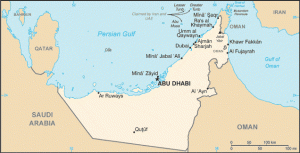
The UAE Road Network
The UAE’s road network is compact by global standards — the country covers only 83,600 km² — but it is exceptionally high quality, heavily invested, and among the most camera-monitored in the world. Road infrastructure is managed at two levels: the federal Ministry of Energy and Infrastructure oversees inter-emirate federal roads; each emirate maintains its own road authority, with Dubai’s Roads and Transport Authority (RTA) and Abu Dhabi’s Department of Municipalities and Transport (DMT) being the most significant.
E11 — Sheikh Zayed Road: The UAE’s most important road corridor, E11 runs approximately 150 km between Abu Dhabi city and Dubai before continuing as Emirates Road (E311) through Sharjah and the northern emirates. In Dubai, E11 passes through the heart of the city’s iconic skyline — the world’s tallest buildings rising on either side — and is one of the most recognisable urban motorway stretches on earth. E11 carries 8–14 lanes in its Dubai urban section. Salik toll gates are positioned on E11 within Dubai.
E311 — Mohammed Bin Zayed Road: Runs parallel to E11 as a faster bypass for through-traffic between Abu Dhabi and Dubai. Continues north as Emirates Road (E611) through Sharjah, Ajman, Umm Al Quwain, and Ras Al Khaimah. Heavily used by freight and commuters avoiding the coastal urban strip; often faster than E11 for Abu Dhabi–Dubai journeys, especially during peak hours.
E611 — Emirates Road (northern section): The northern ring corridor from the Dubai airport area to Ras Al Khaimah, approximately 80 km. Well-maintained dual carriageway at 120 km/h; key freight and commuter route for the northern emirates.
E66 — Dubai–Al Ain Road: Dual carriageway connecting Dubai to Al Ain (150 km) through desert terrain; also provides access to Hatta mountain enclave via a branch. Speed limit 120 km/h on open desert sections. One of the UAE’s most pleasant long-distance drives — straight, well-surfaced, low traffic outside peak periods.
E22 — Abu Dhabi–Al Ain Road: The 150 km corridor connecting Abu Dhabi city to Al Ain through desert; dual carriageway, well-maintained. Al Ain is Abu Dhabi emirate’s second city and a UNESCO World Heritage site for its ancient aflaj irrigation systems and oasis gardens.
E88 — Dubai–Fujairah Road: The trans-mountain expressway crossing the Hajar range between the Gulf coast and Fujairah’s east coast (approximately 130 km). Features tunnels, bridges, and mountain scenery; excellent road quality. One of the UAE’s most scenic drives and the main route to the east coast. Speed limit 120 km/h on open sections.
E75 — Al Ain–Hatta Highway / Dubai–Hatta Road: Connects Dubai to the Hatta mountain enclave (~115 km); passes briefly through a narrow strip of Omani territory. Continues as E44 into Oman for those crossing the border.
Key bridges and crossings: The UAE has no bridges between the Gulf coast and the Asian continent; all cross-Gulf connections are by air or sea. Within the UAE, the main notable crossing is the Maktoum Bridge and Floating Bridge over Dubai Creek, connecting Deira and Bur Dubai. The Al Garhoud Bridge and Business Bay Crossing provide additional Dubai Creek crossings; several are Salik-tolled. The undersea Dubai Water Canal road bridges connect the Jumeirah area to Business Bay.
Driving Rules and Legal Requirements
The UAE’s traffic legislation is Federal Law No. 21 of 1995 (Traffic Law) and its amendments, applied consistently across all seven emirates. Emirate-level authorities (Dubai RTA, Abu Dhabi DMT) publish supplementary regulations and manage local enforcement.
Driving licence recognition: Visitors from approximately 34 countries — including all EU/EEA member states, the UK, USA, Canada, Australia, New Zealand, Japan, South Korea, and GCC nations — may drive in the UAE on their home country licence without an International Driving Permit for tourist stays. Visitors from countries outside this list require an IDP (1968 Vienna Convention) alongside their national licence. UAE residents (with residence visas) must convert their foreign licence to a UAE driving licence within the permitted period; most European, North American, and Australian licences can be exchanged without a driving test. Confirm current recognition status with the Dubai RTA or Abu Dhabi DMT, as the approved country list is periodically updated.
Insurance: All vehicles must carry valid UAE third-party liability insurance at minimum. For rental cars, this is included in the rental agreement. For foreign-registered vehicles driving cross-border from Oman or Saudi Arabia into the UAE, a cross-border insurance certificate (available from UAE insurers or at border posts) is required.
Documents to carry: Driving licence, vehicle registration card (Mulkiyya), valid insurance certificate. For rental vehicles, the rental agreement and insurance documents must be in the car. Foreign drivers should carry their passport.
Seatbelts: Mandatory for all occupants in all seats. Children under 4 years must use an approved child safety seat; children aged 4–10 under 145 cm must use a booster seat. Fines apply per unbelted occupant. UAE traffic police and cameras enforce compliance actively.
Mobile phones: Handheld use while driving is strictly prohibited. Fine: AED 800 + 4 black points. Hands-free use (Bluetooth, speakerphone on a cradle) is permitted.
Black points system: The UAE operates a demerit point (black points) system alongside fines. Accumulating 24 black points within one year triggers a 3-month licence suspension; a second accumulation results in 6 months; a third in one year plus mandatory retesting. Key violations and their black points: drunk driving — 23 points + AED 20,000; running a red light — 12 points + AED 1,000; exceeding speed limit by more than 60 km/h — 12 points + AED 3,000 + 60-day vehicle confiscation; tailgating — 4 points + AED 400; handheld phone — 4 points + AED 800.
Lane discipline and overtaking: Overtake on the left only. Driving slowly in the left (overtaking) lane when not overtaking is an offence — UAE expressway culture strongly enforces fast-lane discipline. Do not flash headlights at the vehicle ahead; if faster traffic approaches from behind, move right when safely possible. Cutting between lanes without signalling is common in UAE traffic but is technically an offence.
Trams and pedestrians: Dubai Metro operates on dedicated elevated infrastructure; trams in Dubai Marina (Al Sufouh Tram) run on surface rails and have absolute priority over road traffic. Pedestrians at marked crossings have right of way; failing to yield to pedestrians at a crossing carries a fine and black points.
Speed Limits and Camera Enforcement
Speed limits in the UAE are set by each emirate’s road authority in coordination with the federal traffic law. All speed is posted and enforced in kilometres per hour (km/h).
| Road / Zone | Limit (cars) | Notes |
|---|---|---|
| Selected Abu Dhabi expressways (e.g. E10, E11 Abu Dhabi–Dubai) | 140 km/h | Posted signs take precedence |
| Inter-emirate expressways (most of E11, E311, E66, E88) | 120 km/h | Standard maximum |
| Highways and major arterials (outside city limits) | 100 km/h | |
| Urban arterial roads (main roads inside cities) | 80 km/h | Common in Dubai, Abu Dhabi |
| Urban residential and secondary streets | 60 km/h | |
| School zones and designated residential zones | 40 km/h | Strictly enforced; cameras common |
Speed tolerance: The UAE historically applied a grace buffer of 20 km/h above the posted limit on federal roads before issuing a fine; however, this buffer is not legally guaranteed, has been reduced on some roads, and should never be relied upon as a driving strategy. Authorities adjust the buffer without public notice. Always aim to drive at or below the posted limit. Variable speed limits are shown on electronic overhead gantries on major expressways — the displayed limit is the enforceable limit at that moment.
Camera network: Speed cameras in the UAE are among the densest in the world — typically positioned every 500 m to 2 km on expressways, at every major intersection, and at school zones. Cameras operate 24 hours, 7 days a week in all weather. Fines are issued automatically to the registered vehicle owner and accumulate; unpaid fines can result in vehicle registration blocks. For rental cars, fines pass through to the renter. Check outstanding fines via the Ministry of Interior Traffic Services portal (moi.gov.ae) or the Dubai RTA, Abu Dhabi Police, and Sharjah Police apps before returning a rental or leaving the country.
Drink-drive: 0.00% BAC — absolute zero tolerance. No amount of blood alcohol is permissible. This is not just a traffic regulation but a criminal law matter. Penalties include immediate arrest, criminal prosecution, substantial fines (AED 20,000+), minimum 6-month licence suspension, and — for expatriates — deportation following sentencing. There is no margin for the previous evening’s drinking; plan accordingly.
Salik Tolls and the Dubai Toll System
Salik is Dubai’s open-road electronic toll system. An RFID sticker tag is affixed to the vehicle’s windshield and communicates with overhead gantry antennas as the vehicle passes beneath — no stopping required. Tolls are AED 4 per passage at most Salik gates, with AED 6 per passage at the Al Maktoum Bridge and Al Garhoud Bridge (updated rates since 2023). Currently 8 Salik gates are active on Dubai roads and bridges. Salik is mandatory: all vehicles using Dubai roads with Salik gantries must carry a registered, funded tag.
Rental cars: All Dubai rental cars come pre-fitted with a Salik tag linked to the rental company’s account. Tolls are charged to the renter — typically at face value plus an administration fee per toll event (AED 5–10 extra per gate, depending on the company). Review the rental agreement for the toll charging policy. Some companies provide a flat daily fee option for unlimited Salik usage.
Visitors with own vehicle: Obtain a Salik tag (AED 35, with AED 50 initial credit loaded) from any ENOC or EPPCO petrol station displaying the Salik logo, from Emirates NBD, Dubai Islamic Bank, or other authorised outlets, or online at salik.gov.ae. Register the tag to your vehicle and load sufficient credit before entering Dubai. Minimum balance triggers automatic top-up if a payment card is linked to the account.
Failure to have Salik: Passing a Salik gate without a registered funded tag results in an AED 50 administrative fine per gate plus the outstanding AED 4 or 6 toll. Fines are issued automatically via numberplate cameras and sent to the registered vehicle owner.
Abu Dhabi tolls (DARB / E-Tag): Abu Dhabi has implemented a toll system on certain routes, operated via the DARB platform. Currently less extensive than Dubai’s Salik, but expanding. Check the Abu Dhabi DMT website for current active toll routes before travel.
Outside Dubai and Abu Dhabi’s designated toll corridors, UAE roads — including all national highways (E-numbered routes), the E311/E611 northern corridors, E88 to Fujairah, and E66 to Al Ain — are generally toll-free.
Fuel, EV Charging, and Petrol Stations
Petrol and diesel in the UAE are government-regulated and revised monthly based on international oil prices. Prices are generally low by European standards — the UAE’s position as a major oil producer means domestic fuel is subsidised relative to global markets, though fuel is no longer as cheap as it was before 2015 pricing reforms.
Fuel types: Special 95 RON petrol, Super 98 RON petrol, and diesel (E-Diesel) are available at all filling stations. 95 RON is the standard grade for most vehicles; 98 RON Super is widely available for premium vehicles. Diesel for commercial use is standard. LPG (autogas) is not widely available in the UAE for passenger vehicles.
Filling stations: The dominant brands are ADNOC (Abu Dhabi National Oil Company — green livery; dominant in Abu Dhabi and throughout the UAE), ENOC/EPPCO (Emirates National Oil Company — dominant in Dubai), and a smaller number of international brands. All filling stations offer both full-service and self-service pumps; attendants are available at most stations. Payment by card or cash; digital payment (Apple Pay, Google Pay) accepted at most modern stations.
Electric vehicles (EV): EV adoption in the UAE is growing rapidly, supported by government incentives including free registration, zero vehicle import duty, and subsidised charging. The main charging networks are DEWA EV Green Charger (Dubai Electricity and Water Authority — the largest network in Dubai, with charging points at malls, petrol stations, and public parking), ADNOC Charge (Abu Dhabi — AC and DC fast chargers at ADNOC stations), and Tesla Superchargers (present in Dubai, Abu Dhabi, Sharjah, and Ras Al Khaimah). CCS Combo 2 is the fast-charging standard; Type 2 AC for slow/overnight. CHAdeMO points are available but declining. For desert routes (E66 to Al Ain, E22 to Al Ain, desert interior roads), EV range planning requires care — charging coverage thins outside major urban centres.
Driving in Dubai, Abu Dhabi, and Other Emirates
Dubai
Dubai is the UAE’s largest city and one of the most car-centric urban environments in the world. Its expressway network — the spine of which is E11 (Sheikh Zayed Road) — is remarkable for its scale, quality, and engineering complexity. Multi-level interchanges (the spaghetti junction near Trade Centre Roundabout; the complex at Deira/Al Garhoud; the DIFC and Financial Centre interchanges) require careful advance lane selection. Dubai’s road system is largely designed for high-speed throughput rather than slow urban manoeuvring; merging at speed from slip roads onto the main E11 carriageway requires assertive driving.
Peak congestion in Dubai occurs on weekday mornings (07:00–09:30) and evenings (17:00–20:00), with the worst bottlenecks at the Sheikh Zayed Road / Financial Centre intersection, the Maktoum and Garhoud bridges over Dubai Creek, and the E11/E311 interchange at Jebel Ali. Friday (the UAE weekend begins Thursday evening) morning and afternoon see lighter traffic; Thursday evening is among the busiest of the week as residents head for weekend activities. Waze and Google Maps live traffic are both excellent in Dubai and should be used for every journey.
Parking in central Dubai is managed via the RTA mParking system — paid parking zones (green and blue) operate on Sunday–Thursday 08:00–22:00 and Friday–Saturday from afternoon; rates vary by zone. The Dubai Metro Red Line provides an excellent alternative for travel between the airport, downtown Dubai, Dubai Marina, and JBR; it eliminates the expressway traffic problem entirely for those corridors.
Abu Dhabi
Abu Dhabi city is built on a near-rectangular island (Abu Dhabi Island) connected to the mainland by three bridges: Maqta Bridge, Mussafah Bridge, and the iconic Sheikh Zayed Bridge (designed by Zaha Hadid). Traffic entering and leaving the island — particularly on weekday mornings and evenings — can be heavy on these three crossing points. The city’s internal grid is well-organised; Corniche Road and Hamdan Street are key urban arteries. Abu Dhabi does not have a metro system as of 2026 (the Abu Dhabi Metro is under development); road and taxi are the primary intra-city modes.
Sharjah and the Northern Emirates
The Dubai–Sharjah commuter corridor is one of the most congested road corridors in the Middle East. Approximately 400,000–500,000 people commute between Dubai and Sharjah daily; the 30 km distance on E11 can take 60–120 minutes during peak hours. The alternative E311 (Mohammed Bin Zayed Road) is consistently faster and strongly recommended for all Dubai–Sharjah journeys. Ajman, Umm Al Quwain, and Ras Al Khaimah are progressively less congested and easier to drive in.
Fujairah and the East Coast
Fujairah, the UAE’s only emirate entirely on the Gulf of Oman coast, is reached from Dubai via the E88 (approximately 130 km, 1.5–2 hours). The trans-mountain section of E88 — passing through the Hajar range via tunnels and viaducts — is one of the UAE’s most scenic drives. The east coast (E99) is quieter, with beach resorts, diving sites, and the historic Fujairah Fort. Driving is straightforward and traffic is minimal outside weekends.
Cross-Border Driving: Oman and Saudi Arabia
UAE to Oman: The most practical crossing for Dubai and Abu Dhabi residents is the Al Ain–Buraimi (Hili gate) crossing between Al Ain (Abu Dhabi emirate) and Buraimi (Oman). The two towns share a conurbation across the border; the crossing is efficient for GCC nationals and UAE residents with proper documents. Third-country nationals require a valid Oman visa (e-Visa available at sultanateofoman.om) or can obtain a visa on arrival at some crossings — confirm current requirements before travel. Cross-border vehicle insurance must be verified; most UAE comprehensive insurance policies extend to Oman, but confirm with your insurer. The drive from Dubai to Muscat via Al Ain is approximately 500 km (5–6 hours).
The Hatta–Wajajah crossing serves Dubai’s Hatta enclave and access to the Oman interior; the E75 Dubai–Hatta road briefly transits Omani territory. GCC nationals and UAE residents pass without barrier stops; third-country nationals should carry passports as they technically cross Oman. The Dibba crossing on the east coast provides access to the Musandam Peninsula exclave of Oman — a stunning fjord region — requiring a separate Oman/Musandam entry.
UAE to Saudi Arabia: The main crossing is Ghuwaifat – Al Batha on the western edge of Abu Dhabi emirate, on the E11/GCC highway corridor toward Riyadh. A Saudi visa (e-Visa for eligible nationalities) is required for third-country nationals. The drive from Abu Dhabi to Riyadh is approximately 1,000 km (~9–11 hours). Cross-border insurance and all documentation should be confirmed before departure.
Seasonal Driving: Heat, Sandstorms, and Flash Floods
Summer heat (June–September): UAE summers are extreme, with air temperatures regularly exceeding 45°C and road surface temperatures reaching 70°C or above. These conditions create specific driving hazards: tyre blowouts are significantly more common (check tyre pressure when cool, not after driving); vehicle coolant systems are under stress; and car interiors parked in direct sunlight can reach 80°C+ within minutes — never leave children, elderly passengers, or pets in a parked car. The UAE Ministry of Human Resources operates a midday work ban outdoors in summer; similar caution applies to prolonged exposure during roadside breakdowns. Ensure air conditioning is fully functional before long desert drives in summer. Carry water in the vehicle at all times.
Sandstorms (haboob): Sudden sand and dust storms, particularly in spring (March–May) and early summer, can reduce visibility to near zero within minutes. If a sandstorm is developing ahead: slow down progressively; pull completely off the road onto the hard shoulder or beyond the road boundary; switch off headlights to avoid attracting other vehicles; activate hazard lights; and wait for conditions to improve. Do not attempt to drive through a severe sandstorm. The UAE Met Office issues sandstorm warnings; RTA Dubai sends variable message signs alerts on expressways.
Flash floods (November–March): Although the UAE receives minimal annual rainfall, when rain does fall it can be intense and localised. The desert and mountain terrain means water has no absorption capacity; runoff is immediate and violent. Flash floods in wadi (dry riverbed) zones — particularly in the Hajar Mountain areas, the Hatta region, and eastern UAE — can bring a wall of water with very little warning. Never attempt to cross a flooded wadi road or flooded underpass, regardless of apparent depth. UAE roads occasionally include underpasses and low-lying sections that flood rapidly; heed road closure barriers and police instructions. The UAE government issues flood warnings via the National Centre of Meteorology.
Road Safety and Emergency Procedures
The UAE has achieved substantial improvements in road safety over the past two decades — fatalities per 100,000 population have fallen from over 20 in the mid-2000s to approximately 3.5–4.0 by the mid-2020s — but the fatality rate per vehicle kilometre remains above many European benchmarks. The primary remaining risks on UAE roads are: high-speed tailgating on expressways; aggressive lane-changing; distracted driving (phone use); fatigue on long desert expressways; and the consequences of the very high average speeds at which UAE expressways are driven.
Tailgating: Following too closely (tailgating) is both dangerous and illegal in the UAE. Fine: AED 400 + 4 black points. On UAE expressways, it is not unusual for vehicles to travel at 130–150 km/h and maintain very small following distances. The recommended approach for foreign drivers is to stay in the rightmost clear lane at a comfortable speed and allow faster traffic to pass on the left.
Breakdown on a UAE expressway: Switch on hazard lights immediately. Move to the hard shoulder if possible; if the vehicle cannot move, stay in the vehicle with seatbelt on and call for assistance. Deploy a reflective warning triangle behind the vehicle if it is safe to exit. Call 999 for police/emergency services or the rental company’s roadside assistance number. ADNOC and ENOC operate roadside assistance services; the Dubai Police patrol expressways and respond quickly. Emergency call posts are installed at regular intervals on expressways.
Accident procedure: In the event of an accident with no injuries, UAE law allows both parties to move vehicles off the main carriageway and exchange insurance details — you do not need to leave vehicles blocking traffic. Call 999 if there are injuries or if the other party is uncooperative. A police report (haadith) is required by insurers for any damage claim. The Dubai Police now allow minor accidents (no injuries, damage below AED 50,000, no dispute) to be reported via the Dubai Police app rather than waiting on-scene. The Abu Dhabi Police app provides a similar service for Abu Dhabi incidents.
Emergency services: 999 — unified UAE emergency (police, ambulance, fire). Dubai Police: 901. Dubai Ambulance: 998. Dubai Civil Defence (fire): 997. Abu Dhabi Police: 800-ADPOLICE (800-2376524). Ras Al Khaimah Police: 07-2053000. UAE emergency services are fast and professionally equipped; response times on expressways are generally under 10 minutes.
FAQ: Driving in the UAE
Q: Does the UAE drive on the left or the right?
A: The UAE drives on the right, consistent with all GCC countries, the wider Middle East, continental Europe, and North America. Steering wheels are on the left side of vehicles. UK, Australian, Indian, and other left-traffic drivers will need to consciously adjust, particularly at junctions and when pulling out from parked positions.
Q: What is the blood alcohol limit for driving in the UAE?
A: Zero tolerance — 0.00% BAC. Any detectable amount of alcohol in the bloodstream while driving is a criminal offence in the UAE. This is enforced absolutely, with no minimum threshold. Even small amounts from the previous evening can result in arrest if a breath test is conducted. Penalties include criminal prosecution, fines up to AED 20,000, minimum 6-month licence suspension, and deportation for expatriate non-nationals. Alcohol is available legally in licensed venues; never consume any alcohol on a day you intend to drive.
Q: What is Salik and do rental cars have it?
A: Salik is Dubai’s open-road electronic toll system. An RFID tag on your windshield deducts AED 4–6 per gate automatically. All Dubai rental cars come pre-fitted with Salik — tolls are added to your bill, often with an administration surcharge. If driving your own vehicle in Dubai, obtain a Salik tag from any ENOC/EPPCO petrol station or at salik.gov.ae (AED 35 for the tag, AED 50 initial credit). Without Salik, passing a toll gate incurs an AED 50 fine per gate plus the outstanding toll.
Q: What is the speed limit on UAE motorways and how are cameras enforced?
A: The standard limit is 120 km/h on most inter-emirate expressways; 140 km/h is posted on selected Abu Dhabi sections (follow the displayed signs). Variable speed limits on gantries override static signs. Speed cameras are installed every 500 m–2 km on all major roads; fines are issued automatically. A speed tolerance above the posted limit exists but is not legally guaranteed — never rely on it. Fines escalate rapidly: AED 300 for minor excess up to AED 3,000 + vehicle confiscation for exceeding the limit by more than 60 km/h.
Q: Can I drive from Dubai to Oman?
A: Yes. The most practical crossing is Al Ain–Buraimi (Hili gate), approximately 150 km from Dubai via E66. You need a valid Oman visa or e-Visa (sultanateofoman.om) if you are not a GCC national. Cross-border vehicle insurance extending to Oman is required; confirm with your insurer or rental company before crossing. An alternative from Dubai is the Hatta road (E75), which briefly transits Omani territory before the Hatta enclave. The drive from Dubai to Muscat is approximately 500 km (5–6 hours from Al Ain crossing).
Q: Is the Dubai Metro useful for visitors?
A: Absolutely. The Dubai Metro Red Line connects Dubai International Airport (Terminals 1 and 3) directly to downtown Dubai, the Dubai Mall, the Burj Khalifa area, Dubai Marina, and the Expo/Al Maktoum area. For these corridors, the Metro is consistently faster and cheaper than driving during peak hours. The Metro does not connect to Abu Dhabi, Sharjah, or other emirates; inter-emirate travel remains car or bus dependent.
Q: How do I check and pay outstanding traffic fines in the UAE?
A: Outstanding fines can be checked and paid via the Ministry of Interior Traffic Services portal (moi.gov.ae), the Dubai Police app, the Abu Dhabi Police app, or the Sharjah Police app. Enter your driving licence number or vehicle plate. For rental cars, the rental company will present unpaid fines on the final invoice. Unpaid fines block vehicle registration renewal and can complicate border departure; resolve all outstanding fines before leaving the UAE.
Q: What should I do if caught in a sandstorm while driving?
A: Reduce speed immediately and switch on headlights. If visibility deteriorates severely, pull completely off the road onto the hard shoulder or beyond the road boundary. Switch OFF headlights once stopped (to avoid attracting other vehicles toward your lights). Activate hazard lights. Remain in the vehicle with seatbelts on. Do not attempt to drive through a zero-visibility sandstorm. Wait for conditions to clear or for emergency services if needed; call 999 if you or others are in danger.
Sources and Update Note
This guide was compiled from the following primary sources: UAE Federal Traffic Law No. 21 of 1995 and subsequent amendments; Roads and Transport Authority Dubai (RTA) official regulations and Salik documentation; Abu Dhabi Department of Municipalities and Transport (DMT) road authority publications; UAE Ministry of Energy and Infrastructure (MoEI) federal road network data; Dubai Police and Abu Dhabi Police official traffic regulations; CIA World Factbook — United Arab Emirates; Wikipedia — Transport in the UAE; and OpenStreetMap UAE data. Speed limits, toll rates, fine amounts, and black points assignments are correct as of early 2026 and are subject to change — always verify current information from posted signs and the official RTA and Abu Dhabi DMT sources. This page will be updated as regulations change.