
Driving Directions and Google Map of Czech Republic — Roads, Routes & Navigation Guide
The Czech Republic — officially Česká republika, also known internationally as Czechia — is a landlocked country in the heart of Central Europe, bordered by Germany to the west, Austria to the south, Slovakia to the east, and Poland to the north. Covering 78,866 km² with a population of approximately 10.9 million, the Czech Republic occupies a key position on the European continent: the historic capital Prague lies almost exactly at the geographical centre of Europe, and the country’s road network reflects its role as a major transit corridor between Western and Eastern Europe.
The Czech Republic drives on the right-hand side of the road with left-hand drive vehicles. Speed limits are enforced in kilometres per hour. The motorway and expressway network — designated with the D prefix (dálnice) and R prefix (rychlostní silnice, being progressively rebranded to D) — has expanded significantly since EU accession in 2004. A defining feature of driving in the Czech Republic is the electronic vignette system (eZnámka): all vehicles using motorways or expressways must purchase a vignette linked to their licence plate, even for a single day’s use.
The most critical rule to know before driving in the Czech Republic: the country enforces an absolute zero-tolerance alcohol limit of 0.00% BAC — one of the strictest drink-drive rules in the EU. No alcohol whatsoever is permitted for drivers. Headlights must be used at all times year-round. The unified EU emergency number is 112; dedicated numbers are 158 (police), 155 (ambulance), and 150 (fire brigade). The currency is the Czech Koruna (CZK) — the Czech Republic is an EU member but has not adopted the euro. Use the route planner on our homepage to plan your driving routes across the Czech Republic.
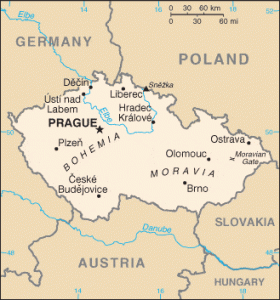
The Czech Road Network
The Czech road network is administered by the ŘSD (Ředitelství silnic a dálnic ČR — Road Directorate of the Czech Republic), a state organisation responsible for construction, maintenance, and management of national motorways and first-class roads. The total road network extends to approximately 55,700 km, of which the national network (silnice I. třídy) comprises approximately 6,200 km. Since EU accession in 2004, substantial EU funding has financed ongoing motorway and expressway expansion.
Motorways (D-prefix — dálnice): The Czech Republic has approximately 1,300 km of motorways. The network fans out from Prague in multiple directions. Key motorways include:
- D1 — Prague–Brno–Ostrava (~380 km): The oldest, most strategically important, and most heavily used motorway in the country, connecting Prague with Brno (the second city and regional capital of Moravia) and continuing northeast to Ostrava near the Polish and Slovak borders. The D1 was originally opened in 1971 and has been continuously widened and upgraded since; sections of it were infamous for poor surface quality and excessive repair works, though a comprehensive resurfacing programme has significantly improved conditions since 2018. Journey time Prague to Brno approximately 2–2.5 hours (200 km); Prague to Ostrava approximately 3.5–4.5 hours (360 km).
- D2 — Brno–Lanžhot (Slovak border) (~61 km): Short but strategically important motorway connecting Brno to the Slovak border at Lanžhot/Brodské; continues as Slovak D2 to Bratislava. Total journey Brno–Bratislava approximately 1.5 hours (130 km).
- D3 — Prague–České Budějovice (~170 km, partially complete): Connects Prague southward through South Bohemia to České Budějovice, with plans to extend to the Austrian border at Dolní Dvořiště. Sections remain under active construction.
- D4 — Prague–Písek (partial, under PPP construction): Southwestern motorway toward Písek; includes a PPP-financed section under construction.
- D5 — Prague–Plzeň–Rozvadov (German border) (~151 km): The primary west-of-Prague motorway; connects to the German A6 at the Rozvadov/Waidhaus border crossing and continues toward Nuremberg. One of the most commercially significant Czech motorways for freight. Journey time Prague to Nuremberg approximately 3.5 hours.
- D6 — Prague–Karlovy Vary–Cheb (German border) (~173 km, partially expressway): Runs northwest from Prague to the Karlovy Vary spa triangle and the German border near Cheb/Eger. Not yet fully motorway standard throughout; some sections remain two-lane expressway.
- D7 — Prague–Chomutov–(German border) (~90 km): Northwestern corridor toward the Ore Mountains (Krušné hory) and the German border near Hora Sv. Šebestiána.
- D8 — Prague–Ústí nad Labem–Petrovice (German border) (~93 km): Northward from Prague to the Elbe valley and German border at Petrovice/Cínovec; connects to the German A17 toward Dresden. Journey time Prague to Dresden approximately 1.5–2 hours. Includes the spectacular Prackovice–Řehlovice viaduct section through the Bohemian Central Highlands.
- D11 — Prague–Hradec Králové–Jaroměř (~115 km, partially complete): Eastward from Prague toward Hradec Králové and the Polish border region; full connection to Jaroměř planned.
- D35 — Olomouc–Mohelnice–Hradec Králové (~200 km, major construction ongoing): A strategic east–west motorway across Moravia and eastern Bohemia, planned to provide a second east–west corridor parallel to but south of the D1; large sections under construction as of 2025.
- D48 — Bělotín–Český Těšín (Polish border) (~60 km): Northeastern corridor from the D1 junction near Bělotín to the Polish border at Chotěbuz/Cieszyn; connects to the Polish A1.
- D49 — Hulín–Starý Hrozenkov (Slovak border) (~60 km, under construction): Connects the D1 near Hulín southeastward to the Slovak border at Starý Hrozenkov/Drietoma; significant sections still under construction.
First-class roads (silnice I. třídy — prefix I/): The national road network below motorway/expressway level comprises first-class roads (numbered I/1, I/2, etc.) which serve as the primary connections between cities not served by motorways. Many are single-carriageway roads passing through towns and villages; quality varies widely. The I/50 (Brno–Uherské Hradiště) and I/35 (Liberec–Hradec Králové–Olomouc) are among the most significant non-motorway national routes. Drivers should anticipate frequent speed limit changes, traffic lights, and pedestrian crossings on first-class roads through built-up areas.
Prague Outer Ring Road (D0 / Pražský okruh): A planned full orbital motorway around Prague approximately 83 km in total circumference. Currently approximately 55 km of the ring is complete and open; the missing southwest section (between Slivenec/D5 and Ruzyně/D7) has been under prolonged planning and environmental assessment. The incomplete ring forces heavy transit traffic through the city, contributing significantly to Prague congestion. When complete, D0 will allow full circumnavigation of Prague without entering the city.
Driving Rules and Legal Requirements
Czech road traffic law is governed by the Road Traffic Act (Zákon o provozu na pozemních komunikacích, Act No. 361/2000 Coll. and amendments). The Czech Republic is a full EU member and applies EU traffic legislation; it is also a Schengen Area member.
Driving licences: EU/EEA driving licences are fully valid in the Czech Republic. UK licences remain valid for visitor use post-Brexit. Non-EU nationals (USA, Canada, Australia, etc.) may drive on their national licence for short stays; for licences in non-Latin script or from countries not party to the 1968 Vienna Convention, an International Driving Permit (IDP) is required alongside the national licence. Non-EU residents staying beyond 185 days must convert their licence to a Czech řidičský průkaz.
Alcohol — absolute zero tolerance: The Czech Republic enforces a 0.00% BAC limit — no alcohol whatsoever is permitted in the driver’s blood. This is among the strictest drink-drive laws in Europe. The prohibition is absolute: even mouthwash, some medications, or fermented food products can theoretically trigger a positive reading, and drivers must be aware of this. Breath testing at police checkpoints is routine. A reading above 0.00% BAC results in a fine, points, and potential licence suspension for a misdemeanour; above 0.10% BAC constitutes a criminal offence with imprisonment and mandatory licence revocation. The rule applies equally to all drivers — residents and visitors alike. There are no exceptions for a “safe” threshold.
Headlights — mandatory at all times: Dipped headlights (or daytime running lights) must be switched on at all times of day throughout the entire year, regardless of weather or time of day. This applies to all vehicles on all roads. Modern vehicles with DRL (daytime running lights) comply automatically; older vehicles must manually use dipped headlights. Failure to comply results in a fine.
Seatbelts: Mandatory for all occupants in all seats. Children under 150 cm or 36 kg must use an appropriate approved child restraint system suitable for their height and weight. Children under 3 years must be in an approved child seat; they may not travel in the front seat unless a rear-facing seat is used with the airbag deactivated. Fine for non-compliance: CZK 2,000–CZK 3,000 per offence.
Mobile phones: Use of handheld mobile phones while driving is strictly prohibited. Fine: CZK 1,500–CZK 2,500. Hands-free devices and dashboard-mounted phone holders are permitted. Enforcement is active, including by unmarked police vehicles.
Winter tyres: Winter tyres are not universally legally mandated in the Czech Republic for all drivers, but Czech law requires that drivers use tyres appropriate to road conditions. Practically, this means that driving on summer tyres in snowy or icy conditions can result in a fine if police determine the tyres were unsuitable. In mountain areas (Krkonoše, Šumava, Jeseníky, Beskydy) winter tyres are effectively essential from November to March. All-season tyres are accepted. Snow chains are permitted and sometimes necessary on mountain passes.
Required safety equipment: All vehicles must carry a reflective warning triangle and a first-aid kit (lékárnička). A high-visibility vest is required for use when exiting the vehicle on a road (mandatory from 2023). A spare tyre or tyre repair kit is required. Fire extinguisher: strongly recommended but not legally mandated for private passenger vehicles. These items are checked at police road stops; missing mandatory items result in fines.
Overtaking and road rules: Overtaking on the right is prohibited except in specific situations (e.g., on multi-lane roads in the same direction when the left lane is slower). The Czech Republic strictly applies the priority to the right (přednost zprava) rule at unmarked junctions. Trams always have priority over other road traffic at junctions and when stopping to let passengers on/off — overtaking a stationary tram at a stop is prohibited when passengers are boarding or alighting unless a raised pavement refuge is present.
Traffic Police (Dopravní policie): Traffic enforcement is conducted by the Policie ČR (Czech Police), specifically the Road Traffic Division. Police vehicles are white with blue reflective stripes. Officers stop vehicles by illuminating blue lights or with a lighted baton. When stopped, pull over safely on the right, switch off the engine, and remain in the vehicle with hands visible. Present your driving licence, vehicle registration (technický průkaz), and insurance document. Officers are generally professional; most have basic English in major corridors. Fixed penalties (pokuta) for minor offences may be paid on the spot or by transfer within 15 days (with a reduction for prompt payment). More serious offences result in proceedings before an administrative authority.
Speed Limits on Czech Roads
Speed limits in the Czech Republic are set by the Road Traffic Act and apply by road category; posted signs always override the defaults. All limits are in km/h.
| Road Type | Cars / Light Vehicles | Vehicles with Trailer | Trucks / Buses |
|---|---|---|---|
| Motorway (dálnice, D-prefix) | 130 km/h | 80 km/h | 90 km/h |
| Expressway (rychlostní silnice, R/D-prefix) | 130 km/h | 80 km/h | 90 km/h |
| Outside built-up area, single carriageway (I/, II/ roads) | 90 km/h | 80 km/h | 80 km/h |
| Urban / built-up area (obec) | 50 km/h | 50 km/h | 50 km/h |
| Residential zone (obytná zóna) | 20 km/h | 20 km/h | 20 km/h |
Night-time urban speed: Unlike some neighbouring countries, the Czech Republic does not have a higher night-time urban speed limit. The standard 50 km/h limit applies at all times within built-up areas. Posted signs may locally reduce limits to 30 km/h or 40 km/h in school zones, pedestrian-heavy areas, or on narrow streets.
Speed enforcement uses fixed cameras (rychlostní radary), mobile police units, and section speed cameras (úsekové měření rychlosti). Section cameras are deployed on multiple sections of the D1 and other national roads. Czech Republic operates a points demerit system (bodový systém): drivers start with 0 points and accumulate up to 12 points; at 12 points, the licence is automatically revoked for 1 year. New drivers in their first year of holding a licence are subject to a 0-point maximum (licence revoked on first serious offence). Speed fines range from CZK 1,500 for minor excess to CZK 10,000+ and mandatory licence suspension for the most severe excess speeds.
Zero-tolerance alcohol penalties summary: Any detectable alcohol (above 0.00% BAC): fine of CZK 2,500–CZK 20,000, 3–7 demerit points, possible licence suspension up to 1 year. Above 0.10% BAC (equivalent to roughly 1 g/L blood): criminal offence under Section 274 of the Czech Criminal Code; imprisonment up to 3 years, ban from driving activity. Repeat offence or accident while intoxicated: up to 8 years imprisonment. Refusal to submit to testing: treated as if over the criminal threshold.
The eZnámka Vignette System
The Czech Republic uses an electronic vignette system called eZnámka (elektronická dálniční známka) for the use of motorways (D) and expressways. Since 1 December 2021, the previous paper windscreen sticker has been entirely replaced by a fully digital system: there is no physical sticker at all. The vignette is registered electronically against your vehicle’s licence plate number and is verified automatically by roadside cameras and police checks.
Who needs a vignette: All vehicles up to 3.5 tonnes gross vehicle weight using motorways or expressways in the Czech Republic must have a valid eZnámka. This includes all passenger cars, motorcycles (over 50cc), campervans under 3.5t, and light vans. Vehicles over 3.5t use the separate MYTO CZ electronic toll system (distance-based, OBU-transponder required). Emergency vehicles, vehicles with disabilities, military vehicles, and certain other categories are exempt.
Vignette validity periods and prices (2025/26 rates in CZK):
| Vignette Type | Validity Period | Price (CZK) | Approx. (EUR) |
|---|---|---|---|
| Annual (roční) | 1 calendar year | CZK 1,500 | ~€60 |
| Monthly (měsíční) | 30 consecutive days | CZK 430 | ~€17 |
| 10-day (desetidenní) | 10 consecutive days | CZK 310 | ~€13 |
| 1-day (jednodenní) | 1 calendar day | CZK 200 | ~€8 |
How to purchase eZnámka: The vignette can be purchased through the following channels:
- Official website: eznámka.cz (also available in English, German, Slovak, and other languages) — the simplest option for advance purchase before entering the Czech Republic. Purchase online, enter your licence plate, and the vignette is registered immediately. No physical receipt or sticker is issued; the system records the registration against your plate.
- Mobile app: eZnámka official app (iOS and Android) — same functionality as the website.
- Petrol stations and post offices: Available at most Czech petrol stations (Shell, OMV, MOL, Benzina/Orlen, EuroOil) and Czech Post (Česká pošta) offices inside the country and at border crossing points.
- Border crossing shops: Available at dedicated vignette sales points at the main border crossings with Germany, Austria, Slovakia, and Poland.
Important: The vignette can be purchased with a start date up to 30 days in advance; it need not start on the day of purchase. You do not need to carry any paper receipt or document in the vehicle — the system is entirely plate-based. However, keeping a digital record (screenshot or email confirmation) is recommended in case of technical disputes. Driving on a motorway or expressway without a valid vignette incurs a fine of CZK 1,500 (if paid on the spot) or CZK 5,000 in administrative proceedings, plus mandatory purchase of the correct vignette. Police verify vignette validity via roadside cameras and plate scanners.
MYTO CZ (for vehicles over 3.5t): Heavy vehicles (trucks, buses, coaches) pay distance-based tolls on motorways, expressways, and selected first-class roads via the MYTO CZ system, operated by CzechToll. Registration and OBU (on-board unit / PREMID transponder) are required. Toll rates for heavy vehicles depend on vehicle category (number of axles) and road type. Non-Czech-registered trucks must register for MYTO CZ before entering Czech motorway/expressway roads.
Fuel, Electric Vehicles, and Charging
Fuel in the Czech Republic is widely available from Benzina (Orlen-owned, the largest domestic chain), Shell, OMV, MOL, EuroOil, Globus (supermarket chain with competitive fuel), and many independent operators. Motorway service areas on D1, D2, D5, and D8 are well-equipped. On secondary roads and in rural mountain areas (Šumava, Krkonoše, Jeseníky), stations can be widely spaced; fill up in larger towns before extended drives into national park areas.
Fuel types: Natural 95 RON (Natural 95) and 98 RON (Natural 98, premium) petrol are standard. Diesel (nafta) in standard and premium grades. LPG (plyn CNG/LPG — autoplyn) is available at a moderate number of stations; CNG (compressed natural gas) is available at some filling points in urban areas. Fuel prices in the Czech Republic are broadly similar to EU average, typically slightly lower than Germany or Austria. Prices are posted visibly and vary between motorway service areas (higher) and supermarket forecourts (lower).
Electric vehicles (EV): The Czech EV charging network is growing rapidly from a moderate base. ČEZ Distribuce (the dominant electricity distribution company) operates the ČEZ DRIVE charging network, one of the largest in the country, with AC and DC chargers at supermarkets, car parks, and petrol stations across the Czech Republic. PRE (Prague Energy) operates charging points in Prague and surroundings. Tesla Superchargers are present in Prague, Brno, Ostrava, Plzeň, and along the D1, D5, and D8 motorway corridors. CCS Combo 2 is the standard for DC fast charging; AC Type 2 for slow/overnight. The IONITY network has chargers at D1 and D8 service areas. CHAdeMO chargers are available but decreasing as CCS becomes dominant. For EV drivers, the D1 Prague–Brno–Ostrava corridor and D5 Prague–German border are well-covered; mountain areas and the eastern Slovak-border corridor have sparser infrastructure but are improving.
Driving in Prague, Brno, and Ostrava
Prague (Praha)
Prague, capital of the Czech Republic and one of Europe’s most visited cities (approximately 8 million tourists annually), has a population of approximately 1.35 million within the city limits (2.7 million in the metropolitan area). Driving in Prague’s historic core is strongly discouraged for visitors; the city is far more effectively explored on foot and by public transport. Prague’s Metro (3 lines: A green, B yellow, C red) covers the city extensively; the tram network (one of the most extensive in Europe with over 140 km of track) reaches virtually every neighbourhood. Prague International Airport (Václav Havel Airport, VHK) is served by Metro line A.
The central historic area — including the Staré Město (Old Town), Malá Strana (Lesser Town), and Hradčany (Prague Castle district) — has significant traffic restrictions. Many streets are pedestrianised or access-restricted. The Charles Bridge (Karlův most) is closed to vehicles entirely. The main problem for car drivers is parking: central Prague’s paid parking zones operate under a resident priority system, and on-street parking for non-residents during working hours is extremely limited and expensive. Underground car parks near the historic centre (e.g., Palác Archa, OC Palladium, Na Příkopě area) fill quickly and charge premium rates.
The incomplete D0 ring road means significant transit and long-distance freight traffic is funnelled through Prague’s radial roads, particularly on the northern and southwestern sides of the city. For travellers passing through Prague rather than stopping, the D0 partial ring road (complete sections from D1/Chodov in the southeast to D8/Ústí direction in the north) allows circumnavigation of the eastern half of Prague. Drivers approaching Prague from the D5 (west/Germany direction) and needing to reach D8 (north/Dresden) must currently pass partially through the city until the southwestern D0 section is completed.
Brno
Brno, the second city of the Czech Republic (population ~400,000 city, ~900,000 metro area), is the capital of the South Moravian Region and a major industrial, commercial, and university city. Brno is served by the D1 from the northwest (Prague), D2 to the southeast (Slovak border), and the planned D43 and D49 corridors under development. The city ring road (Velký městský okruh) is partially complete. Brno has a tram and trolleybus network; driving in the city centre is significantly easier than Prague, though parking in the centrum area near náměstí Svobody is limited. The Brno International Trade Fair (Brněnské veletrhy) — one of the largest exhibition centres in Central Europe — significantly increases traffic during major trade fair periods.
Ostrava
Ostrava (population ~280,000 city, ~700,000 metro area), the capital of the Moravian-Silesian Region in northeastern Czech Republic, is a post-industrial city with a proud steel and mining heritage, undergoing significant regeneration since the 1990s. The city is located at the junction of the D1 (from Prague/Brno), D48 (toward Polish border at Cieszyn), and D56 (toward Frýdek-Místek). Ostrava is relatively easy to navigate by car compared to Prague, with a well-developed road network serving the urban area. The historic centre (centrum) around Masarykovo náměstí is partially pedestrianised. Ostrava–Mošnov Airport serves the region.
Long-Distance Routes and Scenic Drives
Prague – Brno (~200 km via D1): The D1 is the main Prague–Brno motorway route; journey time approximately 2–2.5 hours. This is the most travelled motorway section in the Czech Republic and regularly experiences congestion at weekends, on Czech public holidays, and during D1 repair works (which have been extensive). Travellers should check road condition reports from ŘSD before departure. The alternative via the I/2 national road is slower (approximately 3.5 hours) but passes through attractive Central Bohemian and Moravian landscapes.
Prague – Dresden (~150 km via D8): The D8 provides the fastest route northward from Prague to the German border at Petrovice/Cínovec, connecting to the German A17 toward Dresden. Journey time Prague–Dresden approximately 1.5–2 hours. The D8 cuts through the Bohemian Central Highlands (České středohoří) — a protected landscape of ancient volcanic hills and the Elbe Valley — via an impressive viaduct structure and a 6.5 km tunnel (Trmice tunnel), making this one of the most scenically striking motorway sections in Central Europe.
Prague – Nuremberg (~350 km via D5): The D5 connects Prague with the German border at Rozvadov/Waidhaus, continuing via the German A6 to Nuremberg. Total journey approximately 3–3.5 hours. This is a major freight and passenger corridor between the Czech Republic and Bavaria/southern Germany.
Bohemian Switzerland National Park / Hřensko (near D8): Just south of the German border on the D8 corridor, a short detour leads to the Bohemian Switzerland National Park (Národní park České Švýcarsko), an area of dramatic sandstone rock formations and the spectacular Pravčická brána — the largest natural sandstone arch in Europe. Roads into the park from Hřensko are narrow and winding; the village of Hřensko at the Elbe gorge is extremely popular in summer, causing severe parking and access congestion on peak days. Arrive early or use shuttle services.
Krkonoše (Giant Mountains) — skiing and hiking: The Krkonoše (Krkonoše in Czech, Riesengebirge in German, Karkonosze in Polish) is the highest mountain range in the Czech Republic, straddling the border with Poland. The highest peak, Sněžka (1,603 m), is accessible by cable car from Pec pod Sněžkou. Road access from Prague is via D11 (toward Hradec Králové) then regional roads to Vrchlabí, Janské Lázně, or Pec pod Sněžkou — approximately 160 km from Prague. Mountain roads are winding and narrow; in winter (November–March) conditions can be severe, and winter tyres are essential.
Šumava National Park and the Bohemian Forest: The Šumava (Bohemian Forest) — on the southwestern border with Bavaria and Austria — is the largest national park in the Czech Republic, covering 680 km² of forested mountains, peat bogs, and glacial lakes. Road access from Prague is via D4 (partial) or D3 (under construction) toward České Budějovice, then southwest regional roads. Within the park, speed limits are reduced and some roads are closed to private vehicles to protect the wilderness. The Lipno reservoir is a popular summer water sports destination accessible by road.
Moravian Wine Region (southern Moravia): The Moravian wine country around Mikulov, Valtice, Lednice, Pálava, and Znojmo in southern Moravia is one of the Czech Republic’s most rewarding driving destinations. The scenic Wine Road (Moravská vinná stezka) connects dozens of wine villages and cellars. Road access from Brno is via D2 to Podivín/Mikulov junction — approximately 60–80 km from Brno. The Lednice–Valtice Cultural Landscape (UNESCO World Heritage Site) features a grand ensemble of castle parks, chalets, and garden structures linked by country roads ideal for leisurely driving.
Border Crossings with Neighbouring Countries
The Czech Republic shares borders with four countries: Germany (northwest and west), Austria (south), Slovakia (east), and Poland (northeast and north). All four neighbours are Schengen Area members; there are no passport or customs controls at any Czech land border for EU/Schengen citizens — you simply drive across. Physical border points still exist and may be activated during security or health operations. Non-Schengen visitors must comply with Schengen entry rules and carry their passport.
- Rozvadov / Waidhaus — Germany (D5 / A6): The primary motorway crossing on the D5 corridor; connects Prague/Plzeň with Nuremberg and southern Germany. Highest-volume passenger vehicle crossing on the Czech–German border. Open 24 hours.
- Petrovice (Cínovec) / Zinnwald — Germany (D8 / A17): Motorway crossing on the D8 corridor; connects Prague with Dresden and eastern Germany. Mountain crossing through the Ore Mountains (Krušné hory / Erzgebirge); subject to winter weather closures in severe conditions. Open 24 hours.
- Hora Sv. Šebestiána / Reitzenhain — Germany (I/7 / B174): Secondary crossing in the Ore Mountains; used for regional traffic and transit between western Bohemia and Saxon Erzgebirge. Not a motorway crossing.
- Pomezí nad Ohří / Schirnding — Germany (I/6 area): Secondary western Bohemian crossing near Cheb and the D6 corridor; connects Karlovy Vary / Cheb with Weiden/Bavaria.
- Dolní Dvořiště / Wullowitz — Austria (I/3 / B310): Primary road crossing in southern Bohemia on the planned D3 corridor; connects České Budějovice with Linz (Austria). Road standard is national road; D3 completion will upgrade this corridor to motorway standard.
- Hatě / Kleinhaugsdorf — Austria (I/2 / B303): The main crossing for southern Moravia and the Znojmo wine region; connects to the Austrian A5 motorway near Hollabrunn–Vienna. National road crossing; not motorway standard on the Czech side.
- Mikulov / Drasenhofen — Austria (I/40 / B7): Secondary southern crossing near Mikulov; connects the South Moravian wine region with the Weinviertel in Austria.
- Lanžhot / Brodské — Slovakia (D2 / D2): The main motorway crossing between the Czech Republic and Slovakia; connects Brno directly to Bratislava via the D2 on both sides. High-volume crossing; the Bratislava–Prague corridor is one of the most-used in Central Europe. Open 24 hours.
- Starý Hrozenkov / Drietoma — Slovakia (D49 planned / Slovak road): Southeastern Moravian crossing near Uherské Hradiště; the D49 under construction will eventually provide motorway-standard access. Currently national road.
- Gorzyczki / Bohumín — Poland (D1 / A1): The primary motorway crossing between the Czech Republic and Poland; connects Ostrava (Czech D1) with Katowice (Polish A1). Major freight corridor between the two countries. Open 24 hours.
- Chotěbuz / Cieszyn — Poland (D48 / A1 approach): Secondary crossing near Český Těšín and Cieszyn; connects the Czech D48 with the Polish road toward Cieszyn and A1. Popular crossing for cross-border commuters in the Cieszyn Silesia region.
- Náchod / Kudowa-Zdrój — Poland (I/33 / DK8): Road crossing in northeastern Bohemia (Hradec Králové region); connects Náchod with the Kłodzko Valley (Lower Silesia) in Poland. National road crossing; used by tourists visiting the Adršpach–Teplice Rocks and Krkonoše.
Road Safety and Emergency Procedures
The Czech Republic has made significant road safety improvements since EU accession. Annual road fatalities fell from over 1,400 in 2000 to approximately 480–560 in recent years — a 60%+ reduction — driven by motorway investment, stricter enforcement of the zero-BAC rule, and improved vehicle safety standards. Despite this progress, the Czech Republic’s fatality rate per billion vehicle-km remains above the EU average, largely due to accident risk on rural single-carriageway first-class roads and the legacy D1 motorway before its resurfacing.
Key risk factors: Speeding on regional and national roads; driving behaviour on the D1 (historically poor road surface, heavy traffic, lane-changing freight vehicles); seasonal hazards on mountain roads (Krkonoše, Šumava, Jeseníky in winter); and — despite the zero-BAC rule — alcohol-related incidents, particularly in rural areas on weekend evenings. Pedestrians on unmarked rural roads at night pose a risk on regional roads in agricultural areas.
Breakdown on a motorway: Move immediately to the hard shoulder; switch on hazard lights; exit via the passenger-side door wearing your high-visibility vest. Deploy the warning triangle at minimum 100 m behind the vehicle on motorways. Call 112 (EU emergency) or 1240 (ŘSD motorway information). Emergency SOS phones are installed at approximately 2 km intervals on Czech motorways. Road breakdown assistance is available from automotive clubs ÚAMK (Ústřední automotoklub ČR) at 1230, ARBO at 261 261 261, and ADAC/ÖAMTC reciprocal assistance for members of affiliated clubs.
Accident procedure: Call 112 for injuries; police (158) for all accidents involving personal injury. Completion of the European Accident Statement form is required; both parties sign. Photograph the scene thoroughly before moving vehicles. Police attendance is legally required if there is personal injury, disputed fault, or if total damage exceeds CZK 100,000 (approximately €4,000). For rental vehicles, call the rental company’s 24-hour emergency line immediately.
Emergency contacts: 112 (unified EU emergency — police/ambulance/fire), 158 (Czech Police — Policie ČR), 155 (Ambulance — Záchranná zdravotnická služba), 150 (Fire Brigade — Hasičský záchranný sbor), 156 (Municipal Police — Městská policie), 1230 (ÚAMK roadside assistance). All 112 calls are answered in Czech; English-speaking operators available on 112 for international calls.
FAQ: Driving in Czech Republic
Q: Do I need a vignette (eZnámka) to drive in Czech Republic?
A: Yes, if you intend to use any motorway (D-road) or expressway (R/D-road). The electronic vignette (eZnámka) is registered against your licence plate — there is no physical sticker. Purchase it in advance at eznámka.cz or at a Czech petrol station or border shop. Options are: annual (CZK 1,500), 30-day (CZK 430), 10-day (CZK 310), or 1-day (CZK 200). If you only use national and regional roads (I/, II/, III/ class), no vignette is required. Driving on motorways without a valid eZnámka results in a fine of CZK 1,500–CZK 5,000.
Q: What is the drink-drive limit in Czech Republic?
A: The Czech Republic enforces an absolute zero-tolerance alcohol limit of 0.00% BAC. No alcohol whatsoever is legally permitted in the driver’s blood. This is one of the strictest drink-drive rules in the entire EU. Any detectable amount of alcohol results in a fine and demerit points; above 0.10% BAC is a criminal offence with potential imprisonment. For practical purposes: do not drink any alcohol if you will be driving, even the previous evening — ensure sufficient time for alcohol to clear your system.
Q: Do headlights need to be on during the day in Czech Republic?
A: Yes. Czech law requires dipped headlights (or daytime running lights) to be switched on at all times of day, year-round, on all roads. This applies regardless of weather conditions, time of day, or season. Vehicles with automatic daytime running lights comply automatically; older vehicles without DRL must use dipped headlights manually at all times.
Q: What currency is used in Czech Republic — can I pay in euros?
A: The Czech Republic uses the Czech Koruna (CZK / Kč). The country is an EU member but has not adopted the euro and there is currently no firm timeline for adoption. Euro banknotes are accepted at some tourist-oriented businesses, petrol stations near borders, and major hotels, but you will typically receive change in CZK. ATMs (bankomaty) are widely available in cities, petrol stations, and motorway service areas. Credit and debit cards are widely accepted, including contactless payment.
Q: What safety equipment must I carry in Czech Republic?
A: Czech law requires all vehicles to carry: a reflective warning triangle; a first-aid kit (lékárnička); and a high-visibility vest (mandatory from 2023 when exiting the vehicle on a road). A spare tyre or tyre repair kit is also required. Fire extinguisher: not legally mandatory for private cars but recommended. These items are checked at police stops; missing mandatory equipment results in a fine.
Q: Is the D1 motorway still affected by roadworks?
A: The D1 — Prague to Brno and Ostrava — underwent a major multi-year resurfacing and widening programme that has significantly improved conditions compared to the notoriously poor surfaces of the 2010s. As of early 2026, the D1 surface quality is substantially better, though some sections may still have temporary speed restrictions for maintenance. Check the ŘSD real-time road information portal (dopravniinfo.cz) before departure for current roadwork locations and speed restrictions on any motorway.
Q: Are winter tyres required in Czech Republic?
A: Winter tyres are not universally legally mandated for all conditions, but Czech law requires tyres appropriate to road conditions — meaning that driving on summer tyres in snow or ice can result in a fine. In practice, all-season or winter tyres are essential from November to March in mountain regions (Krkonoše, Šumava, Jeseníky, Beskydy). On motorways and expressways, ŘSD applies pre-emptive measures (gritting, ploughing) to keep roads clear, but conditions can change rapidly. Many Czech drivers fit winter tyres from October; visitors renting cars should confirm tyre type with the rental company.
Q: Is there a low emission zone in Prague?
A: As of early 2026, Prague does not operate a mandatory low emission zone (LEZ) restricting older or more polluting vehicles from the city centre, though such a scheme has been under political discussion. Certain streets in the historic core are closed to private vehicle traffic regardless. Check the Prague City Hall (Magistrát hlavního města Prahy) website for any updates before driving in Prague. The city is far better navigated by Metro, tram, and on foot for sightseeing purposes.
Sources and Update Note
This guide was compiled from the following primary sources: Czech Road Traffic Act (Zákon č. 361/2000 Sb. and amendments); ŘSD (Road Directorate of the Czech Republic) official road network data and motorway documentation; eZnámka official documentation (eznámka.cz); CzechToll MYTO CZ official documentation; Czech Police (Policie ČR) traffic enforcement guidelines; CDV (Transport Research Centre) road safety statistics; BESIP (Road Safety Department, Ministry of Transport) official data; CIA World Factbook — Czech Republic; Wikipedia — Transport in the Czech Republic, Czech motorways, D1 motorway; OpenStreetMap Czech Republic. Speed limits, vignette prices, toll rates, and traffic regulations are correct as of early 2026 and are subject to change; vignette prices in particular are set annually by the Czech Ministry of Transport. Always verify current vignette prices and regulations at eznámka.cz and current road conditions at dopravniinfo.cz. This page will be updated as regulations change.