
Driving Directions and Google Map of Greece — Roads, Routes & Navigation Guide
Greece — officially the Hellenic Republic (Ελληνική Δημοκρατία) — is a southeastern European country occupying the southernmost tip of the Balkan Peninsula, together with thousands of islands scattered across the Aegean and Ionian seas. With a mainland area of approximately 131,957 km² and a population of around 10.4 million, Greece is a geographically diverse and historically extraordinary country. Its dramatic landscape — mountains, peninsulas, valleys, and island archipelagos — directly shapes how its road network has been built and how driving here differs from the rest of continental Europe.
Greece drives on the right-hand side of the road with left-hand drive vehicles, consistent with all other EU mainland countries. Speed limits are enforced in kilometres per hour. The motorway network uses the A prefix (from the Greek Αυτοκινητόδρομος), and Greece’s major motorways — built or modernised largely since 2000 with EU cohesion funds — are generally of a high standard. The country’s unique geography, however, means that island driving, mountain passes, and rural national roads present conditions very different from motorway travel. Greece has one of the highest road fatality rates in the EU; driving defensively and respecting speed limits and traffic laws is essential.
The drink-drive limit is 0.05% BAC for most drivers, with a stricter 0.02% BAC for new licence holders (within the first two years) and professional drivers. The unified EU emergency number is 112; the dedicated Greek police number is 100 and ambulance is 166. Traffic law is enforced by the ELAS (Hellenic Police, Ελληνική Αστυνομία). Use the route planner on our homepage to plan your driving routes across Greece and its islands.
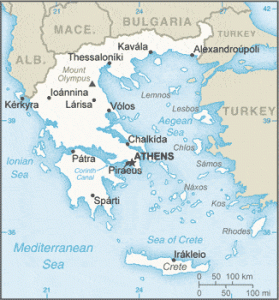
The Greek Road Network
Greece’s road network is managed and developed by the Ministry of Infrastructure and Transport (Υπουργείο Υποδομών και Μεταφορών, YPODOME) and various concession companies that operate the major motorways under public-private partnership agreements. The total classified road network extends to approximately 117,000 km, of which the national network (Εθνικό Οδικό Δίκτυο) comprises around 10,900 km.
Greece’s modern motorway network was largely built between 2000 and 2015, funded substantially by EU Cohesion Funds and the ESPA (National Strategic Reference Framework) structural programmes. The result is a set of high-quality, dual-carriageway motorways connecting the major population centres and border crossings, overlaid on an older national road system that in many rural areas remains narrow, winding, and poorly maintained.
Motorways (A-prefix — Αυτοκινητόδρομοι): Greece has approximately 2,300 km of motorways. Key routes include:
- A1 — Motorway of Athens–Thessaloniki–Evzonoi (~503 km): Greece’s most important motorway, linking Athens with Thessaloniki and continuing to the Evzonoi border crossing with North Macedonia. The Athens–Thessaloniki section is one of the busiest road corridors in the Balkans. Journey time Athens to Thessaloniki is approximately 4.5–5.5 hours. The motorway passes through Larissa, Lamia, and Katerini.
- A2 — Egnatia Odos (~670 km, with branches): One of Europe’s great motorway projects; runs east–west across northern Greece from Igoumenitsa on the Ionian coast to Kipoi/Kakavia on the border with Türkiye and Albania respectively. Connects Igoumenitsa, Ioannina, Kozani, Thessaloniki, Kavala, Xanthi, Komotini, and Alexandroupoli. Financed with major EU support; opened progressively 1997–2009. The Egnatia Odos is the primary transport spine of northern Greece and links the Adriatic/Ionian ferry ports (Igoumenitsa, Patras) with the Turkish border.
- A6 — Attiki Odos (~70 km ring road): Athens’ orbital motorway, connecting the city’s suburbs and satellite towns with the Athens International Airport (Eleftherios Venizelos) and the national motorway network. Often heavily congested during peak hours; electronic tolling throughout.
- A7 — Olympia Odos (Athens–Corinth–Patras, ~220 km): The primary west-of-Athens motorway corridor, connecting the capital to Corinth, Patras (the main ferry port to Italy and Igoumenitsa), and the Peloponnese. A new, modern motorway largely rebuilt post-2010. Journey time Athens to Patras is approximately 2.5–3 hours.
- A8 — Moreas Motorway (Corinth–Kalamata, ~245 km): Runs south through the Peloponnese from Corinth to Kalamata (Tripoli junction). Connects Athens with the central and southern Peloponnese. Partially completed; some sections still under construction or national road standard.
- A29 — Ionia Odos (Antirrio–Ioannina, ~196 km): Connects the Rio–Antirrio suspension bridge (spanning the Gulf of Corinth) northward through Aitolia-Akarnania to Ioannina, connecting the western mainland to the Egnatia Odos.
National Roads (EO — Εθνικές Οδοί): Below the motorway tier, the national road network comprises numbered highways (EO1, EO2, etc.) that serve as the primary routes through regions not served by motorways. Many EO roads are single carriageway, pass through towns and villages, and have mixed traffic including agricultural vehicles, motorcycles, and pedestrians in rural areas. Road condition varies enormously; some EO roads in the Peloponnese, Epirus mountains, and northern Greece are excellent, while others in remote mountain areas are narrow and potholed.
The Rio–Antirrio Bridge (Γέφυρα Ρίου–Αντιρρίου): A engineering landmark and critical transport link, this cable-stayed bridge spans 2.38 km across the Gulf of Corinth, connecting the Peloponnese (Rio, near Patras) to mainland western Greece (Antirrio). Opened in 2004 for the Athens Olympics. Before its construction, the only crossing was by ferry. The bridge carries the A29 Ionia Odos and is tolled. It has dramatically reduced journey times between the Peloponnese and western mainland Greece.
Corinth Canal: The 6.3 km Corinth Canal (opened 1893) bisects the Isthmus of Corinth, separating the Peloponnese from mainland Greece. Road and rail bridges cross the canal; the bridges at Isthmia are on the A7/EO8. The canal is a tourist attraction and a key nautical shortcut but has limited commercial shipping capacity due to its narrow 24.6 m width.
Driving Rules and Legal Requirements
Greece’s road traffic code is the Highway Code (Κώδικας Οδικής Κυκλοφορίας, KOK), enacted by Law 2696/1999 and subsequently amended. Greece is a full EU member state and applies EU traffic legislation; it is also a member of the Schengen Area.
Driving licences: EU/EEA driving licences are fully valid in Greece without restriction for visitors and residents. Non-EU nationals (USA, UK, Canada, Australia, etc.) may drive in Greece on their national licence for visits, provided the licence is valid; for stays exceeding 185 days or for non-Latin script licences, an International Driving Permit (IDP — 1968 Vienna Convention) is required alongside the national licence. UK driving licences remain valid in Greece for visitor use post-Brexit. Rental car drivers should carry the rental agreement.
Insurance: Minimum third-party liability insurance is mandatory. EU-registered vehicles carry automatic third-party coverage across EU member states; carrying the Green Card (International Motor Insurance Certificate) is strongly recommended as proof. Non-EU vehicles must carry a valid Green Card covering Greece.
Seatbelts: Mandatory for all occupants front and rear. Children under 135 cm or 12 years old must use an appropriate child restraint; children under 3 must use a rear-facing child seat in the rear. Violation carries a fine of €350 per unbelted passenger.
Mobile phones: Use of handheld mobile phones while driving is prohibited. Fine: €100. Hands-free devices are permitted. Greece has increased enforcement of phone use in recent years.
Headlights: Dipped headlights (or daytime running lights) are mandatory at all times outside urban areas throughout the year — not only at night or in poor visibility, but even in daylight on open roads. This is a significant rule difference from some other EU countries; it is actively enforced. Within urban areas, headlights are required from sunset to sunrise and during poor visibility.
Alcohol: The general limit is 0.05% BAC. A 0.02% BAC limit applies to: drivers within the first two years of obtaining their licence, professional drivers, motorcyclists, and drivers of heavy vehicles. Above 0.08% BAC constitutes a criminal offence. Penalties range from fines and licence suspension to imprisonment for the highest categories. Roadside breath testing is commonly conducted at checkpoints, especially on holiday weekends and at night.
Drugs: Drug-impaired driving is illegal; roadside testing is conducted. Zero tolerance applies to controlled substances including cannabis, cocaine, amphetamines, and opiates.
Required equipment: All vehicles must carry a reflective warning triangle, a high-visibility vest (to be worn when exiting the vehicle on a road), and a fire extinguisher. A first-aid kit is strongly recommended and required for professional transport vehicles. These are checked at police roadside stops.
Overtaking and lane discipline: Overtaking on the right is prohibited except in specifically designated situations. On single-carriageway national roads, it is common practice — though illegal and dangerous — for drivers to use the hard shoulder to allow faster vehicles to pass. Visitors should not adopt this practice. Priority on roundabouts follows the give-way-to-traffic-on-the-roundabout rule (same as most EU states).
Traffic Police (ELAS): Traffic enforcement is conducted by the Hellenic Police (Ελληνική Αστυνομία — ELAS). The Traffic Department (Τμήμα Τροχαίας) patrols national roads and motorways. Fines for traffic violations are payable at a bank or online within a specified period; a discount of 50% applies if paid within 10 days. Non-residents may be required to pay on the spot or provide a guarantee. Points are deducted from the licence under a demerit system (KOK).
Speed Limits on Greek Roads
Speed limits in Greece are set by the Highway Code (KOK) and apply by default by road category; posted signs always override defaults. All limits are in km/h.
| Road Type | Cars / Light Vehicles | Motorcycles | Trucks / Buses |
|---|---|---|---|
| Motorway (Αυτοκινητόδρομος, A-prefix) | 130 km/h | 130 km/h | 90 km/h |
| National road outside built-up area (EO) | 90 km/h | 80 km/h | 80 km/h |
| Urban / built-up area (κατοικημένη περιοχή) | 50 km/h | 50 km/h | 50 km/h |
| Residential and 30 km/h zones | 30 km/h | 30 km/h | 30 km/h |
Reduced limits for new drivers: Drivers within the first two years of holding their first licence are restricted to 90 km/h on motorways (instead of 130 km/h) and must not exceed the national road limit of 90 km/h. Their BAC limit is also reduced to 0.02%.
Speed enforcement in Greece uses fixed cameras (ραντάρ), mobile units operated by ELAS, and section speed control on some motorway sections. Fixed cameras must be signposted in advance. Fines for speeding are graduated: from €80 for minor excess (1–20 km/h over limit) to €700 and immediate licence suspension for the most severe category (40+ km/h over motorway limit). Repeat offences within two years result in licence suspension. Speed limits in summer on some popular tourist island roads may be locally reduced below the standard national road limit.
Drink-drive penalties: At 0.05–0.079% BAC: fine of €200–€700 and licence suspension. At 0.08–0.109%: criminal offence, up to 2 months imprisonment, fine up to €700, licence suspension 1–3 months. Above 0.11%: more severe criminal penalties apply. ELAS conducts frequent breathalyser checkpoints on main arterial roads, particularly on Friday and Saturday nights, and during Easter and summer holidays.
Motorway Tolls and the e-pass System
Most of Greece’s motorways are tolled. Unlike Portugal’s fully barrier-free system, Greek tolls are collected primarily at manned toll plazas (διόδια) with cash lanes, credit/debit card lanes, and — increasingly — electronic-only lanes. At all major toll plazas, you can pay by cash (euro coins and notes accepted), credit/debit card, or electronic transponder.
e-pass (electronic toll transponder): The Greek electronic toll transponder system is called e-pass (or e-telos in some concession documentation). An e-pass transponder is attached to the vehicle windscreen and communicates with antennas at dedicated e-pass lanes at toll booths and, on some sections, at open-road gantries. The e-pass typically offers a small discount on toll rates. Transponders can be obtained from toll concession offices, motorway service areas, and some petrol stations.
Toll concession companies: Greek motorways are operated by several concession companies: Egnatia Odos S.A. (A2/Egnatia Odos), Nea Odos S.A. (portions of A1 and A29), Olympia Odos S.A. (A7), Moreas S.A. (A8), and Attiki Odos S.A. (A6 — Athens ring road). Each company operates its own toll tariffs and e-pass system, though the transponders are typically interoperable across the national network.
Attiki Odos (A6 — Athens ring road): Operates a fully electronic tolling system; all toll collection points are electronic, and while cash lanes exist at some, most passages require a card or e-pass. Tolls on the Attiki Odos range from approximately €1.40 to €3.30 per section depending on entry/exit points. The Attiki Odos passes Athens International Airport — the toll for airport access from the motorway is approximately €3.20.
Indicative toll costs on major Greek routes (2025/26 rates in euros, subject to annual revision):
| Route / Section | Road | Approx. Toll (car) |
|---|---|---|
| Athens → Thessaloniki (full A1) | A1 | €22–€28 |
| Athens → Patras (A7 Olympia Odos) | A7 | €14–€18 |
| Igoumenitsa → Thessaloniki (Egnatia) | A2 | €18–€24 |
| Rio–Antirrio Bridge (each direction) | A29 | €13.60 |
| Athens ring road section (Attiki Odos) | A6 | €1.40–€3.30 |
| Corinth → Kalamata (Moreas) | A8 | €8–€12 |
Toll rates are reviewed periodically by the concession agreements and Ministry of Infrastructure. Verify current tariffs at the respective concession company websites before travel. Note that the Rio–Antirrio Bridge toll of approximately €13.60 (car, single direction) is one of the highest per-km bridge tolls in Europe — factor this into your Peloponnese travel budget.
Fuel, Electric Vehicles, and Charging
Fuel in Greece is available at BP, Shell, Eko (formerly Hellenic Petroleum), Avin, Revoil, Cyclon, and many independent operators. Motorway service areas are generally well-equipped, though service areas on some rural sections of the Egnatia Odos (A2) in less-populated northern regions can be widely spaced. In urban areas, petrol stations are abundant. On islands, fuel stations are present in major towns but may be absent or limited in remote areas; fill up before heading to remote island villages or mountain areas.
Fuel types: Unleaded 95 RON (αμόλυβδη βενζίνη 95) and 98/100 RON (premium unleaded) are standard. Diesel (πετρέλαιο κίνησης) is widely available in standard and premium grades. LPG (υγραέριο — autogas) is available at a limited number of stations. Fuel prices in Greece are among the higher in the EU due to excise duties and island distribution costs; island fuel (especially on smaller islands) is significantly more expensive than mainland prices due to transport surcharges.
Electric vehicles (EV): Greece is in the earlier stages of EV charging infrastructure development compared to Western Europe, but the network is expanding. Public charging in Athens and Thessaloniki is growing, with Type 2 AC and CCS DC chargers at supermarkets, car parks, and petrol stations. Major motorway service areas on the A1, A7, and A2 (Egnatia) are being progressively equipped with fast DC chargers. Tesla Superchargers are present in Athens, Thessaloniki, Larissa, and at major tourist centres in Crete (Heraklion). On islands, EV charging infrastructure is limited primarily to the main ports and resort towns (Mykonos, Santorini, Rhodes, Corfu, Crete major towns). For island EV travel, plan charging around port locations and verify charging availability before departure. The PlugSurfing, Charge4Europe, and IONITY networks are present in Greece. CHAdeMO and CCS are both supported; CHAdeMO is being phased out as CCS becomes dominant.
Driving in Athens, Thessaloniki, and Crete
Athens (Αθήνα)
Athens is a large, densely populated city of approximately 3.7 million in the Greater Athens area. Traffic congestion in Athens is notorious — the city has one of the highest vehicle ownership rates in the EU relative to its road space, and the topography of the Attica basin, surrounded by mountains on three sides, concentrates all traffic into a relatively constrained network. The Attiki Odos ring road (A6) provides the best circumnavigation of the city, but even this can experience significant queuing during morning and evening peak hours.
Low emission / odd-even restrictions: Athens’ central city (δακτύλιος — literally “ring”) operates a traffic restriction zone based on number plates: on weekdays during peak hours (typically 07:00–20:00), vehicles with odd-numbered plates may only enter on odd calendar days, and even-numbered plates on even days. This system is strictly enforced. Rental cars are often registered with plates that comply on all days; check with your rental company. Exceptions apply to Euro 6 diesel and Euro 5/6 petrol vehicles under certain conditions.
Parking in central Athens is extremely limited. Official car parks exist near Syntagma, Monastiraki, and Omonia squares. The Athens Metro (3 lines) and expanded tram network provide excellent alternatives to driving for central city sightseeing. The Metro connects Athens International Airport (Eleftherios Venizelos) to the city centre in approximately 40 minutes. For visitors, the strongest recommendation is to park at a hotel on the edge of the old city and use public transport.
Thessaloniki (Θεσσαλονίκη)
Greece’s second city (metropolitan population ~1.1 million) sits on the Thermaic Gulf in northern Macedonia. The city is more compact and easier to navigate by car than Athens, though central Thessaloniki is congested during peak hours. The A1 (Motorway of Athens–Thessaloniki) enters the city via the Thessaloniki ring road; the city itself is served by the PATHE corridor (Patras–Athens–Thessaloniki–Evzonoi). The Egnatia Odos (A2) junction is near the western outskirts of the city. Thessaloniki’s port (ΟΛΘ — Thessaloniki Port Authority) is Greece’s largest container port and important for northern Greek freight logistics. The city’s Metro (opened progressively from 2023) is reducing surface congestion. Parking in the centre uses a blue zone paid system.
Crete (Κρήτη)
Crete, Greece’s largest island (8,336 km², ~650,000 inhabitants), is almost entirely self-contained for road travel, as it is not connected to the mainland by bridge. The island’s main road spine is the VOAK (Βόρειος Άξονας Κρήτης — Northern Axis of Crete), a fast dual carriageway running east–west along the northern coast from Kissamos (near Chania) to Sitia. In major sections the VOAK is motorway-equivalent standard; in others it remains a fast national road. Journey time Heraklion to Chania is approximately 2–2.5 hours (148 km).
South of the VOAK, the road network is mountainous and narrow, passing through the White Mountains (Lefka Ori), the Psiloritis massif, and the Dikti mountains. Mountain roads can be steep, narrow, and winding, with sheer drops and limited barriers in places. Rental car companies may restrict which vehicles can be taken on certain unpaved tracks to remote beaches and gorges (e.g., the road to Elafonisi, some tracks to the Samaria Gorge area). Verify your rental agreement coverage before taking vehicles off paved roads. In summer (July–August), mountain road traffic to popular gorges and beaches can be very heavy; start early.
Island Driving and Ferry Travel
Greece comprises approximately 6,000 islands (of which around 200 are inhabited), making ferry travel an essential part of long-distance movement within the country. Taking your car — or renting one on the island — is the standard approach for island exploration, as public transport on most islands is limited.
Ferries: Greece has an extensive domestic ferry network operated by companies including Blue Star Ferries, ANEK Lines, Minoan Lines, Hellenic Seaways, Seajet, and Golden Star Ferries, among others. The main port hubs are Piraeus (Athens, serving the Cyclades, Dodecanese, Crete, and Eastern Aegean), Rafina (northeast of Athens; closer for Evia and the central Cyclades), and Igoumenitsa (northwest mainland; for Corfu and international routes to Italy). International ferry routes to Italy (Ancona, Bari, Brindisi, Venice) depart from Patras and Igoumenitsa.
Bringing your car on a ferry: Most domestic Greek ferries accommodate vehicles. Vehicle spaces must be booked in advance, particularly in July and August, as demand greatly exceeds supply on popular routes (Piraeus–Mykonos, Piraeus–Santorini, Piraeus–Crete). Booking via the ferry company’s website or via ferries.gr or openseas.gr is recommended well in advance for summer travel. Vehicle dimensions (length, height) must be specified at booking. Drive-on/drive-off (RORO) loading is standard on large ferries; on small island hydrofoils and high-speed ferries, vehicles cannot be carried.
Island road conditions: Road quality on Greek islands varies dramatically. The Dodecanese major islands (Rhodes, Kos) have reasonable road networks. The Cyclades (Mykonos, Santorini, Naxos, Paros) have adequate main roads but many minor roads are narrow, winding, and poorly surfaced. Remote villages on hilly islands (Folegandros, Ikaria, Serifos) have genuinely challenging mountain roads requiring careful driving. Some off-road tracks to beaches require a 4WD or high-clearance vehicle; standard rental cars should not be used. Quad bikes and scooters: Despite being popular with tourists on islands, accident rates among tourists on quad bikes and scooters are extremely high. Insurance coverage for quad bikes rented in Greece is often very limited; driving without proper protective equipment on narrow island roads significantly increases risk. If you choose to rent one, use a full-face helmet and exercise extreme caution.
Long-Distance Routes and Scenic Drives
Athens – Thessaloniki (~503 km via A1): Greece’s premier road corridor. The A1 (PATHE corridor — Patras–Athens–Thessaloniki–Evzonoi) is fast, well-maintained, and heavily used. Journey time Athens to Thessaloniki is approximately 4.5–5.5 hours in normal conditions. Total tolls approximately €22–€28. The route passes through the Vale of Tempi (Κοιλάδα των Τεμπών), a dramatic narrow gorge where the Peneios River flows between Mount Olympus and Mount Ossa — a natural landmark of mythological significance.
Athens – Patras – Igoumenitsa (A7 + A29, ~470 km): The primary western corridor, used by travellers heading to Italy by ferry from Patras or Igoumenitsa. The A7 (Olympia Odos, Athens–Patras) is excellent quality. The Rio–Antirrio Bridge connects to the A29 (Ionia Odos) toward Ioannina and the Egnatia Odos junction. From Ioannina to Igoumenitsa (the ferry port) the road climbs into the Pindus Mountains — a spectacular drive through steep gorges and mountain villages. Total journey Athens–Igoumenitsa approximately 5–6 hours.
Athens – Nafplio – Sparta – Mystras (Peloponnese tour): A classic cultural driving route through the Peloponnese. Athens to Nafplio via A7/A8 is approximately 140 km (1.5–2 hours). Nafplio, Greece’s first modern capital, is a beautifully preserved Venetian town. Continuing south via Tripoli to Sparta is another 90 km. Mystras (a Byzantine ghost city, UNESCO World Heritage Site) is 6 km from Sparta. The total loop from Athens and back is approximately 500 km and deserves 2–3 days.
Thessaloniki – Mount Athos approach (eastern Halkidiki): The Halkidiki peninsula southeast of Thessaloniki is a major summer resort area with three “fingers” (Kassandra, Sithonia, Athos). The road from Thessaloniki to the Ouranoupoli port (gateway to the Mount Athos monastic peninsula) is approximately 130 km. Note that the Athos peninsula itself is legally restricted: only men with special permits (diamonitirion) may enter, and no motor vehicles are permitted on the Athos peninsula; access is only by boat from Ouranoupoli.
Zagori (Epirus) mountain roads: The Zagori region in northwest Greece (Epirus) contains 46 stone-built villages (Zagorochoria) and the Vikos Gorge (the deepest gorge relative to its width in the world). Roads here are narrow, winding mountain tracks — challenging and spectacular in equal measure. The road through the Vikos–Aoös National Park demands a small car, patient driving, and considerable time. Not suitable for caravans or motorhomes of any significant size.
Border Crossings with Neighbouring Countries
Greece shares land borders with four countries: Albania, North Macedonia, Bulgaria, and Türkiye. Its maritime boundaries also face Italy across the Ionian Sea and are adjacent to the Turkish coast in the Aegean. All four land neighbours have different Schengen status; border crossing procedures vary accordingly.
- Evzonoi / Bogorodica — North Macedonia (A1 / E75): The primary crossing on the A1 motorway corridor; connects Thessaloniki with Skopje and onward to Serbia and central Europe. North Macedonia is not an EU/Schengen member; passport/ID checks apply. Open 24 hours. This crossing handles heavy freight and tourist traffic on the Balkan route.
- Kakavia / Qafë-Botë — Albania (EO20): The main road crossing between northwest Greece (Ioannina area) and Gjirokastër/Tirana in Albania. Albania is not an EU/Schengen member; passport checks apply. EU citizens may enter with national ID card. Road quality on the Albanian side has improved significantly but is still lower standard than Greek roads in some sections.
- Krystallopigi / Medžitlija — North Macedonia (EO65): Secondary crossing in western Macedonia linking the Florina/Kozani region of Greece with Bitola in North Macedonia. Passport checks apply; less busy than Evzonoi.
- Promahonas / Kulata — Bulgaria (A25 / E79): The main Greek–Bulgarian crossing, located northeast of Thessaloniki near Serres. Bulgaria is an EU member but was only admitted to the Schengen Area in early 2024 (land border checks still transitioning in 2024–2025). EU nationals may typically cross with national ID. The main road on the Greek side connects to the Egnatia Odos (A2); on the Bulgarian side it continues to Sofia.
- Ormenio / Svilengrad — Bulgaria (EO51): Crossing in Thrace (northeast Greece) connecting to Svilengrad in Bulgaria; used for regional traffic and freight.
- Kipoi / İpsala — Türkiye (Egnatia Odos branch / E90): The main road crossing between Greece and Türkiye on the eastern end of the Egnatia Odos (A2). Located near Alexandroupoli in Thrace. Türkiye is not an EU/Schengen member; full passport control and customs apply. This crossing is used by travellers and freight heading to Istanbul and beyond. A valid visa or e-Visa for Türkiye is required for non-Turkish nationals (check requirements in advance). Open 24 hours.
- Kastanies / Pazarkule — Türkiye (EO51): Secondary crossing in Evros region on the Greece–Türkiye border. Subject to periodic closures and migration pressure considerations; verify operational status before travel.
Note: Relations between Greece and Türkiye involve ongoing territorial disputes in the Aegean. While these do not affect standard road border crossings at established points, travellers should be aware of the political context and should not attempt to cross the maritime boundary other than at designated international ports.
Road Safety and Emergency Procedures
Greece has one of the higher road fatality rates among EU member states, though the trend has improved significantly since the early 2000s. Annual road deaths fell from over 2,100 in 2000 to approximately 640–700 in recent years — a reduction of approximately 67%. However, Greece’s fatality rate per billion vehicle-km remains above the EU average. The most dangerous roads are rural national roads (EO network), particularly on narrow mountain sections, and island roads where tourist unfamiliarity with local conditions combines with poor road surfaces and inadequate barriers.
Risk factors specific to Greece: Speed excess on mountain and national roads; drink-driving (particularly in tourist areas in summer); overloaded or inadequately maintained rental vehicles (scooters, quad bikes); fatigue on long motorway journeys; and seasonal hazard from agricultural vehicles, animals on rural roads, and tourist unfamiliarity. Additionally, some national road sections in mountainous areas (Epirus, Central Greece, northern mainland) have poor road surfaces, crumbling edges, and inadequate crash barriers — caution is especially required at night or in wet conditions.
Breakdown on a motorway: Move to the hard shoulder immediately; switch on hazard lights; exit the vehicle wearing your high-visibility vest. Deploy the warning triangle at least 50 m behind the vehicle (100 m on motorways). Call 112 or the motorway concession emergency line. Emergency SOS telephones are available at regular intervals on all major motorways. Motorway concession companies offer emergency towing assistance within their network sections.
Accident procedure: Call 112 for injuries or disputes. Complete the European Accident Statement form with the other party. Photograph the scene. For rental vehicles, notify the rental company immediately. ELAS (police) attendance is required for accidents involving injuries, third-party disputes, or significant damage. ELAS will issue a report (αναφορά τροχαίου ατυχήματος) needed for insurance claims.
OASA / ELAS emergency numbers: General emergency 112; police 100; ambulance / EKAB 166; fire brigade 199; coast guard 108 (for maritime emergencies near islands). The coast guard number is particularly relevant for island ferry incidents.
Easter and summer peak risk periods: The Greek Easter (Πάσχα) holiday — which falls on a different date from western Easter — is associated with the highest annual traffic volumes and road accident rates, as millions of Greek city residents travel to their ancestral villages. The ELAS significantly intensifies traffic operations during this period. July and August, with peak tourist season traffic, are also high-risk months on island roads and national roads in tourist regions.
FAQ: Driving in Greece
Q: Do I need to use headlights during the day in Greece?
A: Yes. Greek law requires dipped headlights (or daytime running lights) at all times when driving outside urban areas, even in good daytime visibility. This applies on national roads, motorways, and mountain roads throughout the year. Within urban areas, headlights are required from sunset to sunrise. Most modern vehicles comply automatically via daytime running lights; if your vehicle lacks these, manually use dipped headlights on open roads.
Q: What are Greek toll rates and how do I pay?
A: Tolls on Greek motorways are collected at manned toll plazas where you can pay by cash (euro), credit/debit card, or with an e-pass transponder. The A1 Athens–Thessaloniki costs approximately €22–€28 for a car; the A7 Athens–Patras approximately €14–€18; and the Rio–Antirrio Bridge approximately €13.60 per direction. The Attiki Odos (Athens ring road) charges per section (€1.40–€3.30). Most rental cars do not come with an e-pass; cash or card is the standard payment method for tourists.
Q: Is my driving licence valid in Greece?
A: EU/EEA licences are fully valid in Greece. UK licences remain valid for visitor use post-Brexit. US, Canadian, Australian, and most other national licences are accepted for short-stay visitors; for licences in non-Latin script (e.g. Chinese, Arabic, Japanese), an IDP is required alongside the national licence. For stays exceeding 185 days, non-EU nationals must exchange their licence for a Greek one.
Q: What is the drink-drive limit in Greece?
A: The general limit is 0.05% BAC. A stricter 0.02% BAC applies to new drivers (within their first two years of holding a licence), professional drivers, motorcyclists, and heavy vehicle operators. Above 0.08% BAC is treated as a criminal offence. Roadside breathalyser checks by ELAS are common, especially on weekend nights and during holiday periods.
Q: How do I take my car to a Greek island?
A: You load your vehicle onto a domestic ferry at one of Greece’s main ports: Piraeus (Athens’ main port), Rafina, Igoumenitsa, or Patras. Vehicle spaces must be booked in advance — especially in July and August when demand is extremely high. Most ferries are RORO (roll-on/roll-off); large ferries to Crete, Rhodes, and the Cyclades comfortably carry cars, campervans, and even motorcycles. High-speed ferries and hydrofoils do not carry vehicles. Verify if your car rental agreement permits travel by ferry.
Q: What equipment must I carry in my car in Greece?
A: Greek law requires all vehicles to carry a reflective warning triangle, a high-visibility safety vest, and a fire extinguisher. The vest must be worn before exiting the vehicle on a road or hard shoulder. A first-aid kit is strongly recommended. These items are checked at police roadside stops; missing equipment results in a fine.
Q: What is the Athens odd-even traffic restriction?
A: Athens’ central ring (δακτύλιος) enforces a weekday number-plate restriction during peak hours (approximately 07:00–20:00): vehicles with odd last digits may enter on odd calendar days; even last digits on even days. This applies Monday–Friday. Certain low-emission vehicles are exempt. Most rental vehicles comply on all days, but confirm with the rental company. Violations attract fines and potential vehicle towing.
Q: Is it safe to rent a scooter or quad bike on a Greek island?
A: Scooters and quad bikes are popular on Greek islands, but accident rates among tourists are very high. Many accidents result from unfamiliarity with narrow mountain roads, loose gravel surfaces, and local driving customs. Insurance provided with island rentals often has very high excesses or significant exclusions. If you choose to rent one, wear a full-face helmet, obey speed limits, and avoid beach tracks that require experience. Consider a small car rental instead — it is safer and often comparably priced.
Sources and Update Note
This guide was compiled from the following primary sources: Greek Highway Code (Κώδικας Οδικής Κυκλοφορίας, Law 2696/1999 and amendments); Ministry of Infrastructure and Transport (YPODOME) official road network data; Egnatia Odos S.A. official documentation; Attiki Odos S.A. official toll documentation; Olympia Odos S.A. toll information; Greek Police (ELAS) traffic enforcement guidelines; ELSTAT (Hellenic Statistical Authority) road accident statistics; CIA World Factbook — Greece; Wikipedia — Transport in Greece, Egnatia Odos, Attiki Odos, Rio–Antirrio Bridge; OpenStreetMap Greece; and official Greek tourism road guides. Speed limits, toll rates, and traffic regulations are correct as of early 2026 and subject to change; toll rates are revised periodically by concession agreement. Always verify current toll costs at concession company websites and current regulations from posted signs and official ELAS/YPODOME sources. This page will be updated as regulations change.