
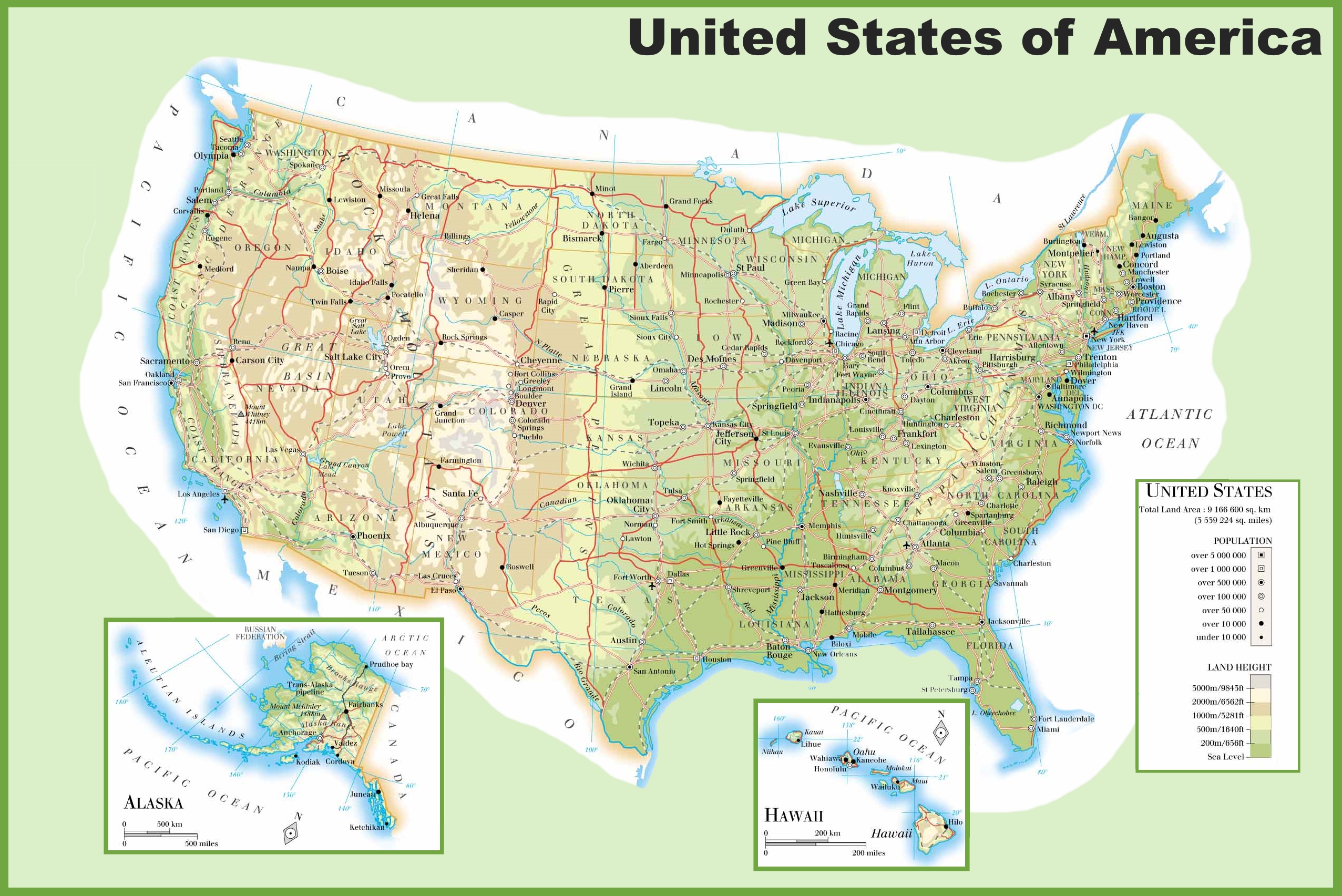
Imagine a detailed canvas of the United States, where mountains rise in shades of brown, rivers wind through green valleys, and cities pulse with life, all captured in a single, intricate snapshot. This USA-Reference-Map unveils the nation’s geography, from the Rocky Mountains in Colorado to the Mississippi River’s meandering path through the Midwest, spanning all 50 states, Alaska, and Hawaii. Whether you’re a traveler planning a cross-country adventure, a student diving into U.S. geography, a historian tracing America’s growth, or a planner studying its landscapes, this map offers an expansive, all-in-one guide to the nation’s physical and political fabric. Let’s embark on a thorough exploration of its features, uncovering the rich history, diverse terrain, and practical insights it holds for understanding America as of 2025!
USA-Reference-Map Insights
Exploring America’s Geographic Mosaic
This comprehensive USA-Reference-Map showcases the U.S.’s physical and political geography with color-coded elevations—brown for mountains like the Sierra Nevada in California, green for plains like the Great Plains in Kansas, and blue for water bodies like the Great Lakes and Gulf of Mexico—alongside state and city labels. It highlights major cities such as New York, Los Angeles, and Chicago, with red dots for capitals like Sacramento, CA, and Austin, TX, and includes major roads, rivers like the Colorado, and mountain ranges like the Appalachians. The map spans from Maine’s rocky coast to Hawaii’s volcanic islands, with insets for Alaska and Hawaii, and shows neighboring regions like Canada and Mexico, offering a versatile tool for navigation, education, and geographic analysis across America’s vast 3,796,742 square miles as of 2025.
Versatile Applications for Travelers, Educators, and Planners
Road trippers and outdoor enthusiasts use this map to plan journeys, identifying routes through mountains like the Cascades in Washington or valleys like Death Valley in California, while hikers target national parks like Yellowstone, marked with green areas. Educators rely on it to teach physical geography, population distribution (e.g., over 300,000 residents marked by larger dots), and state boundaries, while historians explore its depiction of America’s expansion, from the Louisiana Purchase to westward migration. Urban planners and engineers assess infrastructure needs, and emergency services use it for disaster response, making it an indispensable resource for anyone navigating or studying the U.S., fostering informed travel, academic insights, and strategic planning across the nation as of 2025.
Captivating Stories of America’s Landscape and Legacy
Did you know the U.S. encompasses some of the world’s most dramatic terrain, with Denali in Alaska towering at 20,310 feet—the highest peak in North America—and Death Valley in California plunging to 282 feet below sea level, the lowest point? This USA-Reference-Map reflects that diversity, showing the arid Southwest deserts, fertile Midwest plains, and forested Northeast, shaped by millions of years of geological activity. It also captures America’s historical growth, with cities like Boston (founded 1630) and Los Angeles (settled 1781) marking colonial and westward expansion, while rural areas like Montana highlight vast, open spaces. As of 2025, this map tells a story of natural wonder, human settlement, and ongoing development, each feature weaving a narrative of America’s past, present, and future across its 3,796,742 square miles.