
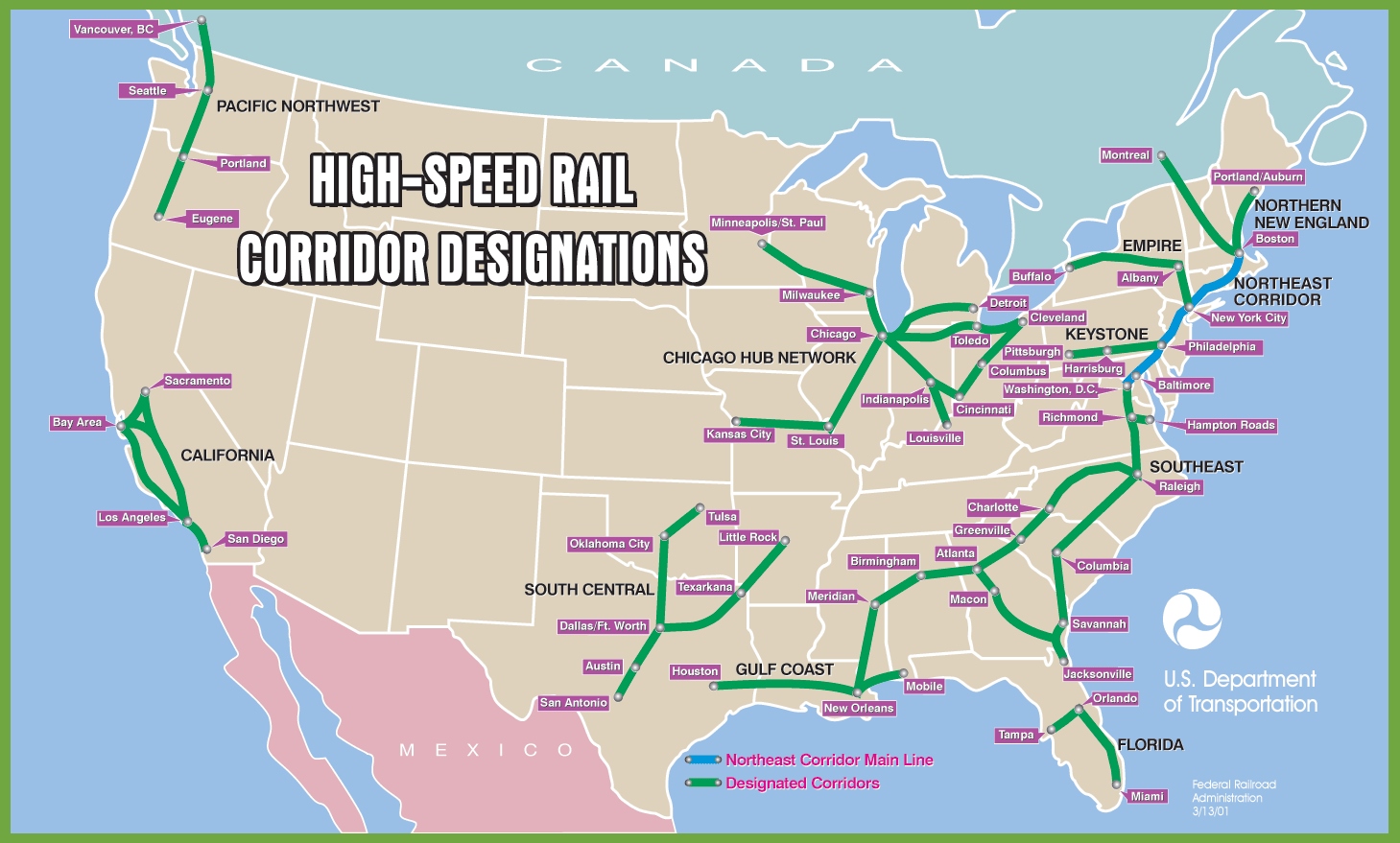
Imagine a futuristic network of green and purple lines streaking across the United States, linking major cities at breathtaking speeds, transforming travel into a swift, sustainable adventure. This USA-High-Speed-Rail-Map unveils the U.S. Department of Transportation’s designated high-speed rail corridors, from the Pacific Northwest’s route between Vancouver, BC, and Eugene, Oregon, to the Northeast Corridor’s high-speed Acela service between Boston and Washington, D.C., spanning all 50 states and reaching into Canada and Mexico. Whether you’re a visionary traveler eager for faster journeys, an environmental advocate promoting sustainable transport, or a geography enthusiast intrigued by America’s infrastructure evolution, this map offers a detailed blueprint for the future of rail travel. Let’s embark on an expansive exploration of its high-speed corridors, uncovering their potential, historical context, and transformative impact on America’s connectivity as of 2025!
USA-High-Speed-Rail-Map Insights
Charting America’s High-Speed Rail Vision
This visionary USA-High-Speed-Rail-Map showcases the U.S. Department of Transportation’s high-speed rail corridor designations with green lines for designated corridors and blue for the Northeast Corridor main line, set against a neutral beige backdrop. It highlights key routes like the California corridor linking Los Angeles, San Diego, and Sacramento, the Chicago Hub Network connecting cities like Minneapolis, Detroit, and St. Louis, and the Southeast corridor from Charlotte to Savannah. The map includes major cities, such as New York, Atlanta, and Houston, with purple dots marking stations, and extends to Canada (e.g., Montreal) and Mexico, with a legend clarifying corridor types. This map serves as a strategic tool for planners, policymakers, and travelers, offering a glimpse into America’s rail future as of 2025, with insets ensuring clarity for Alaska and Hawaii.
Transformative Opportunities for Travel, Sustainability, and Economy
Future travelers will use this map to plan high-speed journeys, such as racing from Los Angeles to San Francisco in hours on proposed California high-speed rail, or zipping from Boston to New York on the Acela at speeds up to 150 mph, reducing travel time and carbon emissions. Environmentalists advocate for these corridors to cut road congestion and greenhouse gases, while urban planners and economists see them boosting regional economies by connecting hubs like Dallas, Chicago, and Miami. Educators teach about modern infrastructure innovation, and policymakers reference it for funding and development, positioning high-speed rail as a cornerstone of America’s sustainable transport strategy as of 2025, fostering connectivity, job creation, and environmental stewardship across the nation.
Inspiring Stories of America’s Rail Revolution
Did you know the U.S. high-speed rail vision, formalized in the 1990s and updated through the 21st century, draws inspiration from global systems like Japan’s Shinkansen and Europe’s TGV, aiming to reduce travel times and enhance mobility? This USA-High-Speed-Rail-Map reflects that ambition, showcasing corridors like the Gulf Coast route from New Orleans to Mobile and the Pacific Northwest line, which could reach speeds of 200 mph or more. States like California lead with projects like the LA-to-SF high-speed rail, while regions like the Midwest push for the Chicago Hub Network, addressing America’s lag in high-speed rail compared to other nations. As of 2025, these corridors promise to reshape travel, reduce fossil fuel dependency, and revitalize rural areas, each line on this map weaving a narrative of innovation, sustainability, and progress for America’s future.