
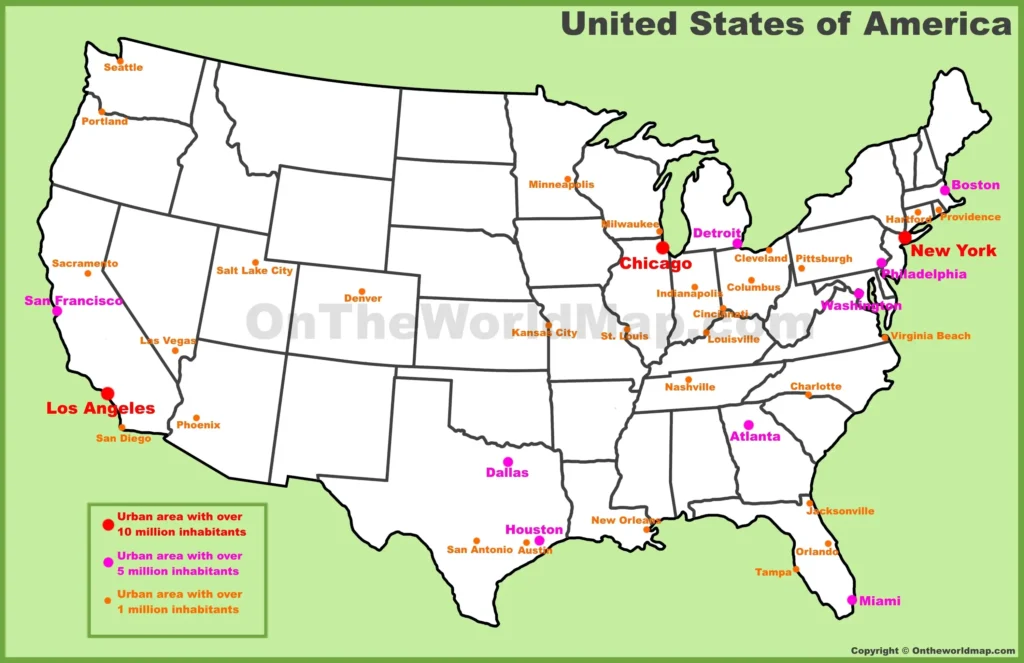
Imagine a clean, crisp map of the United States, where red, pink, and orange dots light up the landscape, marking the nation’s most populous urban areas, from the towering skyscrapers of New York to the sunny streets of Los Angeles, stretching across all 50 states. This USA-Cities-Map reveals the urban centers with populations exceeding 1 million, 5 million, and 10 million, based on recent estimates, connecting bustling metropolises like Chicago, Atlanta, and Miami with a simple yet striking design. Whether you’re a traveler planning a visit to vibrant cityscapes, a demographer studying urban growth, a business strategist targeting markets, or a geography enthusiast marveling at America’s metropolitan diversity, this map offers a detailed guide to the nation’s beating urban heart. Let’s embark on a comprehensive exploration of its colorful dots, uncovering the demographic trends, cultural significance, and practical insights it holds for understanding America’s cities.
USA-Cities-Map Insights
Highlighting America’s Urban Powerhouses
This engaging USA-Cities-Map showcases U.S. urban areas with colored dots: red for cities over 10 million inhabitants (e.g., New York, Los Angeles), pink for those over 5 million (e.g., Chicago, Dallas), and orange for those over 1 million (e.g., Seattle, Denver), set against a white backdrop with state boundaries. It highlights major hubs like Boston on the East Coast, San Francisco on the West Coast, and Houston in the South, with connections to smaller cities like Portland, Oregon, and Charlotte, North Carolina. The map spans from Washington’s Pacific Northwest to Florida’s Atlantic shores, with insets for Alaska and Hawaii, and includes neighboring regions like Canada and Mexico, offering a clear, visual tool for travelers, planners, and analysts to navigate America’s urban landscape, reflecting population shifts and growth patterns.
Boundless Opportunities for Travelers, Businesses, and Scholars
Travelers use this map to plan city breaks, targeting bustling metropolises like Philadelphia (pink, over 5 million) for history or Miami (pink, over 5 million) for beaches, while road trippers connect dots like Atlanta (pink) to Orlando (orange) for cultural exploration. Businesses leverage it to identify market potential in dense urban areas like Los Angeles (red, over 10 million) or San Antonio (orange, over 1 million), while urban planners assess infrastructure needs for growing cities like Denver (orange). Educators teach about urbanization, population density, and regional economics, and policymakers address housing, transportation, and services in crowded hubs like New York (red). This map remains a vital resource for anyone exploring or studying America’s cities, fostering travel, economic strategy, and academic insight across the nation.
Captivating Stories of America’s Urban Evolution
Did you know U.S. urban areas have grown dramatically since the Industrial Revolution, with cities like New York (over 8.8 million, red) becoming global hubs due to immigration and trade, while Los Angeles (over 3.8 million, red) boomed with Hollywood and tech? This USA-Cities-Map reflects that evolution, showcasing Chicago (over 2.7 million, pink) as a railroad capital, Atlanta (over 5.9 million, pink) as a Southern economic center, and Seattle (over 3.9 million, orange) as a tech powerhouse. States like California host multiple urban giants, while rural areas like Wyoming have no dots, highlighting regional disparities. This map tells a story of migration, industrialization—think the 19th-century growth of Pittsburgh (orange)—and modern trends like suburban sprawl, each dot weaving a narrative of America’s urban past, present, and future across its vast landscape.