
Imagine a intricate web of colorful lines stretching across the United States, linking cities, towns, and natural wonders in a vibrant tapestry of movement and opportunity. This USA-Transportation-Map unveils the nation’s extensive transportation network, featuring highways, rail lines, airports, and border crossings, from the bustling I-95 corridor on the East Coast to the remote paths of Alaska, spanning all 50 states, Hawaii, Puerto Rico, and beyond. Whether you’re a road trip enthusiast planning a scenic drive, a logistics professional optimizing freight routes, a traveler navigating airports, or a geography buff exploring America’s infrastructure, this map offers a detailed guide to the lifelines that connect the nation. Let’s dive deeply into its interwoven pathways, uncovering the historical significance, strategic importance, and endless possibilities they represent for modern America!
USA-Transportation-Map Insights
Mapping America’s Transportation Network
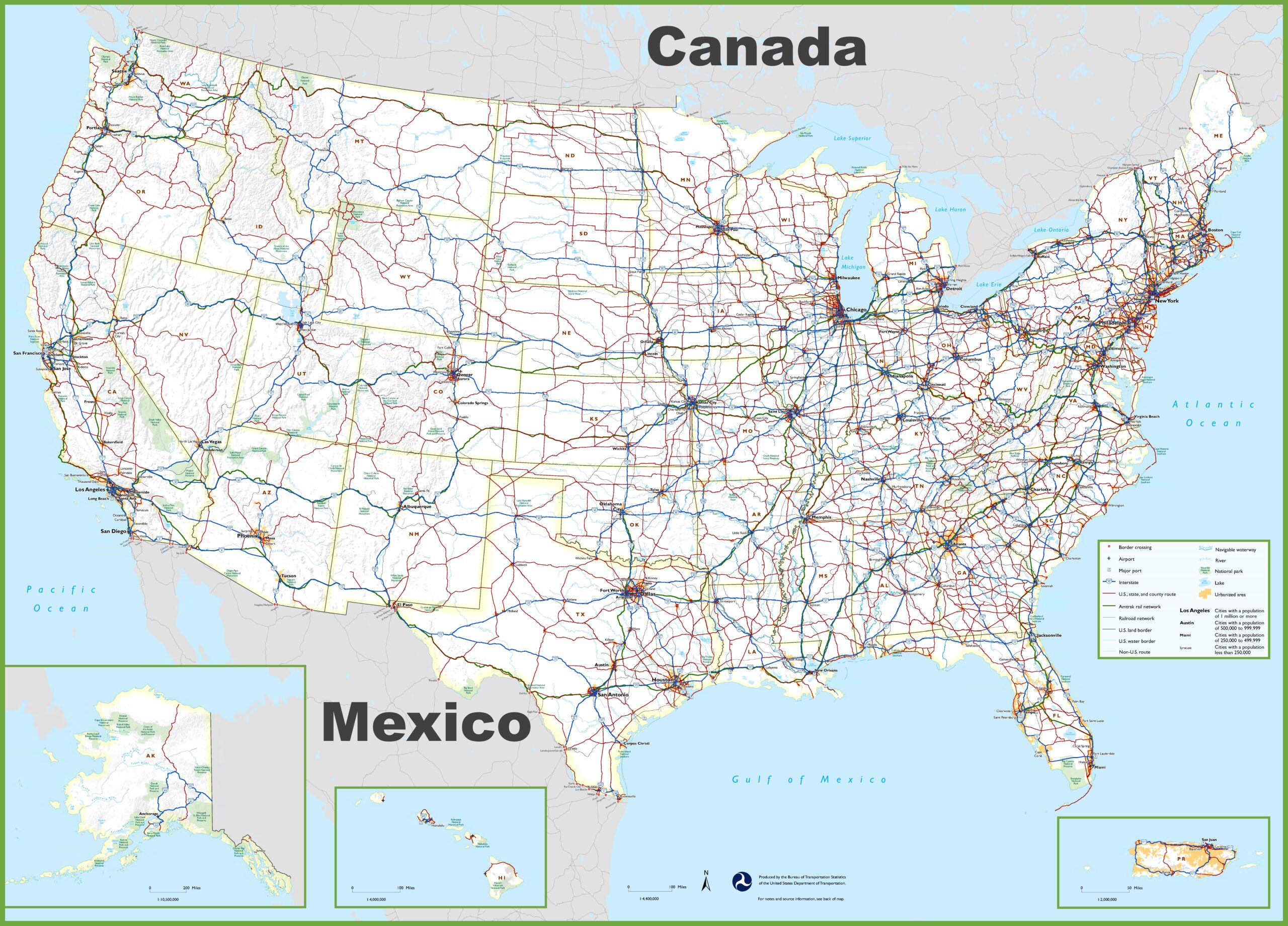
This richly detailed USA-Transportation-Map showcases the U.S. transportation system with a rainbow of lines: blue for interstates, red for U.S. highways, green for rail lines, yellow for airports, and purple for border crossings, stretching from Seattle’s Pacific Northwest to Miami’s sunny shores, with insets for Alaska, Hawaii, and Puerto Rico. It highlights major interstates like I-10 across the South, I-80 through the Midwest, and I-90 in the Northeast, connecting key cities such as Chicago, Los Angeles, and New York, while also marking national parks, urban areas, and rail hubs. The map includes a legend for urban populations, major ports, and scenic routes, with neighboring regions like Canada and Mexico, providing a comprehensive tool for navigation, planning, and geographic analysis across America’s diverse landscape.
Unlimited Opportunities for Travel, Commerce, and Exploration
Road trippers treasure this map for epic journeys—like driving from Denver to Atlanta via I-70 and I-75, or exploring scenic rail routes through the Rockies on Amtrak’s routes. Trucking companies and logistics firms rely on it to chart efficient paths for goods, ensuring timely deliveries nationwide, while airlines and airport authorities use it to manage flight paths and passenger hubs like LAX or JFK. Urban planners and engineers assess infrastructure needs to support growing populations, and outdoor enthusiasts plan visits to national parks like Yellowstone or the Grand Canyon via marked scenic routes. As of 2025, this map remains a vital resource for anyone navigating or studying America’s interconnected transportation system, ensuring seamless movement, economic growth, and cultural exchange across the nation.
Fascinating Stories of America’s Pathways
Did you know the U.S. transportation network, including the Eisenhower Interstate Highway System launched in 1956, was inspired by President Dwight D. Eisenhower’s wartime experiences with Germany’s autobahns, aiming to enhance national defense, commerce, and mobility? This USA-Transportation-Map reflects that legacy, showcasing over 47,000 miles of interstates, critical rail lines like the Transcontinental Railroad completed in 1869, and a vast network of airports serving millions annually. States like California lead in highway and airport density, while rural areas like North Dakota highlight strategic rail and road connectors, underscoring the system’s role in shaping America’s economy, culture, and connectivity. With border crossings facilitating trade with Canada and Mexico, and scenic routes preserving natural beauty, each line on this map tells a story of progress, innovation, and exploration as of 2025.