
Driving Directions and Google Map of Albania — Roads, Albanian Riviera & Navigation Guide
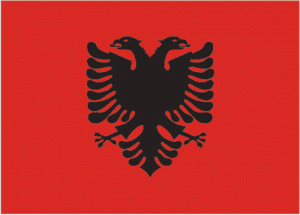
Albania is one of Europe’s last great hidden driving destinations — a compact Balkan country of dramatic contrasts where snow-capped Albanian Alps tower over the north, the turquoise waters of the Ionian Sea lap at the Albanian Riviera in the south, and UNESCO-listed Ottoman towns like Gjirokastër and Berat punctuate a hilly interior surprisingly rich in ancient history. Long isolated under one of Europe’s most austere communist regimes until 1991, Albania has invested heavily in its road infrastructure since the turn of the millennium, and today a growing network of modern motorways connects Tirana to the borders with Kosovo, North Macedonia, and Greece. Use our free driving directions and Google Map below to plan any route across the country — from the Adriatic coast at Durrës to the wild valleys of Valbona and Theth in the Albanian Alps.
Albania drives on the right side of the road, using left-hand drive vehicles — the same convention as all its neighbouring countries. The motorway speed limit is 110 km/h, national roads 90 km/h, and urban areas 50 km/h. Albania enforces near-zero alcohol tolerance: the legal BAC limit for ordinary drivers is just 0.01%, and absolute zero for professional drivers, novices, and motorcyclists. All non-EU visitors must carry an International Driving Permit (IDP) alongside their home licence, and all vehicles must be covered by a valid Green Card (international motor insurance). Secondary roads, particularly in rural and mountain areas, can be narrow and poorly surfaced — a high-clearance vehicle is strongly recommended for exploring Albania’s more remote regions.
Road Network Overview
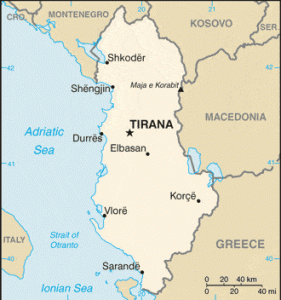
Albania’s total road network extends to approximately 18,000 kilometres, of which around 3,600 km are national roads (Rrugë Kombëtare). The country’s primary road infrastructure is divided between a small but growing motorway network (autostradat) and a system of national roads (rrugë shtetërore — SH prefix) that connect cities, towns, and border crossings. The road network has been transformed over the past two decades from one of Europe’s least developed to a reasonably modern system on the main corridors, though secondary and rural roads retain significant challenges.
The backbone of Albanian motorways is the A1 — the nation’s most important route — which runs from the port city of Durrës on the Adriatic coast eastward through Tirana and then north through the Drin valley to the city of Kukës, and on through the Rrugë e Kombit (“Nation’s Road”) to the border with Kosovo near Morinë. This corridor, completed by 2009 and fully upgraded in subsequent years, is one of the most technically impressive roads in the Balkans — the section through the Drin gorge between Milot and Kukës required dozens of tunnels and viaducts cut into near-vertical canyon walls, and the drive is as spectacular as it is strategic. The A2 motorway links Tirana’s ring road to Durrës — a busy 37 km dual-carriageway route used by several million vehicles annually, and the most heavily trafficked road in Albania. The A3 motorway heads east from Tirana toward Elbasan, passing through the Krrabes Tunnel (approximately 5.5 km beneath the Krrabes Mountain ridge), dramatically shortening the route between the capital and the Elbasan industrial basin. Planned extensions of the A3 toward Korçë and the North Macedonia border are progressing.
National roads designated with the SH prefix form the secondary tier of Albania’s network. The SH1 traces a longitudinal route from Shkodër in the north through Tirana, Elbasan, Gjirokastër, and to the Greek border at Kakavijë — the historic spine of the country, following roughly the path of the ancient Via Egnatia. The SH4 links Tirana northward to Shkodër and continues to the Montenegrin border at Hani i Hotit and Muriqan. The SH8 — the Adriatic-Ionian Coastal Highway — runs along or near the coast from Durrës south through Vlorë and then over the Llogara Pass to the Albanian Riviera and Sarandë. The SH75 connects Gjirokastër to Sarandë in the far south, completing the inland loop. The Korçë basin in the southeast is linked to the rest of the country by the SH3 from Elbasan and is close to both the Greek border at Kapshticë and the North Macedonian border at Qafë Thanë.
Speed Limits
Speed limits in Albania are set by the Albanian Road Traffic Code (Kodi Rrugor, Law No. 8378/1998 and subsequent amendments). They are enforced by the Policia Rrugore (Road Police), which maintains checkpoints on major roads and operates mobile radar speed units. Fixed speed cameras are installed on sections of the A1, A2, A3, and the main approach roads to Tirana. Penalties for speeding are issued on the spot by traffic police and can include fines and temporary licence suspension for serious violations.
| Road type | Speed limit | Notes |
|---|---|---|
| Motorway (autostradë) | 110 km/h | A1, A2, A3; lower limits posted in tunnels and around toll plazas |
| National road (rrugë kombëtare) | 90 km/h | SH-prefix routes; reduced on mountain curves and through villages |
| Urban / built-up area | 50 km/h | All towns and villages; 30 km/h near schools and hospitals; signs confirm |
| School zone / residential | 30 km/h | Speed humps common in towns and villages; watch for unmarked bumps on rural national roads through inhabited areas |
Enforcement is particularly rigorous on the A1 Durrës–Tirana–Kosovo corridor and on the approaches to Tirana. Mobile radar units are frequently deployed on the SH8 coastal road, the SH1, and around the Greek border. Speed fines issued by traffic police must typically be paid on the spot in Albanian Lek (ALL); always request and retain a formal receipt. Driving significantly over the limit — particularly above 130 km/h — results in immediate licence confiscation and vehicle impoundment. Towing a trailer or caravan reduces the motorway limit to 80 km/h.
Toll Roads
Albania operates a manual toll plaza system on its motorways — there is no national vignette (windscreen sticker) system. Tolls are charged at plazas on the A1, A2, and A3 motorways, with payment accepted in Albanian Lek (ALL) cash. Card payment is available at some plazas but should not be relied upon — always carry sufficient ALL cash when using motorways. There is no electronic transponder system currently in operation in Albania. Toll rates are relatively modest by European standards.
| Route / Section | Typical toll (light vehicle, 2025) | Notes |
|---|---|---|
| A2 — Durrës to Tirana (Rinas) | ~ALL 150 | 37 km; Albania’s busiest road; plaza at Rinas near Tirana International Airport |
| A1 — Tirana to Kukës (Rrugë e Kombit) | ~ALL 200–300 | Multiple plazas; dramatic Drin gorge section; continues to Kosovo border at Morinë |
| A3 — Tirana to Elbasan (Krrabes Tunnel) | ~ALL 200 | Includes Krrabes Mountain tunnel (~5.5 km); dramatic approach through forested hills |
| National SH roads | Free | All national (SH prefix) and regional roads are toll-free; only motorways charge tolls |
National roads (SH prefix) throughout Albania are entirely toll-free — only the motorways carry charges. When planning a route, using Google Maps or Waze will show both the motorway option (faster, tolled) and the national road alternative (slower but free). On the Tirana–Durrës corridor, for example, the old SH2 coastal road runs parallel to the A2 motorway and is toll-free but significantly slower due to traffic lights and local traffic. For the Kosovo border run (Tirana–Kukës), the A1 Rrugë e Kombit is by far the superior option in terms of speed and road quality — the old SH1 via Burrel is narrow and very slow.
Road Rules & Licences
Driving Licence & IDP
Citizens of EU and EEA member states may drive in Albania on their valid home-country driving licence without an International Driving Permit, as Albania recognises these by bilateral agreement. All other foreign nationals — including visitors from the United Kingdom, the United States, Australia, Canada, and non-EU countries — must carry a valid International Driving Permit (IDP) alongside their original home-country driving licence. Albania recognises IDPs issued under the 1968 Vienna Convention. The IDP must always be presented together with the original licence; it is not valid as a standalone document.
Albanian traffic police conduct regular document checks at roadblocks and checkpoints, particularly on border approach roads, the coastal highway, and roads to tourist areas. Driving without a valid licence and IDP combination is a serious offence resulting in on-the-spot fines. Rental car companies operating in Albania require a minimum age of 21 and a credit card; most international chains also request an IDP for non-EU customers. The minimum legal driving age in Albania is 18.
Blood Alcohol Limit (BAC)
Albania enforces one of the strictest drink-driving standards in Europe. The legal BAC limit for ordinary drivers is 0.01% — a level so low it is effectively zero tolerance, as 0.01% is within the margin of error of most breathalyser equipment and corresponds to only trace amounts of alcohol in the blood. For professional drivers (operating buses, taxis, and heavy goods vehicles), novice drivers within two years of licence issue, and motorcyclists, the limit is 0.00% — absolute zero. A positive breath test triggers immediate roadside fines, licence suspension, and vehicle immobilisation; blood alcohol above 0.08% can result in criminal prosecution. The Policia Rrugore conducts frequent breath-testing at roadblocks, particularly on summer weekends on the coastal road and at major town junctions. Any alcohol consumption whatsoever before driving in Albania should be considered unacceptable.
Green Card Insurance
Albania is a member of the international Green Card (Carta Verde) insurance system. All foreign-registered vehicles entering Albania must be covered by a valid Green Card — the international certificate of motor insurance. Drivers from countries whose standard motor insurance policies include Green Card coverage for Albania (which most EU and UK policies do, though this should be verified with your insurer before travel) need only carry the Green Card certificate. Drivers whose home insurance does not cover Albania must purchase border insurance at the point of entry — this is available at all major border crossings (Morinë with Kosovo, Qafë Thanë with North Macedonia, Kakavijë and Kapshticë with Greece, Hani i Hotit and Muriqan with Montenegro) and costs approximately €20–40 for a two-week policy. Driving without valid insurance in Albania results in immediate fines and vehicle impoundment.
Other Key Road Rules
- Seatbelts: Compulsory for driver and all passengers, front and rear. Child seats are mandatory for children under 12 or under 150 cm in height.
- Mobile phones: Prohibited while driving; hands-free operation is permitted. Fines are applied at police checkpoints.
- Warning triangle & reflective vest: Mandatory to carry in the vehicle. In the event of a breakdown, the reflective vest must be worn before exiting the vehicle on any road, and the warning triangle placed behind the vehicle.
- Fire extinguisher: Albanian law requires all vehicles to carry a fire extinguisher — this is checked at police roadblocks and border crossings. Rental companies should supply this; those driving their own vehicle into Albania must ensure compliance.
- First aid kit: Mandatory to carry in the vehicle.
- Headlights: Must be switched on when driving through tunnels (numerous on the A1 and A3). Daytime running lights are strongly recommended on national roads.
- Overtaking: Permitted only on the left; never overtake on blind curves, hilltops, or where solid centre lines are painted. On narrow mountain roads, the vehicle descending generally has right of way over ascending traffic, though this is not universally observed.
- Priority roads: On roads outside built-up areas marked with a yellow diamond sign, the main road has priority over side roads. In the absence of markings, the vehicle approaching from the right has priority at uncontrolled intersections.
- Animals on roads: Livestock crossing is common in rural and mountain areas. Reduce speed significantly and allow animals to clear the road; never attempt to drive through a herd.
Fuel & Service Stations
Fuel in Albania is sold primarily as benzinë (petrol/gasoline) and naftë (diesel). Standard unleaded petrol is available at RON 95 grade at most stations, with RON 98 available at larger forecourts in cities. Diesel (gasoil) is widely available and is the predominant fuel for trucks and many SUVs. Gas (LPG / autogas) is available at a significant number of Albanian forecourts and is used by a substantial portion of the private car fleet — Albania has one of the higher rates of LPG vehicle use in the Balkans. Electric vehicle charging infrastructure is very limited outside Tirana and a few coastal tourist areas; EVs should be planned carefully or avoided for touring Albania beyond the main cities.
Fuel prices in Albania are market-determined and fluctuate with international crude oil prices. They tend to be slightly lower than Western European prices for petrol and diesel, reflecting lower taxation. Payment by card is accepted at many modern forecourts on the main corridors and in cities, but cash (Albanian Lek) is essential for rural stations and smaller forecourts, which are frequently cash-only. The major fuel chains operating in Albania include Kastrati (the dominant local chain), Roviton, Interag, Agip (ENI), and Shell at selected locations. In remote mountain areas — particularly the Albanian Alps, the Valbona and Theth valleys, and the roads of eastern Albania — fuel stations are sparse. Always fill up to a full tank when leaving cities or towns when heading into mountain territory, as the next station may be 60–80 km away on a slow mountain road.
Driving in Tirana
Tirana, Albania’s capital and largest city with a metropolitan population of approximately 900,000, is the country’s main entry point and hub. The city is served by Tirana International Airport Nënë Tereza (TIA), located at Rinas, 17 km northwest of the city centre on the A2 motorway. The airport is well connected to the city by taxi and the growing Tirana–Durrës rail link, but many visitors opt to hire a car at the airport for onward driving in Albania.
Driving in central Tirana is manageable but chaotic by Western European standards. The city has been growing rapidly and its road infrastructure — though much improved since the 1990s — struggles to keep pace. The main arteries include Rruga e Kavajës, Bulevardi Zogu I, Rruga Myslym Shyri, and the outer ring road (Unaza e Re — the New Ring Road). Traffic is particularly heavy during morning and evening rush hours (07:30–09:00 and 17:00–19:30), with the A2 motorway approach from Durrës and the Ring Road around the city centre being the most congested points. Parking in central Tirana is managed by the municipality; blue-zone paid parking areas operate in the city core, and multi-storey car parks are available near the main shopping and business districts. Never leave valuables visible in a parked vehicle.
Motorcycles, scooters, and electric bikes are extremely numerous in Tirana and create an unpredictable traffic environment. Lane discipline is loose by convention — many drivers squeeze into gaps or create informal additional lanes. The city’s traffic lights are generally respected but pedestrians cross freely; yield to pedestrians in marked crossings. Roundabouts follow the standard European convention (circulating traffic has priority) but this is not universally observed. Navigation apps — Google Maps and Waze both provide good coverage of Tirana — are strongly recommended for navigating the city’s evolving road layout.
Driving the Albanian Riviera
The Albanian Riviera — the Ionian coastline south of Vlorë, stretching roughly 80 km from Palasa to Sarandë near the Greek border — is one of the most spectacular coastal drives in all of Europe, and one of the Mediterranean’s best-kept secrets. The road is the SH8 (Rruga Nacionale 8 / Rruga Adriatike-Jonike), which after crossing the Llogara Pass (Qafa e Llogarasë) at 1,027 m descends in a series of vertiginous hairpin bends to the turquoise waters of the Ionian Sea below, revealing a coastline of dramatic cliffs, crystal-clear coves, and traditional villages that remained largely undiscovered until the early 2010s.
The drive from Vlorë to Sarandë along the SH8 via the Riviera takes approximately 2.5–3.5 hours without stops — the road is mostly single carriageway, narrow in places, and requires full concentration due to the gradient, curves, and the frequency of tourist and local traffic in summer. Key stops along the route include Dhërmiu, Himara (the main Riviera town, with ATMs and fuel), Palasë, Porto Palermo (a remarkable 19th-century fortress on a headland jutting into the bay, built by Ali Pasha of Ioannina), and Borshi, with its citrus groves and quiet beach. The road continues past Sarandë to the Greek border at Kakavijë — Greece (and Corfu, visible across the water from Sarandë) is just 2 km away. A daily high-speed ferry operates between Sarandë and Corfu Town year-round.
During July and August the SH8 Riviera road can become seriously congested — particularly on the single-lane sections around Himara and Palasa — as the Albanian Riviera has become extremely popular with both Albanian holidaymakers from Tirana and international visitors. Convoys of rental cars and campervans can create tailbacks on the hairpin sections above Dhërmiu. The best time to drive the Riviera is May, June, or September–October, when the road is quieter, the sea is warm, and prices at the small bungalow hotels and restaurants (locally called “bujtina”) are more reasonable.
Northern Albania & the Albanian Alps
Northern Albania — the region of Shkodër, Tropojë, and the Bjeshkët e Namuna (Accursed Mountains / Albanian Alps) — is one of the most dramatic landscapes in Europe, and also one of the most challenging driving environments. The area is increasingly visited by adventure travellers and hikers drawn to the Valbona Valley and Theth, two traditional mountain villages accessible via roads that were gravel tracks until relatively recently and still require a 4WD or high-clearance vehicle for the upper sections, particularly Theth (accessible via the SH22 from Shkodër over the Qafa e Thorës pass at 1,525 m).
The classic northern Albania driving circuit begins in Shkodër — Albania’s fourth city and historic centre of the Gheg culture — and heads north on the SH4 along the shore of Lake Shkodër (shared with Montenegro), one of the largest lakes in the Balkans. From Shkodër, the route continues east along the Drin River to Komani, the embarkation point for the spectacular Komani Lake ferry — a three-hour boat journey through a flooded canyon of extraordinary beauty that connects by water to Fierze, from where the road continues up the Valbona River to the Valbona Valley. The ferry does not operate year-round; confirm schedules before planning this route. Alternatively, the A1 / Rrugë e Kombit motorway from Tirana provides a fast drive to Kukës, from where a good regional road continues to Bajram Curri and the Valbona Valley entrance.
The Theth road from Shkodër via Koplik and Bogë is the most demanding in Albania routinely attempted by visitors — the upper section to Theth village (at 800 m) involves approximately 22 km of steep, narrow, and frequently potholed road over the pass, with limited passing places. A 4WD vehicle with good clearance is essentially mandatory; the road is impassable in winter (November–April) due to snow. Despite the challenge, the reward is extraordinary: Theth is one of the most authentically remote and beautiful mountain villages in the Balkans, with traditional stone guesthouses, the famous Lock-in Tower (Kulla), and walks to the stunning Grunas waterfall and the Syri i Kaltër (Blue Eye) of Theth. The road was being improved in stages as of 2025.
Regional Roads & Routes
Southern Albania — Gjirokastër, Berat & the Greek Border
Southern Albania contains two of the country’s UNESCO World Heritage Sites: Gjirokastër (the “City of Stone”), a remarkably preserved Ottoman bazaar town of grey slate-roofed houses cascading down a hillside beneath a massive fortress, and Berat (“the City of a Thousand Windows”), with its distinctive white Ottoman houses stacked above the Osum River gorge. Gjirokastër is reached from Tirana via the SH1 (or the parallel A1 where sections are complete) south through Elbasan and Berat — a journey of approximately 3–3.5 hours. The approach to Gjirokastër on the SH1 through the deep Drino valley, with the fortress visible on the ridge above, is one of Albania’s most dramatic arrival moments.
The Syri i Kaltër (Blue Eye) near Sarandë — a deep natural freshwater spring of startling cobalt blue, bubbling up from the earth at a constant 10°C surrounded by subtropical vegetation — is reached via a short paved road off the SH99 between Gjirokastër and Sarandë. The archaeological site of Butrint (a UNESCO World Heritage Site of Greek, Roman, Byzantine, and Venetian ruins on a peninsula in the Butrint lagoon) is 22 km south of Sarandë via a good paved road, close to the Greek border at Qafë Boton.
Central Albania — Elbasan, Korçë & Lake Ohrid
Central and eastern Albania offer less-visited but rewarding drives through landscapes of rolling hills, apple orchards, and traditional villages. The city of Korçë in the southeast — known for its elegant French-colonial architecture, the country’s first school, and its annual summer beer festival — is reached from Tirana via the A3 to Elbasan and then the SH3 through the Devoll valley, a total of approximately 3 hours. From Korçë, the Macedonian border at Qafë Thanë is just 10 km away, and the Albanian section of Lake Ohrid — shared with North Macedonia — is accessible via the border at Pogradec on the lake’s western shore. The lakeside road from Pogradec through Lin and Tushemisht, following the shore of one of Europe’s deepest and most ancient lakes, is scenic and peaceful.
Hazards & Safety
Road Conditions on Secondary Routes
While Albania’s motorways and main national roads have improved dramatically since the 1990s, secondary and local roads (rrugë vendore) in rural areas, mountain regions, and smaller towns can be in very poor condition — heavily potholed, narrow, with crumbling shoulders, and without guardrails on mountain sections where a drop of several hundred metres awaits a misjudged overtake. The road surfaces on routes to the Albanian Alps (Theth, Valbona), the remote areas of the Highlands (Tropojë, Dibër), and parts of southern Albania (Skrapar, Përmet) require a high-clearance 4WD vehicle and careful, unhurried driving. Gravel roads are common on routes not shown on most GPS maps as unpaved. Download offline maps (Maps.me or similar) for areas where mobile data coverage is poor.
Aggressive Driving Style
Albania’s driving culture reflects the country’s relatively recent mass adoption of private car ownership — private vehicles were completely banned under communist rule until 1991, and the traffic culture has developed rapidly since then without the decades of road safety education common in Western Europe. Overtaking on blind bends, driving significantly above the speed limit on national roads, ignoring lane markings, and tailgating are not uncommon. The safest approach is to be patient, drive defensively, maintain generous following distances, and never attempt to match the pace of the most aggressive local drivers. Road safety has improved substantially since the 2000s, but Albania continues to have higher accident rates per capita than the EU average.
Mountain Road Hazards
Landslides and road damage after heavy rain or snow are genuine risks on mountain roads, particularly in spring (April–May) and autumn (October–November). Roads over high passes (Llogara, Qafa e Thorës to Theth, SH20 to Valbona) are subject to closure after heavy rain or snow. In winter, roads above approximately 800 m may be impassable without snow chains; the Llogara Pass road (SH8) can be closed for days after heavy snowfall between November and March. Always check conditions locally before heading into the mountains. Livestock — cattle, sheep, and goats — cross mountain roads freely and are particularly hazardous after dark.
Scenic Routes
- Llogara Pass & Albanian Riviera (SH8 — Vlorë to Sarandë): One of Europe’s most spectacular coastal drives. The SH8 climbs from Vlorë through pine forest to the Llogara Pass at 1,027 m — a viewpoint with panoramic views over the Karaburun Peninsula and the Ionian Sea — then descends via hairpin bends to the turquoise Riviera below. The full drive from Vlorë to Sarandë via Himara takes approximately 2.5–3.5 hours. This is Albania’s single most celebrated road experience and not to be missed. Best driven in morning light heading south.
- Rrugë e Kombit — A1 Tirana to Kukës (Drin Gorge): The “Road of the Nation” — the section of the A1 motorway through the Drin River gorge between Milot and Kukës — is one of the most technically impressive mountain motorway builds in Europe. The road cuts through near-vertical canyon walls using a sequence of tunnels, bridges, and viaducts, with the emerald Drin River far below. It is simultaneously a feat of engineering and an outstanding natural spectacle. The full Tirana–Kukës drive takes around 2 hours on the motorway.
- Komani Lake & Valbona Valley Circuit: The combination of the Komani Lake ferry (3 hours through a flooded gorge of extraordinary beauty) with the drive through the Valbona Valley (beneath the Maja e Jezercës peak at 2,694 m — the highest point of the Albanian Alps) constitutes one of the great adventure journeys of the Balkans. The route is feasible May–October; winter closure of mountain roads makes it impossible November–April. Overnight stays in Valbona or Theth guesthouses are strongly recommended.
- Berat — “City of a Thousand Windows” (SH72 from Tirana): The drive from Tirana to Berat via Elbasan or directly via the SH4 and SH72 through the Tomorr mountain foothills (approximately 2 hours each way) leads to one of Albania’s most rewarding towns. The approach from the north across the Osum plain, with Berat’s fortress and white-painted Ottoman houses rising from the river gorge, is unforgettable. The town itself is easily explored on foot once parked near the lower bazaar.
- Lake Ohrid Lakeshore — Pogradec to Lin (eastern Albania): The road along the Albanian western shore of Lake Ohrid — one of Europe’s oldest and deepest lakes, shared with North Macedonia — passes through the lakeside town of Pogradec, the peninsula of Lin (with its early Christian mosaics), and the village of Tushemisht. The deep blue of the lake against the wooded hillsides of North Macedonia across the water creates one of the most serene landscapes in the Balkans. The full lakeshore loop via Ohrid town in North Macedonia requires a border crossing.
- Gjirokastër to Butrint & the Greek Border (SH75/SH99): The southernmost loop of Albania — from the UNESCO fortress city of Gjirokastër south through the Drino valley, past the Blue Eye spring, to the UNESCO ruins at Butrint near the Greek border — takes 2.5–3 hours and encompasses Albanian antiquity, Ottoman heritage, and extraordinary natural beauty in a single day circuit. The road is paved and of reasonable quality throughout.
Frequently Asked Questions
Do I need an IDP to drive in Albania?
EU and EEA licence holders can drive in Albania on their home licence without an IDP. All other foreign nationals — including visitors from the UK, USA, Australia, Canada, and non-EU countries — must carry a valid International Driving Permit (IDP) alongside their original licence. Albania recognises the 1968 Vienna Convention IDP. IDPs are obtained from automobile associations in your home country before travel; they cannot be issued in Albania. Traffic police conduct regular document checks, particularly at border crossings and on popular tourist routes.
Is a Green Card required to drive in Albania?
Yes — Albania is a member of the Green Card system, and all foreign vehicles must be covered by a Green Card (international insurance certificate). Most EU and UK motor insurance policies automatically include Green Card coverage for Albania, but verify this with your insurer before travel. If your policy does not cover Albania, purchase border insurance at the crossing point — available at all major border crossings at modest cost (approximately €20–40 for a two-week policy). Rental vehicles will have insurance included. Driving without valid insurance is a serious offence resulting in immediate fines and impoundment.
What vehicle equipment is mandatory in Albania?
Albanian law requires all vehicles to carry: a reflective warning triangle (at least one, ideally two), a reflective safety vest (to be worn before exiting the vehicle on any road), a fire extinguisher, and a first aid kit. These items are checked at police roadblocks and border crossings — rental companies should supply them, but drivers bringing their own vehicle should verify compliance before entering Albania. In winter, snow chains are strongly recommended for any route over mountain passes.
How good are Albanian roads?
Quality varies enormously by route. The motorways (A1, A2, A3) and main national roads (SH1, SH4, SH8 coastal highway) are generally in good condition, comparable to a reasonable European standard. Secondary and local roads in rural and mountain areas can be very poor — severely potholed, narrow, with limited signage and no safety barriers. The Theth road, remote Highland routes, and many village roads require a 4WD or high-clearance vehicle. Always research road conditions for specific routes before travel, particularly in spring (after winter damage) and late autumn.
Can I cross from Albania into Kosovo and North Macedonia by car?
Yes — Albania has open road borders with Kosovo (A1 Morinë crossing and several secondary crossings), North Macedonia (Qafë Thanë near Korçë and other crossings), Montenegro (Hani i Hotit and Muriqan on the SH4), and Greece (Kakavijë on SH1 and Kapshticë near Korçë). EU and Schengen-area citizens and many nationalities can cross freely; check visa requirements for your nationality for each country. Ensure your vehicle insurance (Green Card) covers all countries on your itinerary. Note that Albania is not yet in Schengen, so border passport checks apply.
Is Albania safe for road trips?
Albania is generally safe for tourists and road travellers. The country has seen remarkable improvements in security and tourism infrastructure over the past decade and no longer carries the extreme risk profile it had in the 1990s. The main risks for road travellers are related to road conditions (poor secondary roads, aggressive driving, livestock on roads) rather than crime. Standard travel precautions apply: do not leave valuables in parked vehicles, use legitimate licensed taxis or rideshare apps in cities, and inform someone of your itinerary when venturing into remote mountain areas. Travel insurance covering medical evacuation is strongly recommended for remote mountain routes.
Sources & Update Note
The information in this guide is compiled from official Albanian sources and verified road information as of February 2026, including: the Albanian Ministry of Infrastructure and Energy (Ministria e Infrastrukturës dhe Energjisë) — road network and motorway data; the Albanian Road Authority (Autoriteti Rrugor Shqiptar) — road maintenance and conditions; the Albanian Road Traffic Code (Kodi Rrugor, Law No. 8378/1998 and amendments) — speed limits, BAC regulations, and licence rules; the Policia Rrugore (Albanian Road Police) — enforcement and emergency contacts; the Albanian National Tourism Agency (Agjencia Kombëtare e Turizmit) — scenic route and destination information; and the Green Card Bureau of Albania for insurance requirements. Road conditions, toll tariffs, and ferry schedules are subject to change; always verify current information locally before travel, particularly for mountain roads in northern and eastern Albania.