
Driving Directions and Google Map of Poland — Roads, Routes & Navigation Guide
Poland — officially the Republic of Poland (Rzeczpospolita Polska) — is the largest country in Central Europe by area and the fifth most populous in the EU, with approximately 37.6 million inhabitants across 312,679 km². Situated at the geographical heart of Europe, Poland is one of the continent’s most strategically important transit countries: the major east–west route between Western Europe and Russia/Ukraine, and the north–south corridor between Scandinavia and southeastern Europe, both run through Polish territory.
Poland drives on the right-hand side with left-hand drive vehicles, consistent with all its neighbours. Speed limits are enforced in kilometres per hour. The road network has undergone a remarkable transformation since Poland joined the EU in 2004, with over €30 billion of EU Cohesion Funds invested in motorways and expressways, expanding the total high-speed network from under 700 km to nearly 13,000 km by the mid-2020s. Despite this progress, many national roads (DK-prefix) remain single-carriageway with mixed traffic, and Poland continues to have one of the higher road fatality rates in the EU.
Poland’s drink-drive limit is an unusually strict 0.02% BAC — one of the lowest thresholds in Europe. The currency is the Polish Złoty (PLN), not the euro; Poland is an EU member but has not adopted the single currency. The unified EU emergency number is 112; dedicated numbers are 997 (police), 999 (ambulance), and 998 (fire brigade). Use the route planner on our homepage to plan your driving routes across Poland.
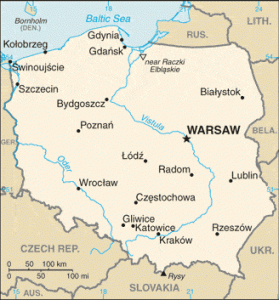
The Polish Road Network
Poland’s road network is administered by the GDDKiA (Generalna Dyrekcja Dróg Krajowych i Autostrad — General Directorate for National Roads and Motorways), which manages the national road network, and by regional Zarząd Dróg Wojewódzkich (voivodeship road boards) for secondary roads. The total road network exceeds 420,000 km, of which the national network (drogi krajowe) is approximately 19,000 km. Since EU accession in 2004, Poland has built one of Europe’s most extensive post-war road construction programmes, funded largely by EU Structural and Cohesion Funds.
Motorways (A-prefix — autostrady): Poland has approximately 4,900 km of motorways, all prefixed with A. The three principal motorways form a cross-shaped backbone of the country:
- A1 — Amber Highway (Bursztynowa) (Gdańsk–Łódź–Piotrków Trybunalski–Gorzyczki, ~566 km): Poland’s main north–south motorway; connects the Baltic port city of Gdańsk with the industrial heartland of Silesia and the Czech border at Gorzyczki/Bohumín. Passes through Toruń, Łódź, and Częstochowa. Journey time Gdańsk to Katowice approximately 4.5–5.5 hours.
- A2 — East–West Motorway (Autostrada Wschodnia/Zachodnia) (Świecko/German border–Poznań–Łódź–Warsaw–Kukuryki/Belarusian border, ~617 km): Poland’s primary east–west corridor and the main route between Berlin and Warsaw, continuing to the Belarusian border. The Berlin–Warsaw journey via A2 is approximately 570 km (5–6 hours total). This is among the most commercially important motorway corridors in Central Europe. The section between Warsaw and Łódź (A2/A1 junction) is extremely busy with freight traffic.
- A4 — Southern Motorway (Autostrada Południowa) (Jędrzychowice/German border–Wrocław–Katowice–Kraków–Rzeszów–Korczowa/Ukrainian border, ~672 km): Poland’s longest motorway, running east–west across the south of the country. Connects Wrocław, Katowice (the Silesian industrial agglomeration), Kraków, and Rzeszów to two border crossings — Germany in the west and Ukraine in the east. The section between Katowice and Kraków is one of the oldest and most used motorway sections in Poland, operated by Stalexport Autostrada Małopolska under a concession. Journey time Wrocław to Kraków approximately 2.5–3 hours; Kraków to Ukrainian border approximately 2–2.5 hours.
- A6 (Szczecin ring road, ~30 km): Short motorway section forming part of the Szczecin urban ring road; connects to the German A11 at the Kołbaskowo border crossing.
- A8 (Wrocław ring road, ~35 km): Motorway ring around Wrocław city, connecting A4 to northern approach roads.
- A18 (Olszyna–Krzyżowa, ~37 km): Short west–east motorway connecting the German A15 at Olszyna to the A4 interchange at Krzyżowa; part of the E40 European route.
Expressways (S-prefix — drogi ekspresowe): Poland’s expressway network of approximately 8,000 km is, in some ways, more important for everyday travel than the motorways, as expressways connect a far larger number of cities and regions. Key expressways include:
- S1 (Kosztowy–Bielsko-Biała–Zwardoń/Slovak border): South from Katowice to Slovakia through the Silesian Beskids mountains.
- S2 (Warsaw southern bypass — part of the S2/A2 Warsaw–Łódź corridor): Forms the southern section of the Warsaw ring road.
- S3 (Szczecin–Zielona Góra–Legnica, ~330 km): North–south expressway in western Poland; connects Szczecin port to Legnica and junction with A4.
- S5 (Nowe Marzy–Bydgoszcz–Poznań–Wrocław, ~360 km): Connects the A1 (near Bydgoszcz) with A4 near Wrocław; important north–south corridor in central-western Poland.
- S6 (Szczecin–Gdańsk along the Baltic coast, ~410 km): The coastal expressway connecting western Pomerania with Tricity (Trójmiasto: Gdańsk–Gdynia–Sopot); opened progressively 2020–2023.
- S7 (Gdańsk–Warsaw–Kraków–Rabka-Zdrój, ~750 km): The longest Polish expressway; a critical corridor connecting the Baltic coast with Warsaw and Kraków; fully completed by 2024.
- S8 (Wrocław–Łódź–Warsaw–Białystok, ~580 km): Major diagonal expressway; connects the southwestern, central, and northeastern regions; supplements the A2 for Warsaw-bound traffic from Wrocław.
- S17 (Warsaw–Lublin–Hrebenne/Ukrainian border, ~310 km): Southeast from Warsaw toward Ukraine via Lublin; important for freight and passenger traffic to/from Ukraine.
- S19 — Via Carpathia (Białystok–Lublin–Rzeszów–Barwinek/Slovak border, ~700 km planned): The north–south Via Carpathia corridor — a major European transport initiative connecting the Baltic Sea (Lithuania) with the Adriatic (Greece) through Poland, Slovakia, Hungary, and beyond; the Polish section is under progressive construction with substantial sections opened by 2025.
- S61 — Via Baltica (Szczuczyn–Budzisko/Lithuanian border, ~200 km): Connects Poland’s expressway network with Lithuania at the Budzisko/Kalvarija border crossing; part of the pan-European Via Baltica corridor (Helsinki–Warsaw–Berlin). Fully opened 2022.
National Roads (DK-prefix — drogi krajowe): Below the motorway and expressway tier, Poland has an extensive network of national roads numbered DK1–DK94 (and higher), most of which are single-carriageway two-lane roads passing through towns and villages. Road quality has improved significantly since 2004, but many DK roads in eastern Poland (Podlaskie, Podkarpacie, Lublin voivodeships) remain narrow, in poor repair, and heavily used by agricultural and heavy goods vehicles. Journey times on DK roads are significantly longer than on A/S roads; for long-distance travel, always use the motorway/expressway network where available.
Driving Rules and Legal Requirements
Polish road traffic law is governed by the Road Traffic Act (Prawo o ruchu drogowym, Act of 20 June 1997 and amendments) and the Road Traffic Offences Act (Kodeks wykroczeń) for minor infringements. Poland applies all relevant EU traffic legislation and is a full Schengen Area member.
Driving licences: EU/EEA driving licences are fully valid in Poland without restriction. UK licences remain valid for visitor use post-Brexit. US, Canadian, Australian, and most other non-EU national licences are accepted for short visitor stays; an International Driving Permit (IDP — 1968 Vienna Convention) is recommended alongside the national licence for non-EU/non-Latin-script licences or for extended stays. Non-EU residents staying beyond 185 days must exchange their licence for a Polish prawo jazdy.
Insurance: Third-party liability insurance (OC — ubezpieczenie odpowiedzialności cywilnej) is mandatory for all vehicles. EU-registered vehicles are automatically covered for third-party liability across EU member states; carrying the Green Card (International Motor Insurance Certificate) is strongly recommended as proof. Non-EU vehicles must carry a valid Green Card covering Poland.
Headlights — mandatory at all times: Poland requires dipped headlights (or daytime running lights) to be switched on at all times of day, throughout the entire year, regardless of weather conditions. This is one of the few EU countries where 24-hour headlight use is legally mandated even in bright summer sunshine. Failure to comply results in a fine. Modern vehicles with automatic DRL (daytime running lights) comply automatically; older vehicles must manually use dipped headlights.
Alcohol — very strict limit: Poland enforces one of the lowest drink-drive thresholds in Europe. The limit is 0.02% BAC (0.2 g/L blood, or 0.1 mg/L breath). This is effectively near-zero tolerance: a single small beer can potentially push a light person above 0.02% BAC. Driving between 0.02% and 0.05% BAC is a misdemeanour (wykroczenie) punishable by a fine of up to PLN 2,500, licence suspension, and community service. Driving above 0.05% BAC is a criminal offence (przestępstwo) punishable by up to 2 years’ imprisonment, a fine, and mandatory licence suspension. There is a culture of very strict enforcement of this rule in Poland; roadside testing at checkpoints is common. For practical purposes, visitors should treat Poland as zero-tolerance for drinking and driving.
Seatbelts: Mandatory for all occupants in all seats. Children under 150 cm must use an appropriate child restraint system. Children under 3 years must travel in an approved child seat. Fine for non-compliance: PLN 100–500 per unbelted passenger.
Mobile phones: Use of handheld mobile phones while driving is prohibited. Fine: PLN 200–500. Hands-free devices are permitted. Poland has introduced automated camera detection of mobile phone use at some locations.
Winter tyres: Winter or all-season tyres are not legally mandatory in Poland (unlike in some neighbouring countries), but their use is strongly recommended from November to March. Polish winters can bring significant snowfall, particularly in the south (Małopolska, Subcarpathia, Silesian highlands) and northeast (Podlaskie, Warmia-Masuria). Snow chains are permitted but rarely used; studded tyres are prohibited. Rental cars in Poland often come with all-season tyres year-round.
Required equipment: All vehicles must carry a reflective warning triangle. A high-visibility vest is not legally required to be worn by the driver when exiting the vehicle on Polish roads (unlike in some other EU countries), but it is strongly recommended and required for professional transport. A first-aid kit is recommended but not legally mandated for private vehicles. Vehicles must have a functioning set of spare bulbs or run-flat/LED systems. Note: requirements differ for foreign-registered vehicles subject to their home country’s rules.
Speed cameras and enforcement: Poland has a dense network of fixed speed cameras (fotoradary) on national roads and in urban areas, operated by the CANARD (Centrum Automatycznego Nadzoru nad Ruchem Drogowym — Centre for Automated Road Traffic Supervision). Section speed cameras (odcinkowe pomiary prędkości — OPP) are deployed on several national road sections. Points-based demerit system (system punktów karnych): drivers accumulate points for violations; reaching 24 points (for new drivers within 1 year of licence: 20 points) leads to licence revocation.
Police (Policja): Traffic enforcement is carried out by the Policja Road Traffic Department. Police vehicles are marked white with blue/yellow checkerboard pattern. Officers may stop vehicles on any road. If stopped, pull over safely, switch off the engine, and present your driving licence, vehicle registration (dowód rejestracyjny), and insurance confirmation. Officers generally speak some English in major cities; less so in rural areas. Fines (mandaty) are issued on the spot for minor violations and are payable immediately or within 7 days. For more serious offences, a court summons (wniosek do sądu) is issued.
Speed Limits on Polish Roads
Poland has notably high motorway speed limits by EU standards — 140 km/h on motorways is the highest standard motorway limit in the EU alongside Germany’s advisory limit. All limits are in km/h and enforced strictly by both camera and patrol.
| Road Type | Cars / Light Vehicles | Vehicles with Trailer | Trucks / Buses |
|---|---|---|---|
| Motorway (autostrada, A-prefix) | 140 km/h | 80 km/h | 90 km/h |
| Expressway (droga ekspresowa, S-prefix) | 120 km/h | 80 km/h | 90 km/h |
| Dual carriageway outside built-up area | 100 km/h | 80 km/h | 80 km/h |
| Single carriageway outside built-up area (DK) | 90 km/h | 70 km/h | 70 km/h |
| Urban area (obszar zabudowany) | 50 km/h | 50 km/h | 50 km/h |
| Residential zone (strefa zamieszkania) | 20 km/h | 20 km/h | 20 km/h |
Night-time urban speed: Between 23:00 and 05:00 within urban areas, the speed limit was historically increased to 60 km/h on roads without a centre line and 50 km/h with one. This was simplified: since amendments in recent years, the standard urban limit of 50 km/h applies at all times. Some urban bypass roads or roads outside the built-up area designation may carry 70–90 km/h limits as posted.
Drink-drive penalties summary: 0.02–0.049% BAC: misdemeanour, fine up to PLN 2,500, licence suspension 6 months–3 years, community service. Above 0.05% BAC: criminal offence, up to 2 years’ imprisonment, unlimited fine, licence suspension from 3 years up to a lifetime ban for repeat offenders. In-vehicle confiscation at 0.05%+ is possible. Police checkpoints (kontrole drogowe) routinely test all stopped drivers with breathalyser units.
Motorway Tolls and the e-TOLL System
Poland’s motorway toll system underwent a significant modernisation in October 2021, when the old viaTOLL system was replaced by e-TOLL — a GPS/GNSS-based electronic toll collection system operated by the Krajowa Administracja Skarbowa (KAS — National Revenue Administration) on behalf of the state.
Who must use e-TOLL: All vehicles over 3.5 tonnes gross vehicle weight (trucks, buses, heavy vans) must register and use e-TOLL on all national motorways (A) and expressways (S). For passenger cars and vehicles under 3.5t, e-TOLL is used on state-managed toll motorway sections and is available voluntarily. There are, however, several important distinctions:
- State-managed motorway sections (GDDKiA): The majority of Polish motorways — including most of A1, most of A2, and A4 east of Katowice — are managed directly by the state. On these sections, passenger cars pay per-kilometre tolls via e-TOLL (app or OBU transponder). There are no cash toll booths; payment is electronic only. The per-km rate for passenger cars is approximately PLN 0.10–0.20/km depending on the section, making the total toll for a typical motorway journey modest (e.g., Warsaw–Łódź ~2–4 PLN).
- A4 Katowice–Kraków (Stalexport concession): This approximately 60 km section is operated by Stalexport Autostrada Małopolska S.A. under a long-term concession. It retains traditional manned toll booths where cash (PLN or EUR accepted at some plazas), credit/debit card, or e-TOLL is accepted. Current toll for a passenger car: approximately PLN 8–12 for the full section.
- A2 Warsaw–Stryków section: Formerly a free section for passenger cars; converted to e-TOLL billing. Check current status on the GDDKiA toll calculator before travel.
How to use e-TOLL as a visitor:
- e-TOLL PL mobile app: Download the official e-TOLL PL app (available on iOS and Android) before entering Poland. Register your vehicle’s licence plate and a payment method (credit/debit card). The app uses your phone’s GPS to track motorway usage and bill tolls automatically. Keep the app running and the phone mounted visibly while driving on toll sections. This is the simplest option for visitors.
- OBU (On-Board Unit): A GPS-based transponder that can be rented or purchased at selected motorway service areas, petrol stations, and border crossing facilities in Poland. The OBU registers with e-TOLL and bills your pre-registered payment method. Recommended for frequent users or those driving high-toll-volume routes.
- Pre-payment / post-payment: For rental cars, many Polish rental companies now offer an e-TOLL package as an add-on. Check if your rental car already has a registered transponder; if not, download the e-TOLL PL app before collecting the vehicle.
Indicative toll costs on major Polish routes for passenger cars (2025/26 rates in PLN; subject to revision):
| Route / Section | Road | Approx. Toll (car) |
|---|---|---|
| Warsaw → Łódź (via A2) | A2 | PLN 2–5 |
| Warsaw → Poznań (via A2) | A2 | PLN 10–20 |
| Warsaw → German border (A2 full) | A2 | PLN 15–30 |
| Gdańsk → Katowice (A1 full) | A1 | PLN 15–25 |
| Katowice → Kraków (A4 concession) | A4 (Stalexport) | PLN 8–12 |
| Wrocław → Kraków (A4 full) | A4 | PLN 15–25 |
Note: S-road expressways are free for passenger cars in Poland; tolls apply only to vehicles over 3.5t on expressways. Always verify current rates using the official e-TOLL toll calculator at etoll.gov.pl before your journey, as rates are subject to revision.
Fuel, Electric Vehicles, and Charging
Fuel in Poland is widely available from major networks including Orlen (state-owned dominant brand, ubiquitous across the country), BP, Shell, Circle K (formerly Statoil), Lotos (now merged with Orlen), Amic Energy, and many independent operators. Motorway service areas on A1, A2, and A4 are generally well-equipped. In eastern Poland (Podlaskie, Subcarpathia) and rural areas, fuel stations are less frequent on DK roads; fill up in larger towns before extended rural driving.
Fuel types: Unleaded 95 RON (benzyna bezołowiowa Pb95) and 98 RON (premium) petrol are standard. Diesel (olej napędowy ON) in standard and premium grades is widely available. LPG (gaz płynny — autogaz) is exceptionally popular in Poland — Poland has one of the largest LPG vehicle fleets in Europe, and LPG pumps are available at a very high proportion of Polish petrol stations. Ethanol E85 is available at selected stations. Fuel prices in Poland are among the lower in the EU due to Poland’s lower cost base and historically lower excise duty rates, though prices have risen significantly since 2021–2022 and with the Russia–Ukraine war’s impact on energy markets.
Electric vehicles (EV): Poland’s EV charging infrastructure is expanding rapidly from a relatively low base. The GreenWay network operates fast DC chargers along major motorway corridors. Orlen Charge (Orlen’s EV charging brand) is increasingly integrated into Orlen petrol stations across the country, including along A1, A2, and A4 service areas. Tesla Superchargers are present in Warsaw, Kraków, Gdańsk, Wrocław, Poznań, and several motorway service areas. CCS Combo 2 is the standard for DC fast charging; AC Type 2 for slow/overnight. CHAdeMO chargers are becoming less common. The eMSP (e-Mobility Service Provider) ecosystem is growing, with Plugshare, ChargePoint, and Ionity networks present in major urban areas. For long-distance EV travel on A1, A2, and A4, charging coverage is now adequate; on S-road expressways and rural DK roads, plan charging carefully. Warsaw has the most developed urban charging infrastructure.
Driving in Warsaw, Kraków, and Wrocław
Warsaw (Warszawa)
Warsaw, Poland’s capital, is a city of approximately 1.9 million within the city limits and 3.1 million in the metropolitan area. The road network is extensive but under significant ongoing development and construction. The city is bisected north–south by the Vistula River (Wisła), with road bridges at several points — the A2 motorway crosses on the Siekierkowski Bridge; the S2 southern bypass uses the Południowa Obwodnica Warszawy. The planned S7 northern bypass (Trasa Armii Krajowej) completes the Warsaw ring road concept.
Warsaw traffic congestion is significant during rush hours (07:00–09:30 and 16:00–19:00 on weekdays). The city centre (Śródmieście), Old Town (Stare Miasto), and business districts around ul. Marszałkowska, al. Jerozolimskie, and Nowy Świat can be very slow. Warsaw has no official low emission zone, but parking in the central paid zone (Strefa Płatnego Parkowania Niestrzeżonego — SPPN) is expensive and limited. Warsaw Metro (2 lines; a third partially open) and an extensive tram and bus network make it practical to park outside the centre and use public transport for city sightseeing. Park-and-ride (Parkuj i Jedź) car parks at Metro stations on the outskirts offer free parking for metro users.
Kraków
Kraków (population ~780,000 in the city, ~1.5 million metro area) is Poland’s most-visited tourist city, a UNESCO World Heritage Site (Wawel Royal Castle, Old Town), and Poland’s historical royal capital. The city centre is largely pedestrianised around the Rynek Główny (Main Market Square) and Wawel Hill; driving within the historic core is heavily restricted, with most streets closed to non-resident vehicles. Parking in the centre is extremely limited and expensive; several underground car parks serve the core area (e.g., under the Rynek Główny area, near the Galeria Krakowska shopping centre at Kraków Główny railway station).
The main approach routes to Kraków are the A4 motorway from east (Rzeszów) and west (Katowice/Wrocław), and the S7 expressway from the north (Warsaw). A ring road system (Trasa Łagiewnicka, Trasa Zwierzyniecka, and the Autostradowa Obwodnica Krakowa on A4) allows circumnavigation. Kraków has a Clean Transport Zone (Strefa Czystego Transportu) planned for introduction; check current status before travelling to the city centre with older vehicles.
Wrocław
Wrocław (population ~680,000; metropolitan ~1.1 million), situated on the Oder River in Lower Silesia, is one of Poland’s most dynamic cities. Known as the “Venice of Poland” for its many bridges (over 100 bridges cross the Oder and its tributary channels), Wrocław has a complex urban road network. The A8 ring road and A4 motorway provide efficient access; the city’s tram network is excellent for central city travel. Wrocław’s Fabryczna railway station area has been heavily reconstructed with modern road infrastructure. The city centre around the Rynek (Market Square) is mostly pedestrianised; parking in central Wrocław uses a paid zone system similar to Warsaw and Kraków.
Long-Distance Routes and Scenic Drives
Warsaw – Kraków (~295 km via A2+A1 or S7): Two main route options. The motorway route via A2 (Warsaw–Łódź) and A1 (Łódź–Katowice area) and then A4 (to Kraków) is approximately 340 km and takes 3–4 hours but passes through the industrial Silesian junction. The more direct S7 expressway (fully completed by 2024) runs approximately 295 km and takes 3–3.5 hours, passing through Radom and Kielce — a faster and more direct option with no industrial detour. The S7 is the recommended Warsaw–Kraków route.
Warsaw – Gdańsk (~340 km via A1/S7): The S7 expressway connects Warsaw directly to Gdańsk via the Baltic coast. Journey time approximately 3.5–4 hours. Gdańsk — the birthplace of the Solidarity movement and one of Poland’s most historically significant cities — is an excellent destination combining medieval Old Town (Stare Miasto), the amber trade heritage, and the Baltic Sea. The Gdańsk–Gdynia–Sopot Tricity (Trójmiasto) agglomeration has approximately 1.5 million residents and significant road congestion during peak hours.
Warsaw – Białystok – Via Baltica (S61, ~200 km to Lithuanian border): The Via Baltica (S61) connects Warsaw’s northeastern suburbs (via S8 to Białystok) to the Lithuanian border at Budzisko/Kalvarija. This is the main road route from Poland to the Baltic States (Lithuania, Latvia, Estonia). The S61 is among the newest expressways in Poland, fully opened in 2022; it is excellent quality throughout. Journey time Warsaw to Lithuanian border approximately 3.5–4 hours.
Kraków – Zakopane (Tatra Mountains, ~100 km via DK47/S7): The route south from Kraków to Zakopane — Poland’s premier mountain resort at the foot of the Tatra Mountains, the highest range of the Carpathians — is one of the most popular leisure drives in Poland. The S7 expressway now extends to Rabka-Zdrój; from there the DK47 national road leads to Zakopane. Heavy traffic on Friday evenings and Sunday afternoons in winter (skiing) and summer (hiking/cycling). The Tatras themselves are accessible on foot and by cable car; the road to Morskie Oko glacial lake is restricted to buses and horse-drawn carriages — private vehicles may not access it.
Wrocław – Jelenia Góra – Karkonosze (Sudeten Mountains, ~130 km via A4/DK3): A scenic drive from Wrocław south to the Karkonosze (Krkonoše/Giant Mountains) on the Polish–Czech border. The route via DK3 passes through Lower Silesia’s historic towns. The Karkonosze is a national park and major winter and summer resort area, featuring Mount Śnieżka (1,603 m, the highest peak of the Sudeten range). Roads in the mountain section are winding and narrow; heavy traffic at ski season weekends.
Masuria Lake District (Pojezierze Mazurskie), northeast Poland: The Masuria region — approximately 200–250 km northeast of Warsaw — is Poland’s premier lake district, with over 2,000 lakes. Driving here on local roads through forests and lakeside villages is beautiful and relaxing outside the peak summer months. The main access is via S8/DK58 from Warsaw toward Olsztyn, then regional roads. The roads are generally pleasant single-carriageway national and regional roads; no motorway access in this region.
Border Crossings with Neighbouring Countries
Poland borders seven countries: Germany (west), Czech Republic (south), Slovakia (south), Ukraine (east), Belarus (east), Lithuania (northeast), and Russia’s Kaliningrad Oblast (north). As a Schengen Area member, border crossings within Schengen (Germany, Czech Republic, Slovakia, Lithuania) are open without passport or customs checks. Crossings to non-Schengen countries (Ukraine, Belarus, Kaliningrad) require full documentation.
- Świecko / Frankfurt (Oder) — Germany (A2 / E30): The main motorway crossing on the A2 between Warsaw/Poznań and Berlin. One of the highest-volume border crossings in Europe (Schengen — no controls for EU citizens). The German A12 continues to Berlin. Open 24 hours.
- Olszyna / Ludwigsdorf — Germany (A18 / E40): Motorway crossing on the A18/A4 corridor; connects southern Lower Silesia with the German A15 toward Dresden and Berlin.
- Zgorzelec / Görlitz — Germany (DK94 / B6): Road crossing connecting Zgorzelec (Poland) with Görlitz (Germany) — twin towns straddling the Neisse River. Not a motorway crossing; used for regional traffic.
- Kołbaskowo / Pomellen — Germany (A6 / A11): Northwest crossing connecting Szczecin (Poland) with Stettin ring road and German A11 toward Berlin.
- Gorzyczki / Bohumín — Czech Republic (A1 / D1): The main motorway crossing on the A1 (Poland) — D1/D56 (Czech Republic) corridor; connects Katowice/Silesia to Ostrava and Prague. High-volume freight and passenger crossing.
- Kudowa-Zdrój / Náchod — Czech Republic (DK8): Regional crossing in the Sudeten mountains; connects Lower Silesia with Bohemia (Hradec Králové).
- Cieszyn / Český Těšín — Czech Republic / Slovakia triangle: Historic crossing on the Olza River; connects the Silesian city of Cieszyn (Poland) with Český Těšín (Czech Republic). The Czech–Slovak border nearby allows easy onward travel to Slovakia.
- Chyżne / Trstená — Slovakia (DK7 / E77): The main road crossing from Poland to Slovakia, located near Orava at the foot of the Tatra Mountains. DK7 continues north through Nowy Targ to Kraków; on the Slovak side, road 59 leads to Ružomberok and onward. Open 24 hours.
- Zwardoń / Svrčinovec — Slovakia (S1 / D3): The western Slovakia crossing on the S1 expressway corridor (under extension); connects Katowice/Bielsko-Biała with Žilina in Slovakia.
- Korczowa / Krakovets — Ukraine (A4 / M11): The primary motorway-class crossing between Poland and Ukraine. The A4 on the Polish side connects to the M10/M11 on the Ukrainian side toward Lviv. Since the 2022 Russian invasion of Ukraine, this crossing has experienced significantly elevated traffic from refugees and logistics convoys; expect queues, especially for trucks. Open 24 hours.
- Hrebenne / Rawa Ruska — Ukraine (S17 / M11): Secondary crossing south of the Korczowa / Krakovets point; used for additional capacity especially during high-traffic periods.
- Dorohusk / Yahodyn — Ukraine (DK12 / P14): Eastern crossing on the Bug River; connects Chełm (Poland) with Kovel (Ukraine). Rail crossing also present.
- Terespol / Brest — Belarus (A2 / M1): The main crossing between Poland and Belarus (and onward to Russia via Minsk); road bridge over the Bug River. Due to the Russia–Ukraine war, Polish-Belarusian border relations are severely strained; the crossing has faced periodic closures and highly elevated security measures. Non-essential travel to Belarus is strongly discouraged by EU governments. Visa requirements for Belarus must be verified in advance.
- Budzisko / Kalvarija — Lithuania (S61 / Via Baltica): The main road crossing between Poland and Lithuania; carries the Via Baltica (E67) corridor. Schengen — no controls for EU citizens. Open 24 hours. The crossing handles significant transit traffic toward the Baltic states.
- Bezledy / Bagrationovsk — Kaliningrad (Russia): This crossing is currently closed due to EU sanctions and security measures related to Russia’s invasion of Ukraine. Travel to and from the Russian exclave of Kaliningrad through Poland is not possible as of early 2026; transit through Lithuania to Kaliningrad is also severely restricted. Do not attempt this crossing.
Road Safety and Emergency Procedures
Poland’s road safety record has improved substantially since EU accession, but the country still records one of the higher road fatality rates in the EU. Annual road deaths fell from over 6,000 in the early 2000s to approximately 1,900–2,200 in recent years — a major improvement, but still well above the EU average per billion vehicle-km. The main risk factors are speeding on single-carriageway national roads, drink-driving (despite the strict 0.02% limit, a meaningful proportion of serious accidents involve alcohol), driver fatigue on long cross-country journeys, and pedestrian accidents in rural areas where there are no footpaths.
Most dangerous roads: Single-carriageway national roads (DK-prefix) in rural areas, particularly those in eastern Poland, remain the most dangerous. Overtaking opportunities on DK roads are limited; unmarked and unexpected hazards (agricultural machinery, cyclists, livestock on road, unlit sections) are more common than on A/S roads. At night, rural DK roads in Podlaskie, Subcarpathia, and Lublin voivodeships carry significantly elevated risk.
Breakdown on a motorway: Move immediately to the hard shoulder; hazard lights on; exit the vehicle wearing your high-visibility vest. Deploy the warning triangle at minimum 100 m behind the vehicle. Call 112 (EU emergency) or the motorway emergency line posted on kilometre markers. GDDKiA-operated emergency SOS telephones are installed at regular intervals. On concession motorways (A4 Stalexport section), the concession operates its own rescue service. Keep passengers away from the carriageway and stand behind the crash barrier if available.
Accident procedure: Call 112 immediately if there are injuries; police (997) if police attendance is needed. Complete the European Accident Statement form (Europejskie Zgłoszenie Wypadku) with the other party. Photograph the scene extensively. Police attendance is required if there is personal injury or a dispute about fault. For rental vehicles, contact the rental company emergency line. Do not move vehicles before police arrive if there are injuries.
Winter driving: Polish winters are significant, particularly from December to February. Snow and ice are routine occurrences. Motorways and expressways are maintained well and gritted promptly, but DK national roads and regional roads can be icy and slow for extended periods. Mountain roads in the Tatras, Sudeten, and Bieszczady areas may require snow chains or may close entirely. Check weather forecasts (IMGW — Institute of Meteorology and Water Management) and road conditions (GDDKiA traffic information) before winter mountain drives.
Emergency contacts: 112 (EU — police/ambulance/fire), 997 (Police), 999 (Ambulance / WSRM), 998 (Fire brigade), 986 (Municipal Guard — Straż Miejska — for urban area incidents). Polish-language ability helps, but 112 operators generally have English-language capacity.
FAQ: Driving in Poland
Q: What is the drink-drive limit in Poland?
A: Poland’s drink-drive limit is an unusually strict 0.02% BAC (0.2 g/L blood), one of the lowest in Europe. In practice, this means even one small beer can potentially put a lighter person over the limit. Driving above 0.02% BAC is a misdemeanour; above 0.05% BAC is a criminal offence. Roadside breathalyser testing is routine at police checkpoints. Visitors should treat Poland as near-zero tolerance for alcohol and driving.
Q: Do I need to use headlights during the day in Poland?
A: Yes. Polish law requires dipped headlights (or daytime running lights) to be on at all times, day and night, throughout the entire year. This applies on all roads including motorways, national roads, and urban streets. Modern vehicles with automatic DRL systems comply automatically; if your vehicle lacks DRL, use dipped headlights manually on all Polish roads at all times.
Q: How do I pay motorway tolls in Poland?
A: Most Polish motorways use the e-TOLL electronic system — there are no cash toll booths on state-managed sections (A1 most sections, A2, A4 Wrocław–Katowice). Download the free e-TOLL PL app before entering Poland, register your licence plate and payment card, and keep the app running while driving on toll roads. The A4 Katowice–Kraków section still has traditional toll booths accepting cash (PLN/EUR) and cards. S-road expressways are free for passenger cars.
Q: What currency does Poland use — can I pay in euros?
A: Poland uses the Polish Złoty (PLN) — Poland is an EU member but has not adopted the euro. Euro cash is accepted at some border services, major hotels, and tourist-oriented businesses, but you will often receive change in PLN. ATMs (bankomaty) are widely available in cities and motorway service areas. Credit and debit cards (Visa, Mastercard) are widely accepted; contactless payment is prevalent. Currency exchange offices (kantory) offer competitive rates — usually better than bank rates or airport exchanges.
Q: Is my UK or non-EU driving licence valid in Poland?
A: EU/EEA licences are fully valid. UK licences remain valid in Poland for visitor use post-Brexit. US, Canadian, Australian, and most other national licences are accepted for short-stay visitors. If your licence uses a non-Latin script (Arabic, Chinese, Japanese, Cyrillic), an IDP (1968 Vienna Convention) is required alongside the national licence. For stays exceeding 185 days, non-EU nationals must convert to a Polish driving licence.
Q: What are Polish motorway speed limits?
A: Poland has the highest standard motorway speed limit in the EU at 140 km/h on motorways (A-roads) for passenger cars. Expressways (S-roads) have a 120 km/h limit. National roads outside urban areas are 90 km/h; urban areas are 50 km/h. These limits are strictly enforced by fixed cameras, section cameras, and police patrols. Note that the 140 km/h limit applies regardless of road conditions; in rain, fog, or ice, drivers are expected to reduce speed appropriately — the legal limit is the maximum, not a target speed.
Q: Are there winter tyre requirements in Poland?
A: Winter tyres are not legally mandatory in Poland (unlike in some neighbouring countries such as Austria, Czech Republic, and Slovakia where they are required in winter conditions). However, their use is strongly recommended from November to March, especially in southern mountain regions and northeastern Poland. All-season tyres are a practical alternative. Standard summer tyres are legal but risky during snow and ice; you remain responsible for safe driving regardless of conditions.
Q: Is it safe to drive near the Polish–Belarusian and Polish–Ukrainian borders?
A: The Polish–Ukrainian border (Korczowa/Hrebenne/Dorohusk crossings) is open and operational; the security situation on the Polish side is normal, though expect elevated traffic and some queuing due to the ongoing Russia–Ukraine war. The Polish–Belarusian border has been subject to significantly elevated tensions, irregular migration pressure, and periodic closure of some crossings since 2021; non-essential travel to Belarus is strongly discouraged by EU governments. The Kaliningrad (Russia) crossing at Bezledy is closed. Driving within Poland itself near these eastern borders is completely safe.
Sources and Update Note
This guide was compiled from the following primary sources: Polish Road Traffic Act (Prawo o ruchu drogowym, 1997 and amendments); GDDKiA (General Directorate for National Roads and Motorways) official road network and toll data; e-TOLL official documentation (etoll.gov.pl); CANARD (Centre for Automated Road Traffic Supervision) speed camera data; Krajowa Administracja Skarbowa (KAS) e-TOLL regulations; Stalexport Autostrada Małopolska S.A. toll documentation; Polish National Police (Policja) traffic enforcement guidelines; SEWIK (Road Accident Database) statistics; CIA World Factbook — Poland; Wikipedia — Transport in Poland, Polish motorways, Polish expressways; OpenStreetMap Poland. Speed limits, toll rates, and traffic regulations are correct as of early 2026 and subject to change; toll rates in particular are revised periodically. Always verify current toll costs at etoll.gov.pl and current regulations from posted signs and official GDDKiA/Policja sources. This page will be updated as regulations change.